Eriksen Helle Brander, Fuursted Kurt, Jensen Anders, Jensen Christian Salgård, Nielsen Xiaohui, Christensen Jens Jørgen, Shewmaker Patricia, Rebelo Ana Rita, Aarestrup Frank Møller, Schønning Kristian, Slotved Hans-Christian
Department of Clinical Microbiology, Herlev and Gentofte Hospital, Herlev, Denmark.
Department of Bacteria, Parasites, and Fungi, Statens Serum Institut, Copenhagen, Denmark.
Front Microbiol. 2023 Mar 2;14:1120023. doi: 10.3389/fmicb.2023.1120023. eCollection 2023.
For , β-lactam susceptibility can be predicted from the amino acid sequence of the penicillin-binding proteins PBP1a, PBP2b, and PBP2x. The combination of PBP-subtypes provides a PBP-profile, which correlates to a phenotypic minimal inhibitory concentration (MIC). The non- Mitis-group streptococci (MGS) have similar PBPs and exchange -alleles with . We studied whether a simple BLAST analysis could be used to predict phenotypic susceptibility in Danish isolates and in internationally collected MGS.
Isolates with available WGS and phenotypic susceptibility data were included. For each isolate, the best matching PBP-profile was identified by BLAST analysis. The corresponding MICs for penicillin and ceftriaxone was retrieved. Category agreement (CA), minor-, major-, and very major discrepancy was calculated. Genotypic-phenotypic accuracy was examined with Deming regression.
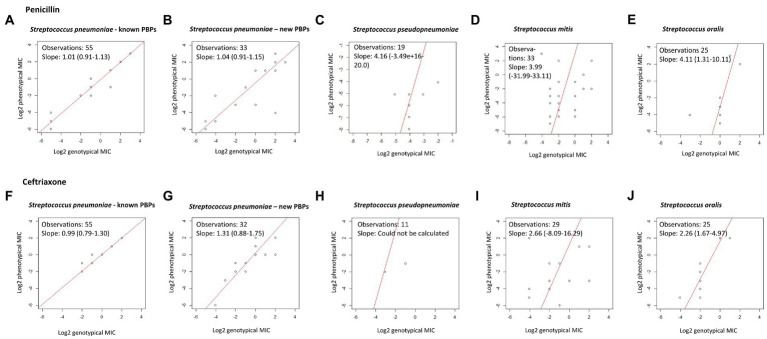
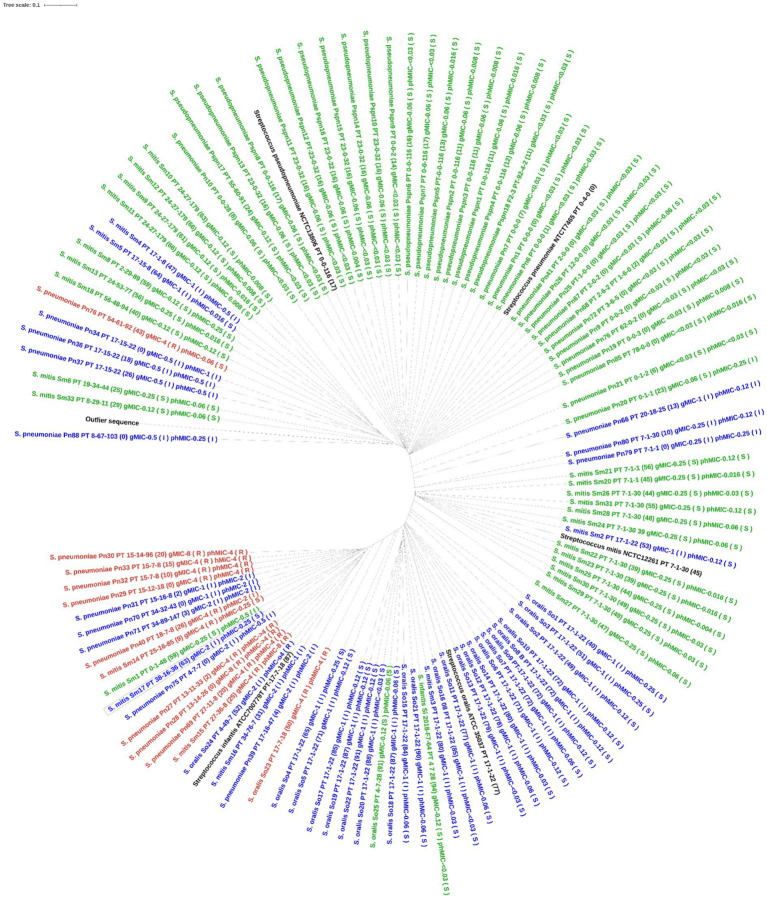
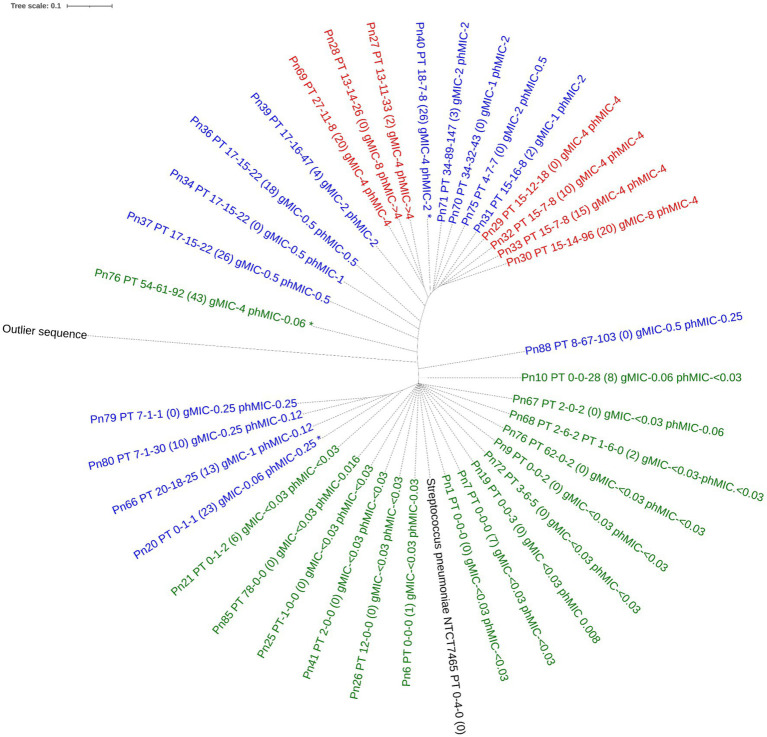
Among 88 isolates, 55 isolates had a recognized PBP-profile, and CA was 100% for penicillin and 98.2% for ceftriaxone. In 33 isolates with a new PBP-profile, CA was 90.9% (penicillin) and 93.8% (ceftriaxone) using the nearest recognized PBP-profile. Applying the database to non- MGS revealed that none had a recognized PBP-profile. For , CA was 100% for penicillin and ceftriaxone in 19 susceptible isolates. In 33 isolates, CA was 75.8% (penicillin) and 86.2% (ceftriaxone) and in 25 isolates CA was 8% (penicillin) and 100% (ceftriaxone).
Using a simple BLAST analysis, genotypic susceptibility prediction was accurate in Danish isolates, particularly in isolates with recognized PBP-profiles. Susceptibility was poorly predicted in other MGS using the current database.
对于肺炎链球菌,β-内酰胺敏感性可通过青霉素结合蛋白PBP1a、PBP2b和PBP2x的氨基酸序列来预测。PBP亚型的组合提供了一个PBP谱,其与表型最小抑菌浓度(MIC)相关。非米勒链球菌群(MGS)具有相似的PBPs并与肺炎链球菌交换等位基因。我们研究了简单的BLAST分析是否可用于预测丹麦肺炎链球菌分离株以及国际收集的MGS的表型敏感性。
纳入具有可用全基因组测序(WGS)和表型敏感性数据的分离株。对于每个分离株,通过BLAST分析确定最佳匹配的PBP谱。检索青霉素和头孢曲松的相应MIC。计算类别一致性(CA)、轻微、主要和非常主要差异。用戴明回归检验基因型-表型准确性。
在88株肺炎链球菌分离株中,55株具有公认的PBP谱,青霉素的CA为100%,头孢曲松的CA为98.2%。在33株具有新PBP谱的肺炎链球菌分离株中,使用最接近的公认PBP谱时,青霉素的CA为90.9%,头孢曲松的CA为93.8%。将肺炎链球菌数据库应用于非MGS显示,没有一个具有公认的PBP谱。对于肺炎链球菌,19株敏感分离株中青霉素和头孢曲松的CA均为100%。在33株肺炎链球菌分离株中,青霉素的CA为75.8%,头孢曲松的CA为86.2%;在25株肺炎链球菌分离株中,青霉素的CA为8%,头孢曲松的CA为100%。
使用简单的BLAST分析,丹麦肺炎链球菌分离株的基因型敏感性预测是准确的,特别是在具有公认PBP谱的分离株中。使用当前数据库对其他MGS的敏感性预测较差。