Laboratory Medicine, UK NEQAS for Leucocyte Immunophenotyping, Sheffield Teaching Hospitals NHS Foundation Trust, Sheffield, United Kingdom.
Department of Oncology and Metabolism, University of Sheffield, Sheffield, United Kingdom.
Blood Adv. 2023 Jul 25;7(14):3686-3694. doi: 10.1182/bloodadvances.2022009379.
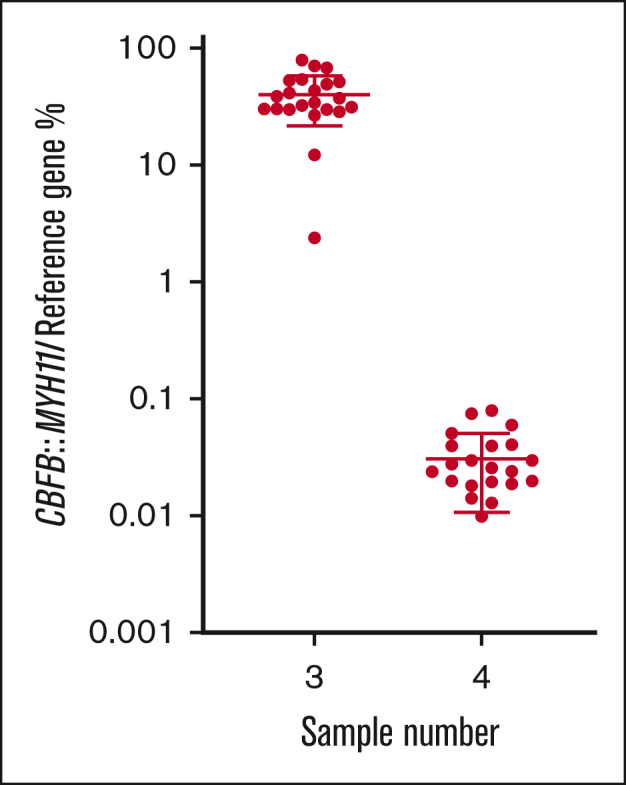
The European LeukaemiaNet (ELN) measurable residual disease (MRD) working group has published consensus guidelines to standardize molecular genetic MRD testing of the t(8;21)(q22;q22.1) RUNX1::RUNX1T1, inv(16)(p13.1q22) CBFB::MYH11, t(15;17)(q24.1;q21.2) PML::RARA, and NPM1 type A markers. A study featuring 29 international laboratories was performed to assess interlaboratory variation in testing and the subsequent interpretation of results, both crucial to patient safety. Most participants in this study were able to detect, accurately quantify, and correctly interpret MRD testing results, with a level of proficiency expected from a clinical trial or standard-of-care setting. However, a few testing and interpretive errors were identified that, in a patient setting, would have led to misclassification of patient outcomes and inappropriate treatment pathways being followed. Of note, a high proportion of participants reported false-positive results in the NPM1 marker-negative sample. False-positive results may have clinical consequences, committing patients to unneeded additional chemotherapy and/or transplant with the attendant risk of morbidity and mortality, which therefore highlights the need for ongoing external quality assessment/proficiency testing in this area. Most errors identified in the study were related to the interpretation of results. It was noted that the ELN guidance lacks clarity for certain clinical scenarios and highlights the requirement for urgent revision of the guidelines to elucidate these issues and related educational efforts around the revisions to ensure effective dissemination.
欧洲白血病网络(ELN)可测量残留疾病(MRD)工作组发布了共识指南,以标准化 t(8;21)(q22;q22.1) RUNX1::RUNX1T1、inv(16)(p13.1q22) CBFB::MYH11、t(15;17)(q24.1;q21.2) PML::RARA 和 NPM1 型 A 标志物的分子遗传学 MRD 检测。进行了一项涉及 29 个国际实验室的研究,以评估检测中的实验室间差异以及随后对结果的解释,这对患者安全至关重要。这项研究的大多数参与者能够准确地检测、准确地定量和正确地解释 MRD 检测结果,这达到了临床试验或标准护理环境的预期熟练程度。然而,也发现了一些检测和解释错误,如果在患者环境中,这些错误会导致患者结果的错误分类和不适当的治疗途径。值得注意的是,相当一部分参与者报告在 NPM1 标志物阴性样本中出现假阳性结果。假阳性结果可能会产生临床后果,使患者接受不必要的额外化疗和/或移植,伴随发病率和死亡率的风险,因此强调了在该领域进行持续的外部质量评估/能力测试的必要性。研究中发现的大多数错误都与结果的解释有关。值得注意的是,ELN 指南在某些临床情况下缺乏清晰度,并强调需要紧急修订指南,以阐明这些问题,并围绕修订版开展相关教育工作,以确保有效传播。