Chen Yiran, Wu Xiaoling, Chen Xi, Guo Deliang, Ma Weijie, Guo Yonghua, Xu Kequan, Ma Shuxian, Yuan Yufeng, Zhu Qian
Department of Hepatobiliary and Pancreatic Surgery, Zhongnan Hospital of Wuhan University, Wuhan, Hubei, 430071, People's Republic of China.
Clinical Medicine Research Center for Minimally Invasive Procedure of Hepatobiliary & Pancreatic Diseases of Hubei Province, Wuhan, Hubei, 430071, People's Republic of China.
J Hepatocell Carcinoma. 2023 Mar 14;10:429-446. doi: 10.2147/JHC.S404008. eCollection 2023.
Hepatocellular carcinoma (HCC) was the sixth most prevalent cancer worldwide. Long non-coding RNA TGFB2-OT1 has been proven to mediate inflammation and autophagy in vascular endothelial cells. However, its function in HCC is still unknown.
We analyzed the relationship between TGFB2-OT1 expression and the clinicopathological features of 202 HCC patients. RT-qPCR was used to analyze the TGFB2-OT1 expression in HCC cell lines and tissues. In vitro and in vivo assays were conducted to verify the effect of TGFB2-OT1 on the phenotype of HCC. RNA pull-down assays were applied to reveal the proteins binding to the TGFB2-OT1. Western-blot assays were conducted to analyze the protein expression in HCC cell lines.
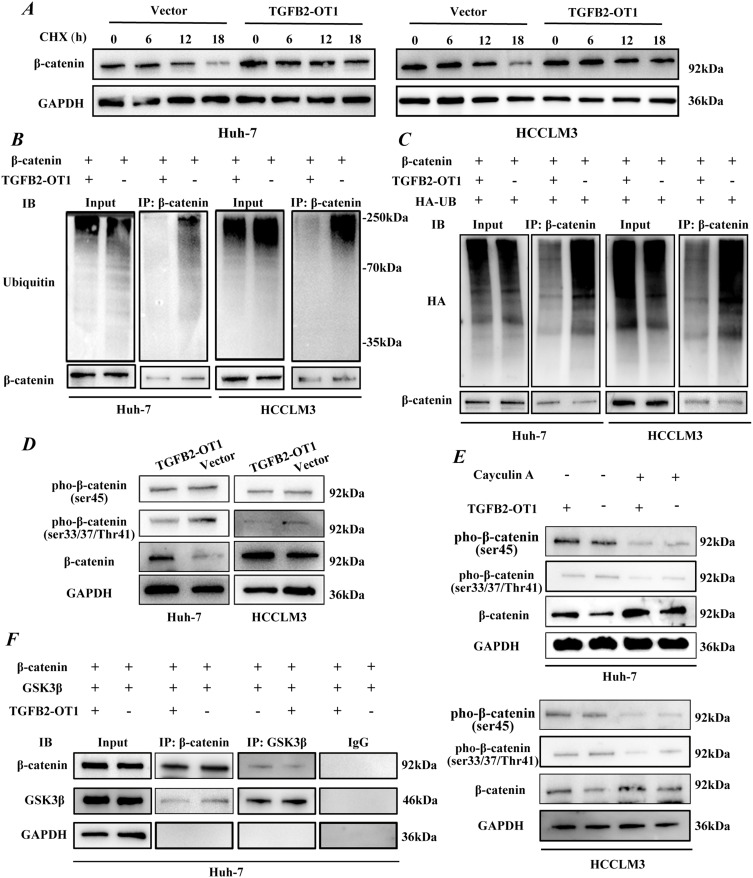
TGFB2-OT1 was found to be highly expressed in HCC samples and hepatoma cells. TGFB2-OT1 expression was significantly associated with age ( = 0.001), cirrhosis ( = 0.003), tumor size ( < 0.001), tumor encapsulation ( = 0.029), tumor protruding from the liver surface ( = 0.040), and alpha fetoprotein (AFP, < 0.001) levels. TGFB2-OT1 promoted proliferation, migration, invasion, and angiogenesis in HCC cells, both in vitro and in vivo. TGFB2-OT1 binds to β-catenin and competitively impaired the binding of β-catenin to GSK3β, thus suppressing the phosphorylation of β-catenin at Ser33, Ser37, and Thr41.
TGFB2-OT1 is overexpressed in HCC and predicts the poor prognosis of HCC patients. TGFB2-OT1 impedes the phosphorylation of β-catenin and acts as an alternative activator of the Wnt/β-catenin pathway to promote the progression and angiogenesis of HCC.
肝细胞癌(HCC)是全球第六大常见癌症。长链非编码RNA TGFB2-OT1已被证明可介导血管内皮细胞中的炎症和自噬。然而,其在HCC中的功能仍不清楚。
我们分析了202例HCC患者中TGFB2-OT1表达与临床病理特征之间的关系。采用RT-qPCR分析HCC细胞系和组织中TGFB2-OT1的表达。进行体外和体内实验以验证TGFB2-OT1对HCC细胞表型的影响。应用RNA下拉实验揭示与TGFB2-OT1结合的蛋白质。进行蛋白质免疫印迹实验分析HCC细胞系中的蛋白质表达。
发现TGFB2-OT1在HCC样本和肝癌细胞中高表达。TGFB2-OT1表达与年龄(P = 0.001)、肝硬化(P = 0.003)、肿瘤大小(P < 0.001)、肿瘤包膜(P = 0.029)、肿瘤突出于肝表面(P = 0.040)以及甲胎蛋白(AFP,P < 0.001)水平显著相关。在体外和体内,TGFB2-OT1均促进HCC细胞的增殖、迁移、侵袭和血管生成。TGFB2-OT1与β-连环蛋白结合,并竞争性地削弱β-连环蛋白与GSK3β的结合,从而抑制β-连环蛋白在Ser33、Ser37和Thr41位点的磷酸化。
TGFB2-OT1在HCC中过表达,并预示HCC患者预后不良。TGFB2-OT1阻碍β-连环蛋白的磷酸化,并作为Wnt/β-连环蛋白通路的替代激活剂促进HCC的进展和血管生成。