Department of Medical Oncology, Massachusetts General Hospital, Boston, MA, USA.
University Hospital of Salamanca/IBSAL/Cancer Research Center-IBMCC (USAL-CSIC), Salamanca, Spain.
Blood Cancer J. 2023 Mar 22;13(1):41. doi: 10.1038/s41408-023-00804-y.
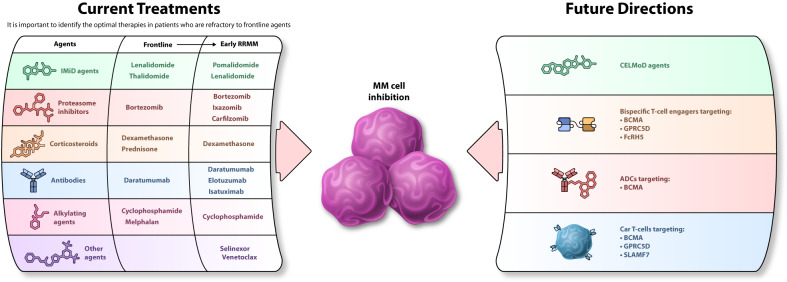
Almost all patients with multiple myeloma (MM) will eventually develop disease that has relapsed with or become refractory to available treatments and will require additional therapy. However, data are still lacking on how best to sequence regimens in the relapsed/refractory (RR) setting after the failure of early-line lenalidomide, bortezomib, and/or daratumumab, the most commonly used agents in clinical practice today. With the treatment landscape rapidly changing in response to emerging clinical trial data and approvals of several new drugs and additional combinations, it is critically important to focus on patients with RRMM. Variability in patient baseline characteristics, such as the number of prior lines of treatment, refractoriness to prior treatments, prior stem cell transplant, and timing and dosing of prior lenalidomide, makes it difficult to select the best options for patients with RRMM for whom first-line treatments have failed. The aim of this review is to provide both an overview of current therapies and future directions within the RRMM treatment landscape, and a framework for clinicians to choose the most promising next treatment option.
几乎所有多发性骨髓瘤(MM)患者最终都会出现疾病复发,或者对现有治疗产生耐药,需要额外的治疗。然而,在早期使用来那度胺、硼替佐米和/或达雷妥尤单抗(当今临床实践中最常用的药物)后疾病复发/难治的情况下,如何最好地对方案进行排序,相关数据仍很缺乏。随着新的临床试验数据和几种新药以及更多联合用药的获批,治疗领域迅速变化,因此关注复发/难治性多发性骨髓瘤患者至关重要。患者基线特征的变异性,如既往治疗线数、既往治疗耐药性、既往干细胞移植、以及既往来那度胺的时间和剂量,使得难以为一线治疗失败的 RRMM 患者选择最佳方案。本综述的目的是提供当前治疗方案的概述以及 RRMM 治疗领域的未来方向,并为临床医生提供选择最有前途的下一个治疗方案的框架。