Department of Nephrology, College of Health Sciences, Nelson R Mandela School of Medicine, University of KwaZulu-Natal, Durban, South Africa.
Department of Paediatrics and Child Health, College of Health Sciences, Mandela School of Medicine, Nelson R, University of KwaZulu-Natal, Durban, South Africa.
BMC Nephrol. 2023 Mar 21;24(1):62. doi: 10.1186/s12882-023-03109-1.
Chronic kidney disease (CKD) is a globally significant non-communicable disorder. CKD prevalence varies between countries and within a country. We compared the prevalence rates of CKD in South Africa with sub-Saharan Africa, Africa, and globally.
We registered a systematic review with the International Prospective Register of Systematic Reviews for prevalence studies reporting CKD stages III-V from 2013 to 2021. The analysis sought to explain any significant differences in prevalence rates. The R statistical package was used for data analysis. Comparisons included measures of effect size due to the large sample sizes analysed. We also compared sex differences in prevalence rates, common aetiologies, and type of study methodologies employed.
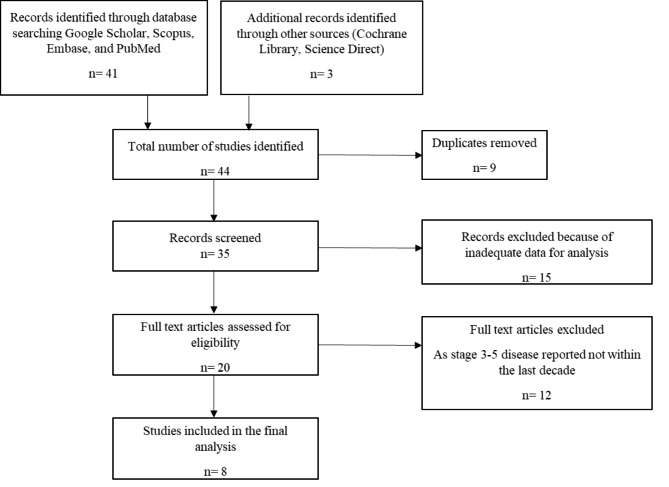
Eight studies were analysed, with two from each region. The matched prevalence rates of CKD between the various regions and South Africa showed significant differences, except for one comparison between South Africa and an African study [p = 0.09 (95% CI - 0.04-0.01)]. Both sub-Saharan African studies had a higher prevalence than South Africa. One study in Africa had a higher prevalence, while the other had a lower prevalence, whilst one Global study had a higher prevalence, and the other had a lower prevalence compared to South Africa. The statistical differences analysed using the Cramer's V test were substantially less than 0.1. Thus, differences in comparisons were largely due to differences in sample sizes rather than actual differences.
Variable prevalence rates between regions included disparities in sample size, definitions of CKD, lack of chronicity testing and heterogeneous laboratory estimations of eGFR. Improved consistency and enhanced methods for diagnosing and comparing CKD prevalence are essential.
慢性肾脏病(CKD)是一种全球范围内重要的非传染性疾病。CKD 的患病率在国家之间和一个国家内部存在差异。我们比较了南非与撒哈拉以南非洲、非洲和全球的 CKD 患病率。
我们对 2013 年至 2021 年期间报告 CKD Ⅲ-Ⅴ期的患病率研究进行了系统评价注册。该分析旨在解释患病率差异的原因。使用 R 统计软件包进行数据分析。由于分析的样本量大,因此采用了效应量的测量方法进行比较。我们还比较了不同地区和南非的患病率、常见病因和研究方法学类型的性别差异。
分析了 8 项研究,其中每个地区有 2 项。除了南非与非洲一项研究的比较(p=0.09[95%CI-0.04-0.01])外,各地区与南非之间的 CKD 匹配患病率存在显著差异。两个撒哈拉以南非洲的研究的患病率均高于南非。一个非洲的研究的患病率较高,另一个则较低,而一个全球的研究的患病率较高,另一个则较低。使用 Cramer's V 检验分析的统计差异远小于 0.1。因此,比较中的差异主要归因于样本量的差异,而不是实际差异。
区域间患病率的差异包括样本量、CKD 定义、缺乏慢性检测以及 eGFR 的实验室估计方法的异质性等方面的差异。提高一致性并改进用于诊断和比较 CKD 患病率的方法至关重要。