Singh Simar, Sarroza Dennis, English Anthony, McGrory Maya, Dong Ao, Zweifel Larry, Land Benjamin B, Li Yulong, Bruchas Michael R, Stella Nephi
Department of Pharmacology, University of Washington, Seattle, USA.
Center for Cannabis Research, University of Washington, Seattle, USA.
bioRxiv. 2023 Mar 6:2023.03.03.531053. doi: 10.1101/2023.03.03.531053.
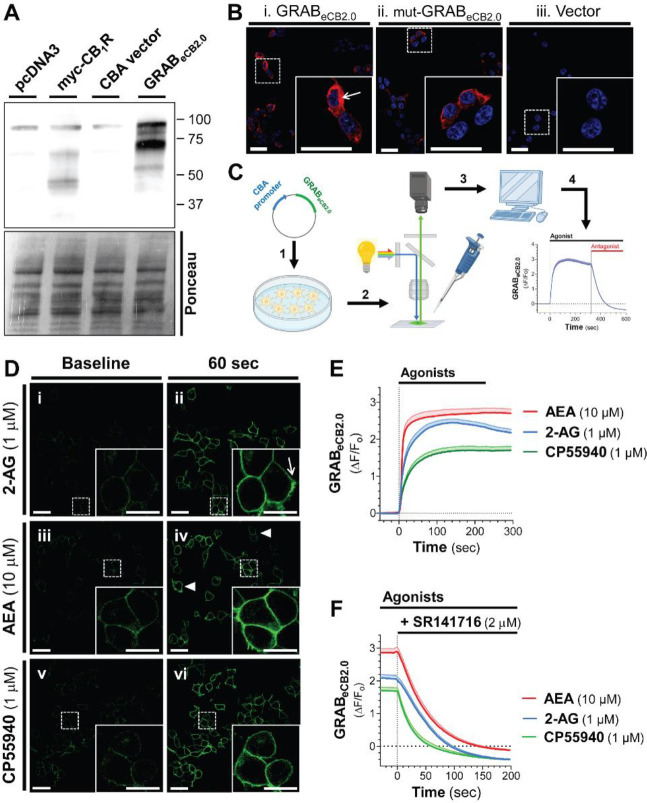
The endocannabinoids (), 2-arachidonoylglycerol () and arachidonoyl ethanolamine (), are produced by separate enzymatic pathways, activate cannabinoid receptors with distinct pharmacology, and differentially regulate pathophysiological processes. The genetically encoded sensor, GRAB detects real-time changes in eCB levels in cells in culture and preclinical model systems; however, its activation by eCB analogues produced by cells and by phyto-cannabinoids remains uncharacterized, a current limitation when interpreting changes in its response. This information could provide additional utility for the tool in in vivo pharmacology studies of phyto-cannabinoid action.
GRAB was expressed in cultured HEK293 cells. Live cell confocal microscopy and high-throughput fluorescent signal measurements.
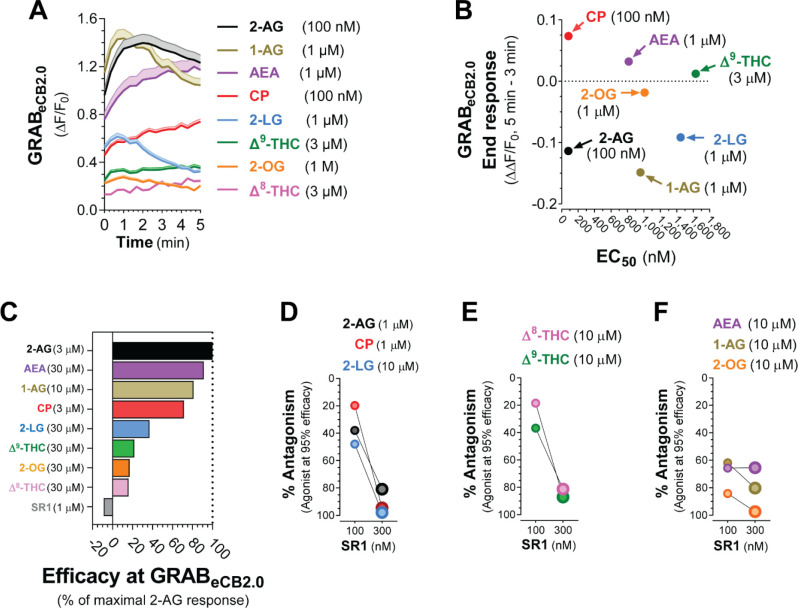
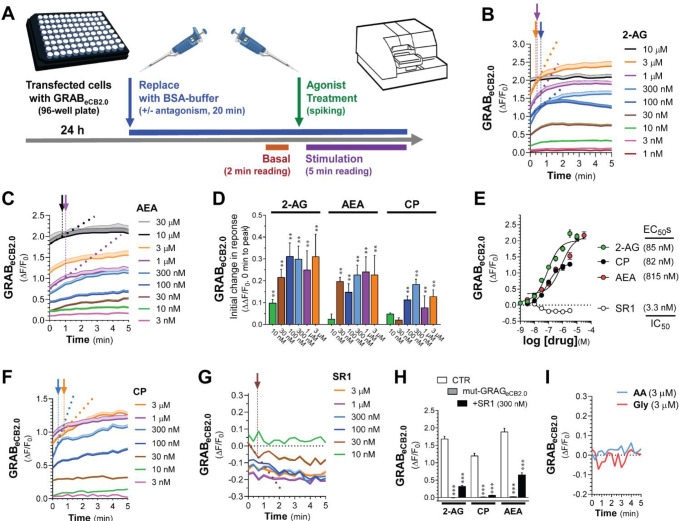
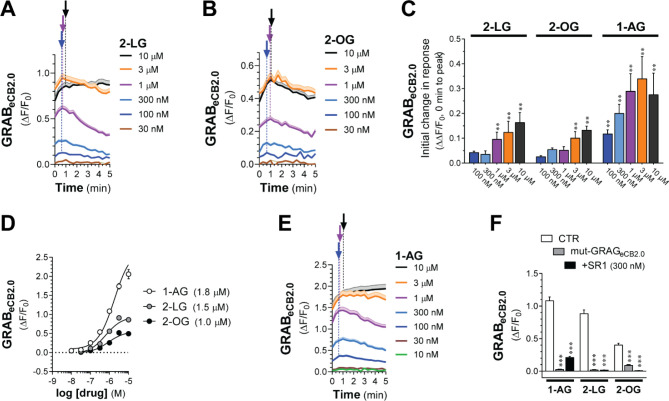
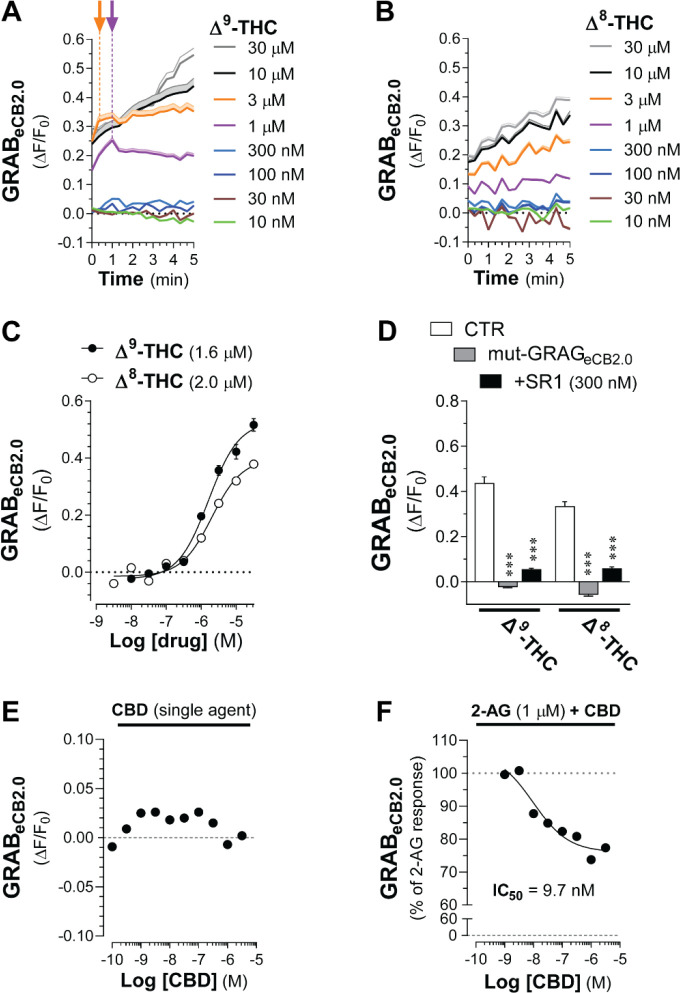
2-AG increased GRAB fluorescent signal (EC = 85 nM), and the cannabinoid 1 receptor () antagonist, SR141617, decreased GRAB signal (, IC = 3.3 nM), responses that mirror their known potencies at cannabinoid 1 receptors (). GRAB fluorescent signal also increased in response to AEA (EC = 815 nM), the eCB analogues 2-linoleoylglycerol and 2-oleoylglycerol ( and , ECs = 1.5 and 1.0 μM, respectively), Δ-tetrahydrocannabinol () and (ECs = 1.6 and 2.0 μM, respectively), and the artificial CBR agonist, CP55,940 (, EC = 82 nM); however their potencies were less than what has been described at CBR. Cannabidiol () did not affect basal GRAB fluorescent signal and yet reduced the 2-AG stimulated GRAB responses (IC = 8.8 nM).
2-AG and SR1 modulate the GRAB fluorescent signal with ECs that mirror their potencies at CBR whereas AEA, eCB analogues, THC and CP increase GRAB fluorescent signal with ECs significantly lower than their potencies at CBR. CBD reduces the 2-AG response without affecting basal signal, suggesting that GRAB retains the negative allosteric modulator () property of CBD at CBR. This study describes the pharmacological profile of GRAB to improve interpretation of changes in fluorescent signal in response to a series of known eCBs and CBR ligands.
内源性大麻素2-花生四烯酸甘油酯(2-AG)和花生四烯酸乙醇胺(AEA)通过不同的酶促途径产生,以不同的药理学特性激活大麻素受体,并对病理生理过程进行差异性调节。基因编码的传感器GRAB可检测培养细胞和临床前模型系统中内源性大麻素水平的实时变化;然而,其被细胞产生的内源性大麻素类似物和植物大麻素激活的情况仍未得到充分研究,这是目前在解释其反应变化时的一个局限性。该信息可为该工具在植物大麻素作用的体内药理学研究中提供更多用途。
GRAB在培养的HEK293细胞中表达。采用活细胞共聚焦显微镜和高通量荧光信号测量。
2-AG增加GRAB荧光信号(EC50 = 85 nM),大麻素1受体(CB1R)拮抗剂SR141617降低GRAB信号(pIC50 = 3.3 nM),这些反应反映了它们在CB1R上已知的效力。GRAB荧光信号也因AEA(EC50 = 815 nM)、内源性大麻素类似物2-亚油酰甘油和2-油酰甘油(分别为1.5和1.0 μM)、Δ9-四氢大麻酚(THC)和大麻二酚(CBD)(分别为1.6和2.0 μM)以及人工CB1R激动剂CP55,940(pEC50 = 82 nM)而增加;然而,它们的效力低于在CB1R上所描述的效力。大麻二酚(CBD)不影响基础GRAB荧光信号,但降低了2-AG刺激的GRAB反应(IC50 = 8.8 nM)。
2-AG和SR1以反映其在CB1R上效力的EC50调节GRAB荧光信号,而AEA、内源性大麻素类似物、THC和CP以显著低于其在CB1R上效力的EC50增加GRAB荧光信号。CBD降低2-AG反应而不影响基础信号,表明GRAB保留了CBD在CB1R上的负变构调节剂(NAM)特性。本研究描述了GRAB的药理学特征,以改善对一系列已知内源性大麻素和CB1R配体反应中荧光信号变化的解释。