Ellis Nicole A, Myers Kevin S, Tung Jessica, Ward Anne Davidson, Johnston Kathryn, Bonnington Katherine E, Donohue Timothy J, Machner Matthias P
Eunice Kennedy Shriver National Institute of Child Health and Human Development, National Institutes of Health, Bethesda, Maryland, USA.
Great Lakes Bioenergy Research Center, University of Wisconsin-Madison, Madison, Wisconsin, USA.
bioRxiv. 2023 Nov 8:2023.02.03.527066. doi: 10.1101/2023.02.03.527066.
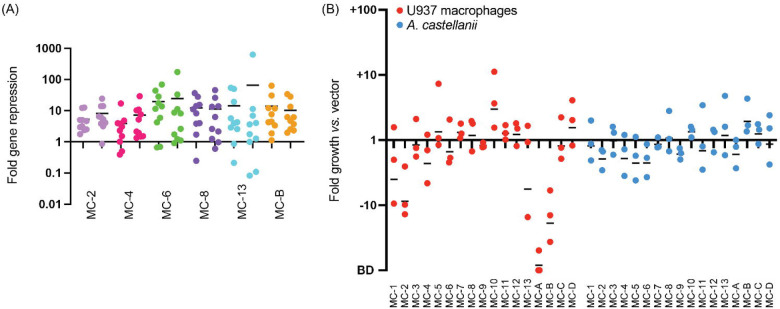
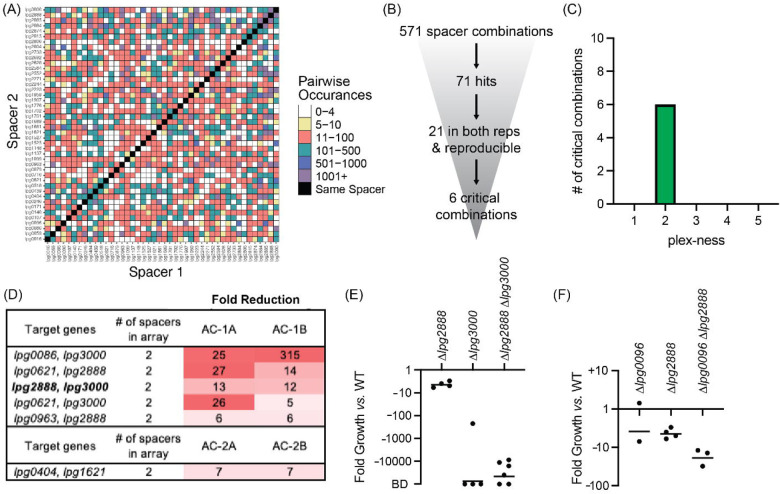
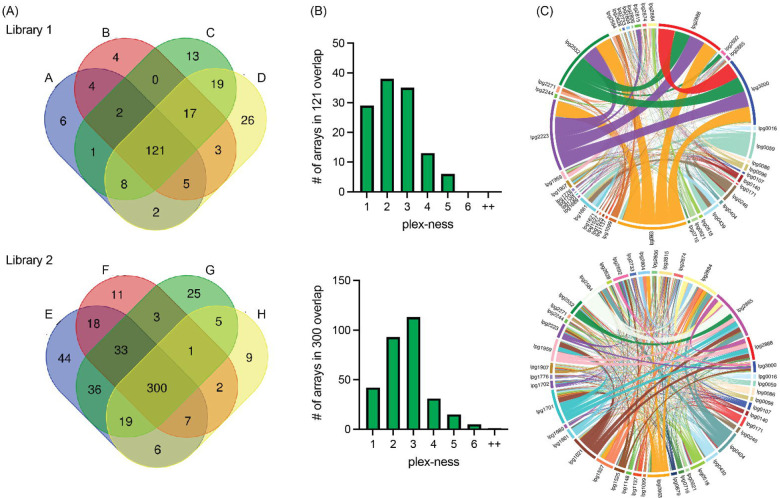
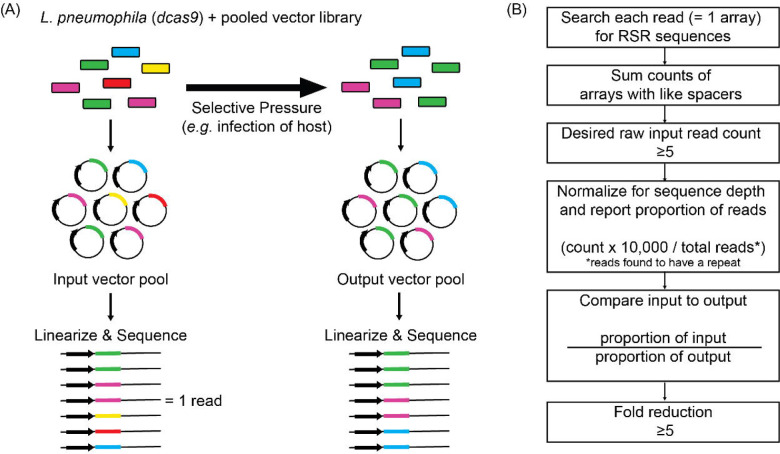
Identifying virulence-critical genes from pathogens is often limited by functional redundancy. To rapidly interrogate the contributions of combinations of genes to a biological outcome, we have developed a multiplex, randomized CRISPR interference sequencing (MuRCiS) approach. At its center is a new method for the randomized self-assembly of CRISPR arrays from synthetic oligonucleotide pairs. When paired with PacBio long-read sequencing, MuRCiS allowed for near-comprehensive interrogation of all pairwise combinations of a group of 44 virulence genes encoding highly conserved transmembrane proteins for their role in pathogenesis. Both amoeba and human macrophages were challenged with bearing the pooled CRISPR array libraries, leading to the identification of several new virulence-critical combinations of genes. and were particularly fascinating for their apparent redundant functions during human macrophage infection, while alone was essential for virulence in the amoeban host . Thus, MuRCiS provides a method for rapid genetic examination of even large groups of redundant genes, setting the stage for application of this technology to a variety of biological contexts and organisms.
从病原体中鉴定毒力关键基因往往受到功能冗余的限制。为了快速探究基因组合对生物学结果的贡献,我们开发了一种多重、随机的CRISPR干扰测序(MuRCiS)方法。其核心是一种从合成寡核苷酸对中随机自组装CRISPR阵列的新方法。当与PacBio长读长测序相结合时,MuRCiS能够近乎全面地探究一组44个编码高度保守跨膜蛋白的毒力基因的所有成对组合在发病机制中的作用。用携带汇集的CRISPR阵列文库的菌株对变形虫和人类巨噬细胞进行攻击,从而鉴定出几种新的毒力关键基因组合。在人类巨噬细胞感染期间,[具体基因1]和[具体基因2]因其明显的冗余功能而特别引人关注,而单独的[具体基因3]对于变形虫宿主中的[病原体名称]毒力至关重要。因此,MuRCiS提供了一种对甚至大量冗余基因进行快速基因检测的方法,为将该技术应用于各种生物学背景和生物体奠定了基础。