Departments of Molecular Microbiology and Immunology, University of Southern California, Los Angeles, CA, 90033, USA.
California State University, Channel Islands, Camarillo, CA, USA.
Adv Sci (Weinh). 2023 May;10(14):e2206812. doi: 10.1002/advs.202206812. Epub 2023 Mar 22.
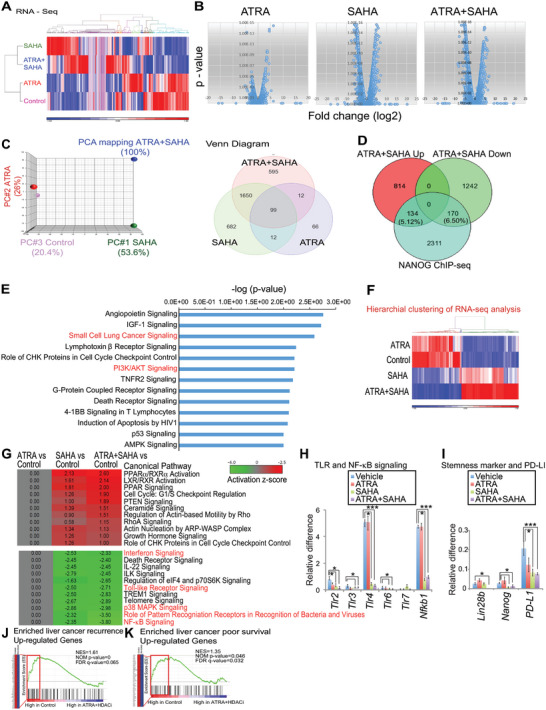
A critical barrier to effective cancer therapy is the improvement of drug selectivity, toxicity, and reduced recurrence of tumors expanded from tumor-initiating stem-like cells (TICs). The aim is to identify circulating tumor cell (CTC)-biomarkers and to identify an effective combination of TIC-specific, repurposed federal drug administration (FDA)-approved drugs. Three different types of high-throughput screens targeting the TIC population are employed: these include a CD133 (+) cell viability screen, a NANOG expression screen, and a drug combination screen. When combined in a refined secondary screening approach that targets Nanog expression with the same FDA-approved drug library, histone deacetylase (HDAC) inhibitor(s) combined with all-trans retinoic acid (ATRA) demonstrate the highest efficacy for inhibition of TIC growth in vitro and in vivo. Addition of immune checkpoint inhibitor further decreases recurrence and extends PDX mouse survival. RNA-seq analysis of TICs reveals that combined drug treatment reduces many Toll-like receptors (TLR) and stemness genes through repression of the lncRNA MIR22HG. This downregulation induces PTEN and TET2, leading to loss of the self-renewal property of TICs. Thus, CTC biomarker analysis would predict the prognosis and therapy response to this drug combination. In general, biomarker-guided stratification of HCC patients and TIC-targeted therapy should eradicate TICs to extend HCC patient survival.
有效癌症治疗的一个关键障碍是提高药物选择性、降低毒性和减少肿瘤复发,这些肿瘤是由肿瘤起始干细胞样细胞(TICs)扩增而来的。目的是确定循环肿瘤细胞(CTC)生物标志物,并确定 TIC 特异性的、重新利用的美国食品和药物管理局(FDA)批准药物的有效组合。采用了三种不同类型的针对 TIC 群体的高通量筛选方法:包括 CD133(+)细胞活力筛选、NANOG 表达筛选和药物组合筛选。当与针对 Nanog 表达的相同 FDA 批准药物库结合使用时,在经过改进的二次筛选方法中,组蛋白去乙酰化酶(HDAC)抑制剂与全反式维甲酸(ATRA)联合使用,在体外和体内显示出对 TIC 生长抑制的最高疗效。添加免疫检查点抑制剂进一步降低了复发率并延长了 PDX 小鼠的存活时间。对 TIC 的 RNA-seq 分析表明,联合药物治疗通过抑制长非编码 RNA MIR22HG 降低了许多 Toll 样受体(TLR)和干细胞基因。这种下调诱导了 PTEN 和 TET2 的表达,导致 TIC 自我更新特性的丧失。因此,CTC 生物标志物分析将预测这种药物组合的预后和治疗反应。总的来说,基于生物标志物的 HCC 患者分层和 TIC 靶向治疗应根除 TICs,以延长 HCC 患者的生存时间。