Vanderbilt University Medical Center, Nashville, TN, 37232, USA.
Georgetown Lombardi Comprehensive Cancer Center, Georgetown University, Washington, DC, USA.
BMC Cancer. 2023 Mar 23;23(1):265. doi: 10.1186/s12885-023-10708-6.
COVID-19 particularly impacted patients with co-morbid conditions, including cancer. Patients with melanoma have not been specifically studied in large numbers. Here, we sought to identify factors that associated with COVID-19 severity among patients with melanoma, particularly assessing outcomes of patients on active targeted or immune therapy.
Using the COVID-19 and Cancer Consortium (CCC19) registry, we identified 307 patients with melanoma diagnosed with COVID-19. We used multivariable models to assess demographic, cancer-related, and treatment-related factors associated with COVID-19 severity on a 6-level ordinal severity scale. We assessed whether treatment was associated with increased cardiac or pulmonary dysfunction among hospitalized patients and assessed mortality among patients with a history of melanoma compared with other cancer survivors.
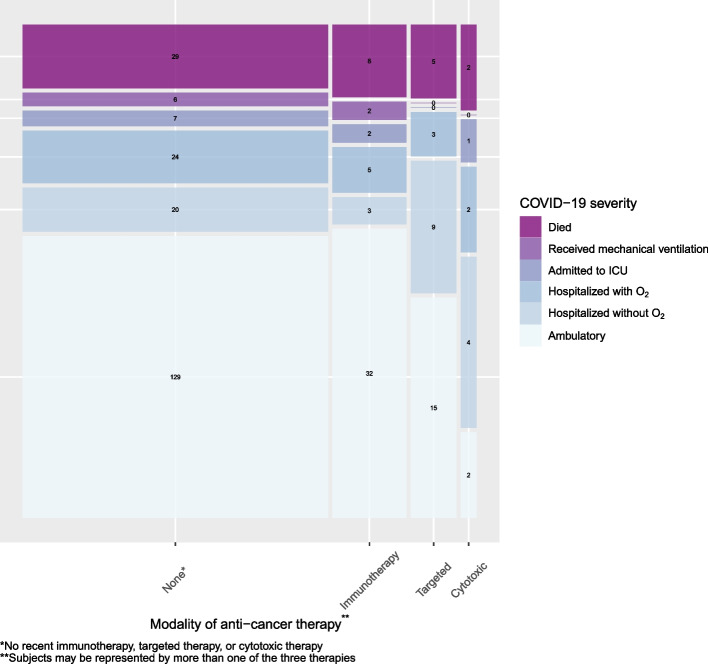
Of 307 patients, 52 received immunotherapy (17%), and 32 targeted therapy (10%) in the previous 3 months. Using multivariable analyses, these treatments were not associated with COVID-19 severity (immunotherapy OR 0.51, 95% CI 0.19 - 1.39; targeted therapy OR 1.89, 95% CI 0.64 - 5.55). Among hospitalized patients, no signals of increased cardiac or pulmonary organ dysfunction, as measured by troponin, brain natriuretic peptide, and oxygenation were noted. Patients with a history of melanoma had similar 90-day mortality compared with other cancer survivors (OR 1.21, 95% CI 0.62 - 2.35).
Melanoma therapies did not appear to be associated with increased severity of COVID-19 or worsening organ dysfunction. Patients with history of melanoma had similar 90-day survival following COVID-19 compared with other cancer survivors.
COVID-19 对合并症患者(包括癌症患者)影响特别大。尚未对大量黑色素瘤患者进行专门研究。在这里,我们试图确定与黑色素瘤患者 COVID-19 严重程度相关的因素,特别是评估正在接受主动靶向或免疫治疗的患者的结局。
我们使用 COVID-19 和癌症联盟(CCC19)注册中心,确定了 307 名被诊断患有 COVID-19 的黑色素瘤患者。我们使用多变量模型来评估与 COVID-19 严重程度相关的人口统计学、癌症相关和治疗相关因素,严重程度为 6 级序数量表。我们评估了住院患者中治疗是否与心脏或肺部功能障碍增加相关,并评估了黑色素瘤病史患者与其他癌症幸存者相比的死亡率。
在 307 名患者中,52 名在过去 3 个月内接受了免疫治疗(17%),32 名接受了靶向治疗(10%)。使用多变量分析,这些治疗与 COVID-19 严重程度无关(免疫治疗 OR 0.51,95%CI 0.19-1.39;靶向治疗 OR 1.89,95%CI 0.64-5.55)。在住院患者中,未观察到肌钙蛋白、脑利钠肽和氧合等指标提示心脏或肺部器官功能障碍增加。有黑色素瘤病史的患者与其他癌症幸存者相比,90 天死亡率相似(OR 1.21,95%CI 0.62-2.35)。
黑色素瘤治疗似乎与 COVID-19 严重程度增加或器官功能恶化无关。COVID-19 后有黑色素瘤病史的患者与其他癌症幸存者的 90 天生存率相似。