Drott Jenny, Engström My, Jangland Eva, Fomichov Victoria, Malmström Marlene, Jakobsson Jenny
Division of Nursing Science, Department of Health, Medicine and Caring Sciences, Linköping University, Linköping, Sweden.
Department of Surgery, Linköping University Hospital, Linköping, Sweden.
BMC Nurs. 2023 Mar 22;22(1):79. doi: 10.1186/s12912-023-01258-0.
A high level of competence among staff is necessary for providing patient-safe surgical care. Knowledge regarding what factors contribute to the professional development of specialist nurses in surgical care and why they choose to remain in the workplace despite high work requirements is needed. To investigate and describe the organizational and social work environment of specialist nurses in surgical care as part of studying factors that impact on professional development.
This was a cross-sectional study with a strategic convenience sampling procedure that recruited 73 specialist nurses in surgical care in Sweden between October to December 2021. The study was guided by STROBE Statement and checklist of cross-sectional studies. The validated Copenhagen Psychosocial Questionnaire was used, and additional demographic data. Descriptive statistics were performed and the comparison to the population benchmarks was presented as the mean with a 95% confidence interval. To study potential differences among the demographic and professional characteristics, pairwise t tests were used with Bonferroni adjustment for multiple comparisons with a significance level of 5%.
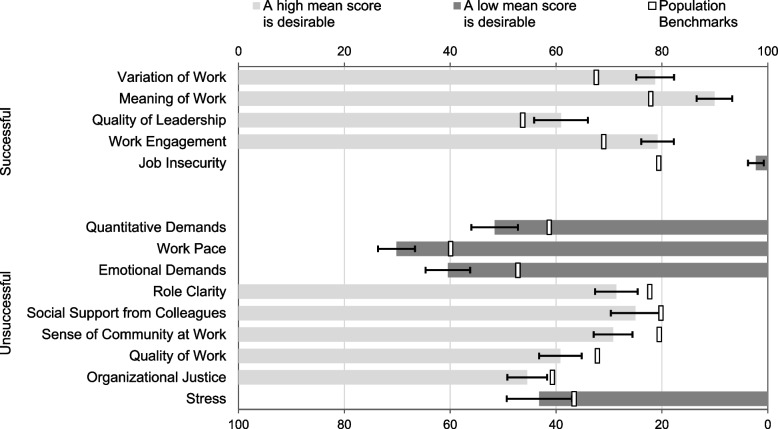
Five domains were identified as factors related to success, as they received higher scores in relation to population benchmarks: quality of leadership, variation of work, meaning of work and work engagement as well as job insecurity. There was also a significant association between a having a manager with low nursing education and job insecurity (p = 0.021).
Quality of leadership is important for the professional development of specialist nurses in surgical care. Strategic work seems to include managers with a higher nursing education level to prevent insecure professional working conditions.
员工具备高水平的专业能力是提供患者安全手术护理的必要条件。我们需要了解哪些因素有助于外科护理专科护士的专业发展,以及尽管工作要求很高,他们为何仍选择留在工作岗位。作为研究影响专业发展因素的一部分,调查并描述外科护理专科护士的组织和社会工作环境。
这是一项采用战略便利抽样程序的横断面研究,于2021年10月至12月在瑞典招募了73名外科护理专科护士。该研究以STROBE声明和横断面研究清单为指导。使用了经过验证的哥本哈根心理社会问卷以及其他人口统计学数据。进行了描述性统计,并将与总体基准的比较结果以95%置信区间的均值呈现。为研究人口统计学和专业特征之间的潜在差异,使用了配对t检验,并采用Bonferroni校正进行多重比较,显著性水平为5%。
五个领域被确定为与成功相关的因素,因为它们在与总体基准的比较中得分更高:领导质量、工作多样性、工作意义和工作投入以及工作不安全感。护理教育水平低的管理者与工作不安全感之间也存在显著关联(p = 0.021)。
领导质量对外科护理专科护士的专业发展很重要。战略工作似乎需要包括护理教育水平较高的管理者,以防止出现职业工作条件不安全的情况。