Young Christina B, Mormino Elizabeth C, Poston Kathleen L, Johnson Keith A, Rentz Dorene M, Sperling Reisa A, Papp Kathryn V
Department of Neurology and Neurological Science Stanford University School of Medicine Stanford California USA.
Center for Alzheimer Research and Treatment Department of Neurology Brigham and Women's Hospital Harvard Medical School Boston Massachusetts USA.
Alzheimers Dement (Amst). 2023 Mar 20;15(1):e12414. doi: 10.1002/dad2.12414. eCollection 2023 Jan-Mar.
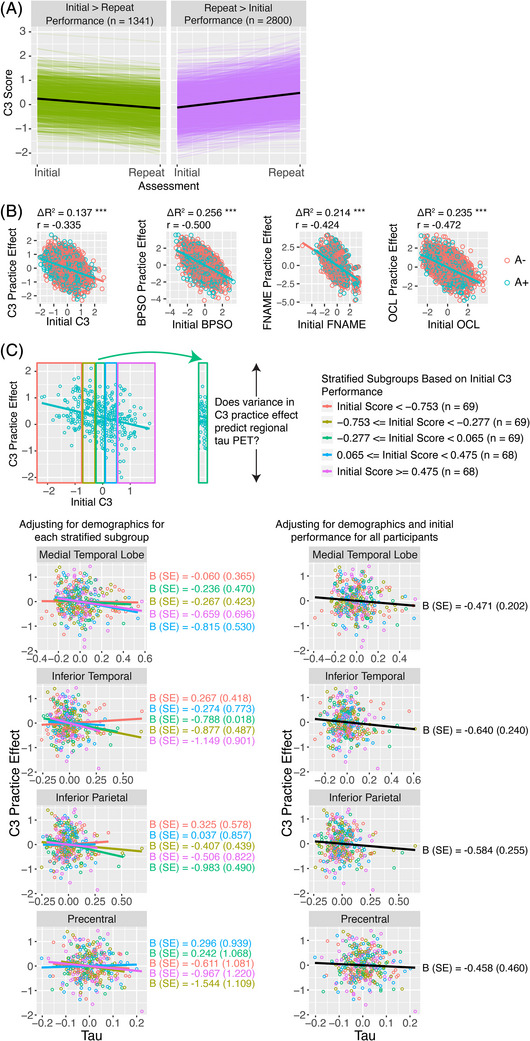
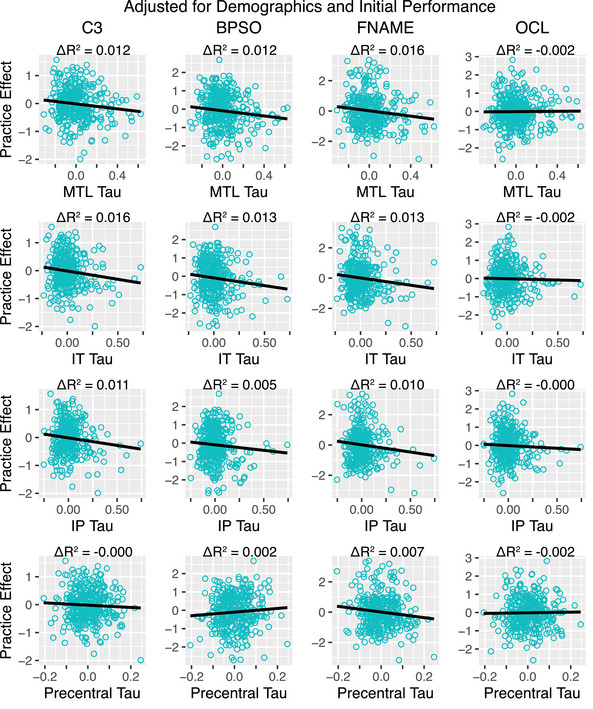
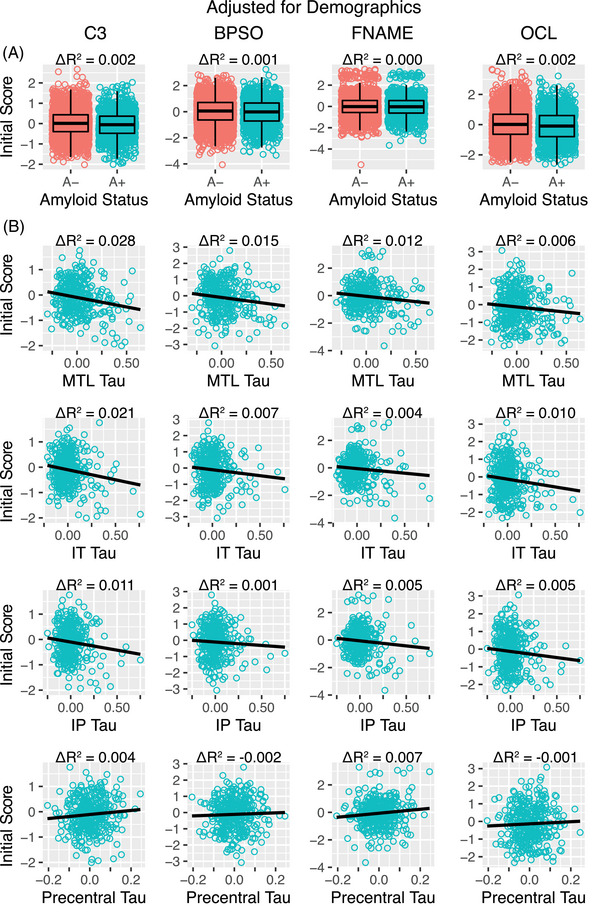
Scalable cognitive paradigms that provide metrics such as the Computerized Cognitive Composite (C3) may be sensitive enough to relate to Alzheimer's disease biomarkers in the preclinical clinically unimpaired (CU) stage. We examined CU older adults ( = 3287) who completed alternate versions of the C3 approximately 51 days apart. A subset of CU with abnormal amyloid also completed tau positron emission tomography (PET) imaging. C3 initial performance and practice effects were examined in relation to amyloid status and continuous regional tau burden. Initial C3 performance was associated with amyloid status across all participants, and with tau burden in the medial temporal lobe and early cortical regions in CU with abnormal amyloid. Short-term practice effects were associated with reduced tau in these regions in CU with abnormal amyloid, but were not associated with amyloid status. Thus, computerized cognitive testing repeated over a short follow-up period provides additional insights into early Alzheimer's disease processes.
可扩展的认知范式,如提供计算机化认知综合指标(C3)等指标,可能足够敏感,能够在临床前期未受损(CU)阶段与阿尔茨海默病生物标志物相关联。我们研究了3287名CU老年人,他们相隔约51天完成了C3的不同版本。淀粉样蛋白异常的CU亚组还完成了tau正电子发射断层扫描(PET)成像。研究了C3的初始表现和练习效应与淀粉样蛋白状态和连续区域tau负担的关系。所有参与者的C3初始表现均与淀粉样蛋白状态相关,在淀粉样蛋白异常的CU中,与内侧颞叶和早期皮质区域的tau负担相关。短期练习效应与淀粉样蛋白异常的CU中这些区域tau的减少相关,但与淀粉样蛋白状态无关。因此,在短随访期内重复进行计算机化认知测试,可为早期阿尔茨海默病进程提供更多见解。