York and Scarborough Teaching Hospital NHS Foundation Trust, York, UK.
University of York, York, UK.
Clin Med (Lond). 2023 Mar;23(2):157-163. doi: 10.7861/clinmed.2022-0252.
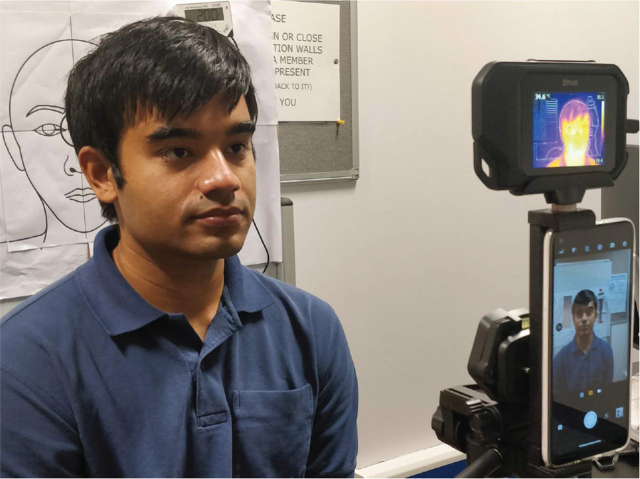
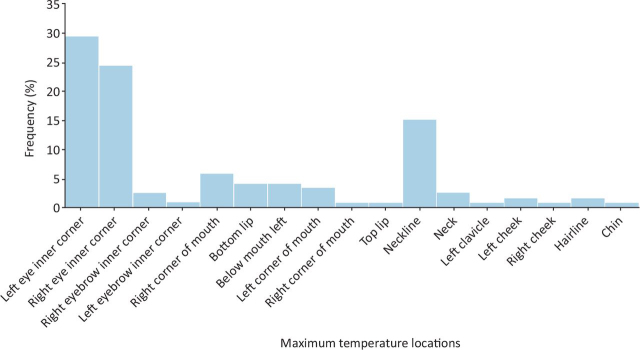
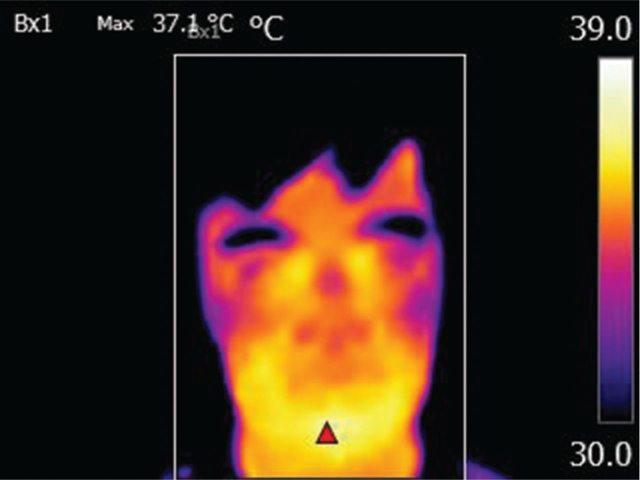
During the coronavirus 2019 (COVID-19) pandemic, the implementation of non-contact infrared thermometry (NCIT) became an increasingly popular method of screening body temperature. However, data on the accuracy of these devices and the standardisation of their use are limited. In the current study, the body temperature of non-febrile volunteers was measured using infrared (IR) thermography, IR tympanic thermometry and IR gun thermometry at different facial feature locations and distances and compared with SpotOn core-body temperature. Poor agreement was found between all IR devices and SpotOn measurements (intra-class correlation coefficient <0.8). Bland-Alman analysis showed the narrowest limits of agreement with the IR gun at 3 cm from the forehead (bias = 0.19°C, limits of agreement (LOA): -0.58°C to 0.97°C) and widest with the IR gun at the nose (bias = 1.40°C, LOA: -1.15°C to 3.94°C). Thus, our findings challenge the established use of IR thermometry devices within hospital settings without adequate standard operating procedures to reduce operator error.
在 2019 年冠状病毒病(COVID-19)大流行期间,非接触式红外测温仪(NCIT)的应用成为一种越来越流行的体温筛查方法。然而,这些设备的准确性数据及其使用的标准化数据有限。在本研究中,使用红外(IR)热成像、IR 鼓膜测温仪和 IR 枪式测温仪在不同的面部特征位置和距离测量无发热志愿者的体温,并与 SpotOn 核心体温进行比较。所有 IR 设备与 SpotOn 测量值之间的一致性均较差(组内相关系数<0.8)。 Bland-Alman 分析显示,与额头 3 厘米处的 IR 枪具有最窄的一致性(偏差=0.19°C,一致性界限(LOA):-0.58°C 至 0.97°C),与 IR 枪在鼻子处的一致性最宽(偏差=1.40°C,LOA:-1.15°C 至 3.94°C)。因此,我们的发现挑战了在没有足够的操作程序以减少操作人员误差的情况下在医院环境中使用 IR 测温仪的既定做法。