Population Health Laboratory (#PopHealthLab), University of Fribourg, Fribourg, Switzerland.
Biostatistics and Prevention Institute, University of Zurich, Zurich, Switzerland.
Int J Equity Health. 2023 Mar 23;22(1):51. doi: 10.1186/s12939-023-01853-2.
During the 2020/2021 winter, the labour market was under the impact of the COVID-19 pandemic. Changes in socioeconomic resources during this period could have influenced individual mental health. This association may have been mitigated or exacerbated by subjective risk perceptions, such as perceived risk of getting infected with SARS-CoV-2 or perception of the national economic situation. Therefore, we aimed to determine if changes in financial resources and employment situation during and after the second COVID-19 wave were prospectively associated with depression, anxiety and stress, and whether perceptions of the national economic situation and of the risk of getting infected modified this association.
One thousand seven hundred fifty nine participants from a nation-wide population-based eCohort in Switzerland were followed between November 2020 and September 2021. Financial resources and employment status were assessed twice (Nov2020-Mar2021, May-Jul 2021). Mental health was assessed after the second measurement of financial resources and employment status, using the Depression, Anxiety and Stress Scale (DASS-21). We modelled DASS-21 scores with linear regression, adjusting for demographics, health status, social relationships and changes in workload, and tested interactions with subjective risk perceptions.
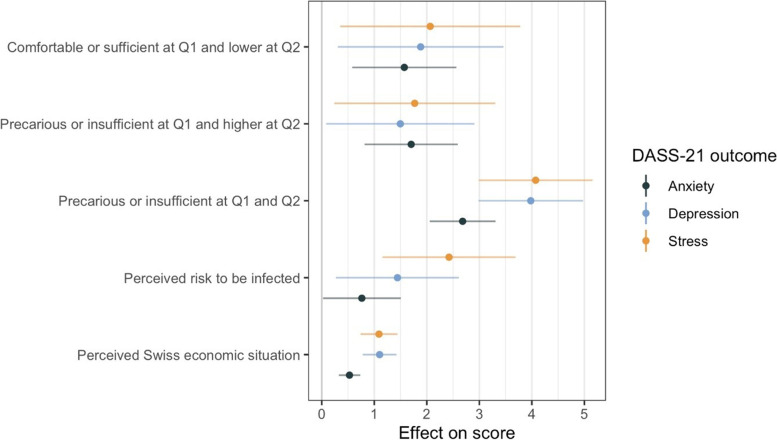
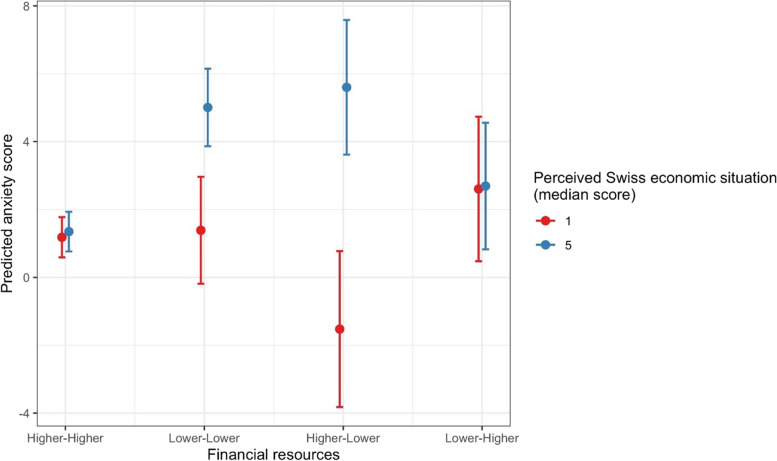
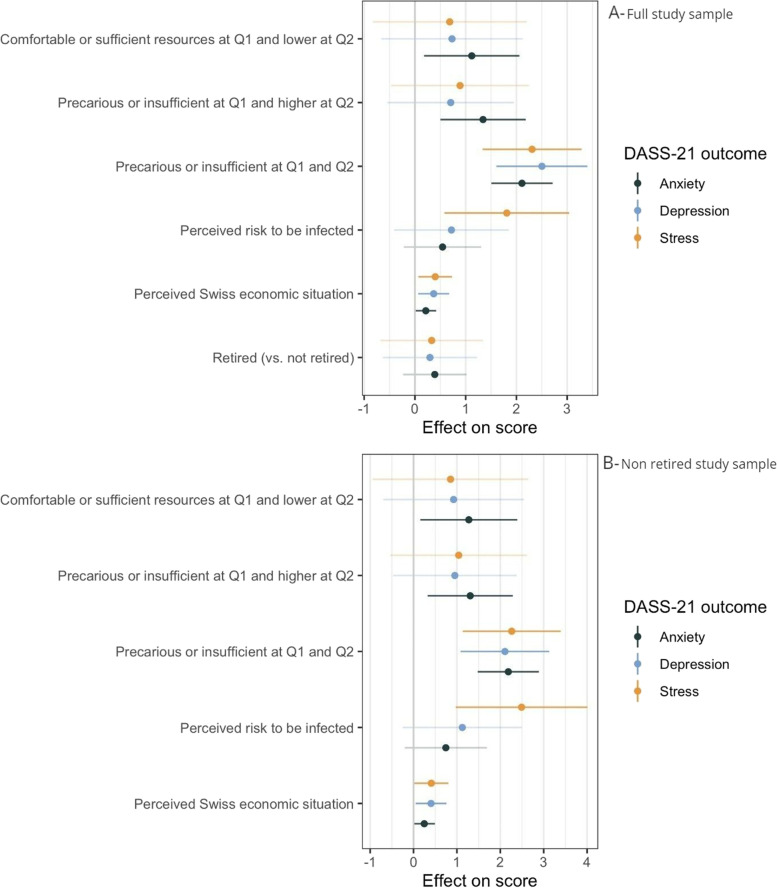
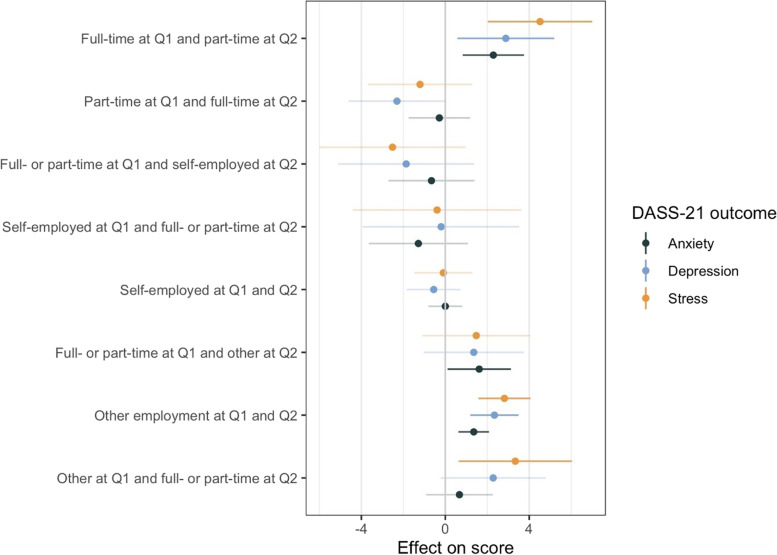
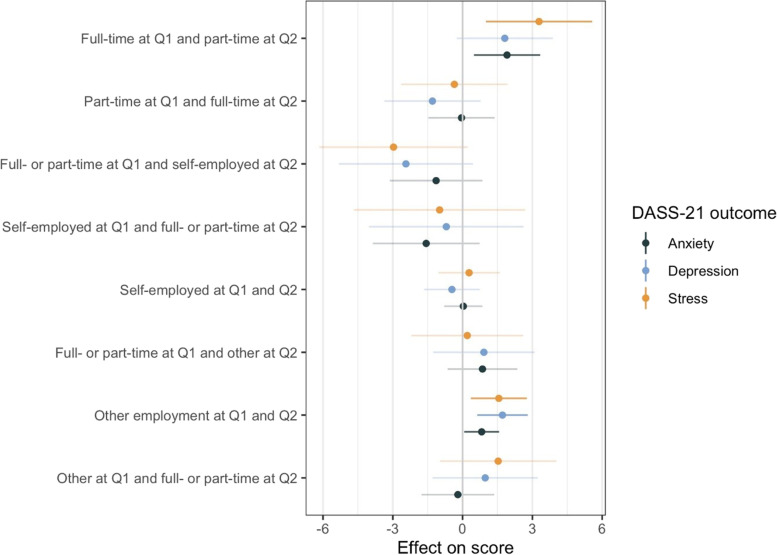
We observed scores above thresholds for normal levels for 16% (95%CI = 15-18) of participants for depression, 8% (95%CI = 7-10) for anxiety, and 10% (95%CI = 9-12) for stress. Compared to continuously comfortable or sufficient financial resources, continuously precarious or insufficient resources were associated with worse scores for all outcomes. Increased financial resources were associated with higher anxiety. In the working-age group, shifting from full to part-time employment was associated with higher stress and anxiety. Perceiving the Swiss economic situation as worrisome was associated with higher anxiety in participants who lost financial resources or had continuously precarious or insufficient resources.
This study confirms the association of economic stressors and mental health during the COVID-19 pandemic and highlights the exacerbating role of subjective risk perception on this association.
在 2020/2021 年冬季,劳动力市场受到了 COVID-19 大流行的影响。在此期间,社会经济资源的变化可能会影响个人的心理健康。这种关联可能会因主观风险感知而减轻或加剧,例如对感染 SARS-CoV-2 的风险感知或对国家经济状况的感知。因此,我们旨在确定在第二波 COVID-19 期间和之后,财务资源和就业状况的变化是否与抑郁、焦虑和压力呈前瞻性相关,以及对国家经济状况和感染风险的看法是否改变了这种关联。
瑞士全国基于人群的电子队列中的 1759 名参与者在 2020 年 11 月至 2021 年 9 月期间进行了随访。两次评估了财务资源和就业状况(2020 年 11 月至 2021 年 3 月,2021 年 5 月至 7 月)。在第二次评估财务资源和就业状况后,使用抑郁、焦虑和压力量表(DASS-21)评估心理健康状况。我们使用线性回归对 DASS-21 评分进行建模,调整了人口统计学、健康状况、社会关系以及工作量的变化,并测试了与主观风险感知的相互作用。
我们观察到 16%(95%CI=15-18)的参与者抑郁评分超过正常水平,8%(95%CI=7-10)的参与者焦虑评分超过正常水平,10%(95%CI=9-12)的参与者压力评分超过正常水平。与持续舒适或充足的财务资源相比,持续不稳定或不足的资源与所有结果的评分恶化相关。财务资源增加与更高的焦虑相关。在劳动年龄组中,从全时工作转为兼职工作与更高的压力和焦虑相关。感知瑞士经济状况令人担忧与那些失去财务资源或持续不稳定或不足的资源的参与者的更高焦虑相关。
本研究证实了在 COVID-19 大流行期间经济压力源与心理健康之间的关联,并强调了主观风险感知在这种关联中的加剧作用。