Gagesch Michael, Hüni Andreas, Geschwindner Heike, Abderhalden Lauren A, Lang Wei, Bieri-Brüning Gaby, Bischoff-Ferrari Heike A
Department of Aging Medicine, University Hospital Zurich, 8091 Zurich, Switzerland.
Center on Aging and Mobility, University Hospital Zurich and University of Zurich, 8006 Zurich, Switzerland.
Geriatrics (Basel). 2023 Mar 6;8(2):35. doi: 10.3390/geriatrics8020035.
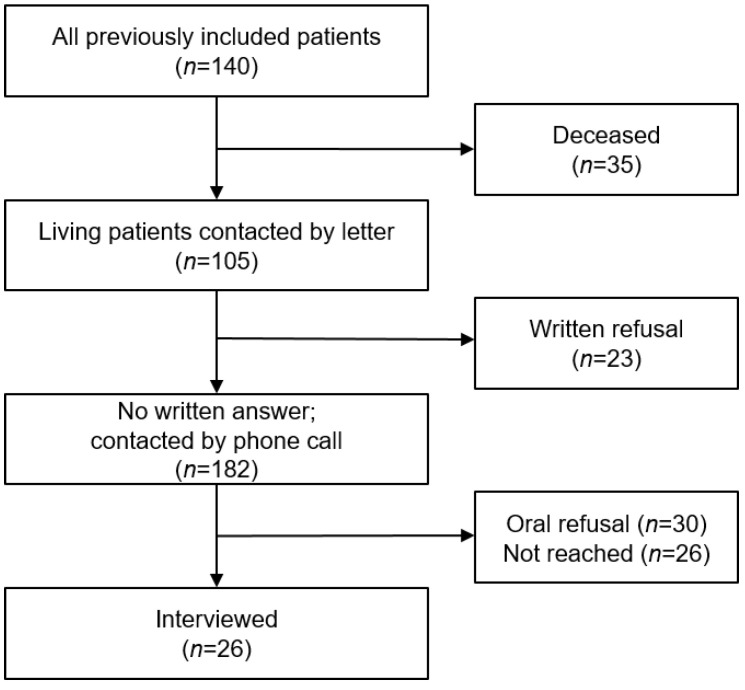
(1) Background: Post-acute care (PAC) aims to support functional recovery in older adults after acute hospitalization in order to regain a sufficient level of self-care facilitating their return home. However, the long-term outcomes of PAC are understudied due to challenges in recording a follow-up. We aimed to investigate the feasibility of a 12-month follow-up after PAC in Swiss nursing homes, examining practicability and potential factors influencing participation rate. (2) Methods: Collection of one-year follow-up data among 140 eligible patients after PAC in nursing homes was attempted. Patients were recruited using letters and phone calls between August and December 2017. We compared baseline data of all initial PAC patients with those who declined participation in the follow-up to identify factors potentially influencing participation. (3) Results: Overall mortality at 12 months was 25% ( = 35 of 140). Of the 105 survivors, 53 (50%) refused participation, 26 (25%) were interviewed, and 26 (25%) were lost to follow-up. Comparison of baseline characteristics between participants and objectors indicated significant statistical differences in Mini-Mental State Examination (MMSE) scores (participants mean of 26.0 [SD 3.92] vs. objectors mean of 23.5 points [SD 4.40], = 0.015). Further, logistic regression showed statistically significantly greater odds of participation (OR 1.25 [95% CI 1.06-1.48]) for each point increase in MMSE scores. (4) Conclusions: Long-term follow-up studies in older adults after PAC are challenging due to high mortality and dropout rates. Of note, intact cognitive function at baseline was associated with a higher willingness to participate in a follow-up phone interview. The assessment of cognitive function should be considered when estimating the participation rate in older patients.
(1) 背景:急性后期护理(PAC)旨在支持老年人急性住院后的功能恢复,以重新获得足够的自我护理水平,便于他们回家。然而,由于随访记录存在挑战,PAC的长期结果尚未得到充分研究。我们旨在调查瑞士养老院中PAC后12个月随访的可行性,研究其实用性以及影响参与率的潜在因素。(2) 方法:尝试收集养老院中140名符合条件的PAC患者的一年随访数据。2017年8月至12月期间,通过信件和电话招募患者。我们比较了所有初始PAC患者与拒绝参与随访患者的基线数据,以确定可能影响参与的因素。(3) 结果:12个月时的总死亡率为25%(140例中有35例)。在105名幸存者中,53例(50%)拒绝参与,26例(25%)接受了访谈,26例(25%)失访。参与者和拒绝者的基线特征比较表明,简易精神状态检查表(MMSE)评分存在显著统计学差异(参与者平均分为26.0[标准差3.92],拒绝者平均分为23.5分[标准差4.40],P = 0.015)。此外,逻辑回归显示,MMSE评分每增加1分,参与的几率在统计学上显著更高(比值比1.25[95%置信区间1.06 - 1.48])。(4) 结论:由于高死亡率和失访率,PAC后老年人的长期随访研究具有挑战性。值得注意的是,基线时完整的认知功能与参与随访电话访谈的意愿较高相关。在估计老年患者的参与率时,应考虑认知功能的评估。