Dana Center for Preventive Ophthalmology, Johns Hopkins Medicine, Baltimore, Maryland.
Johns Hopkins Bloomberg School of Public Health, Baltimore, Maryland.
Ophthalmology. 2023 Aug;130(8):863-871. doi: 10.1016/j.ophtha.2023.03.012. Epub 2023 Mar 22.
We provide global estimates of the prevalence of corneal blindness and vision impairment in adults 40 years of age and older and examine the burden by age, sex, and geographic region from 1984 through 2020.
Corneal opacities (COs) are among the top 5 causes of blindness worldwide, yet the global prevalence, regional differences, and risk factors are unclear.
Abstracted data from the published literature and surveys were obtained from the Global Burden of Disease Vision Loss Expert Group. We supplemented this by an independent systematic literature search of several databases. Studies that provided CO vision impairment data based on population-based surveys for those 40 years of age or older were included, for a total of 244. For each of the 4 outcomes of blindness and moderate to severe vision impairment (MSVI) caused by trachomatous and nontrachomatous CO (NTCO), time trends and differences in prevalence by region, age, and sex were evaluated using a Poisson log-linear model with a generalized estimating equation method. Age-standardized estimates of global prevalence of blindness and MSVI were calculated using the 2015 United Nations standard populations.
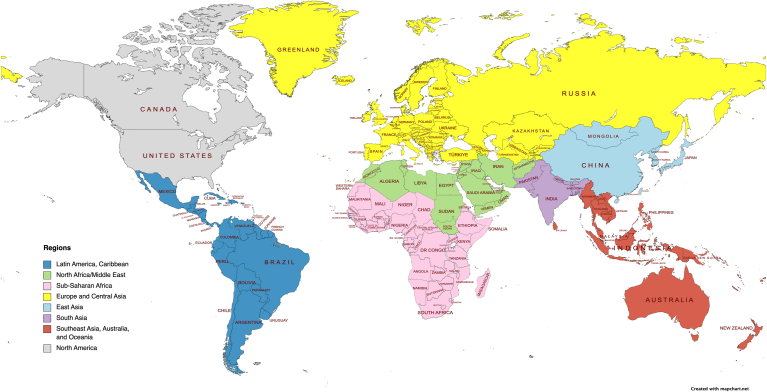
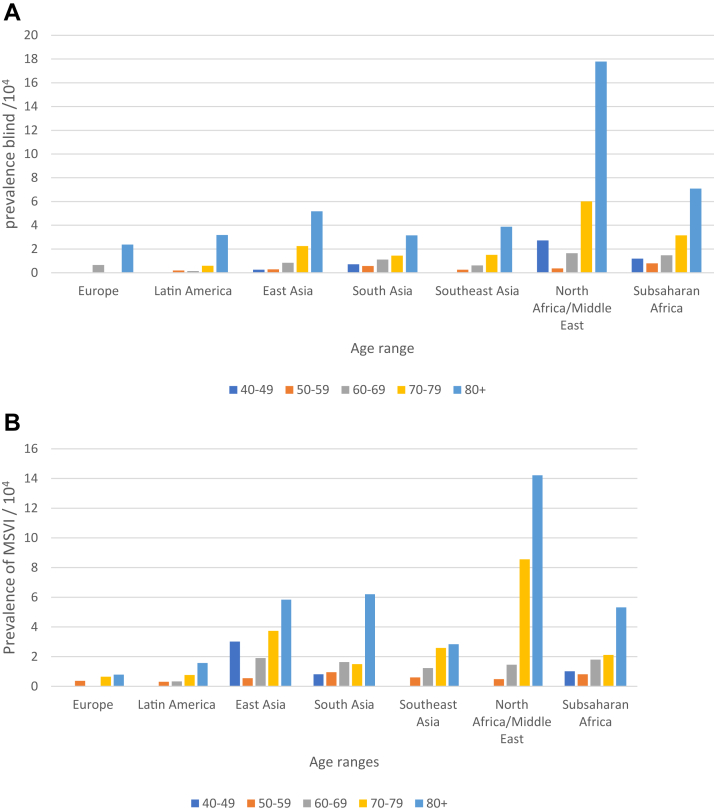
The global prevalence of blindness resulting from NTCO in those 40 years and older was 0.081% (95% confidence interval [CI], 0.049%-0.315%); that of MSVI was 0.130% (95% CI, 0.087%-0.372%). A significant increase with age was found (prevalence rate ratio, 2.15; 95% CI, 1.99-2.32). Latin America and Europe showed the lowest rates, with 2- to 8-fold higher rates of blindness or MSVI in other regions. The global prevalence of blindness resulting from trachomatous CO in those 50 years and older was 0.0094% (95% CI, 0%-0.0693%); that from MSVI was 0.012% (95% CI, 0%-0.0761%). Blindness resulting from trachomatous CO and MSVI increased with age and female sex, and rates were significantly higher in the African regions. A decrease in trachomatous blindness rates over time was found (prevalence rate ratio, 0.91; 95% CI, 0.86-0.96).
An estimated 5.5 million people worldwide are bilaterally blind or have MSVI resulting from CO, with an additional 6.2 million unilaterally blind. Blindness resulting from trachomatous CO is declining over time, likely because of the massive scaleup of the global trachoma elimination program and overall socioeconomic development.
FINANCIAL DISCLOSURE(S): The author(s) have no proprietary or commercial interest in any materials discussed in this article.
主题:我们提供了全球 40 岁及以上成年人角膜盲和视力障碍的患病率估计值,并根据年龄、性别和地理位置检查了 1984 年至 2020 年期间的负担情况。
临床相关性:角膜混浊(CO)是全球 5 大致盲原因之一,但全球患病率、地区差异和危险因素尚不清楚。
方法:从全球疾病负担视力丧失专家小组发表的文献和调查中提取了摘要数据。我们还通过对几个数据库进行独立的系统文献搜索进行了补充。纳入了针对 40 岁及以上人群的基于人群调查的 CO 视力损害数据的研究,总计 244 项研究。对于因沙眼和非沙眼性 CO(NTCO)引起的失明和中度至重度视力损害(MSVI)的 4 个结局,使用泊松对数线性模型和广义估计方程方法评估了地区、年龄和性别之间的患病率趋势和差异。使用 2015 年联合国标准人口计算了全球 40 岁及以上人群因 NTCO 导致的失明和 MSVI 的年龄标准化估计值。
结果:全球 40 岁及以上人群因 NTCO 导致的失明患病率为 0.081%(95%置信区间,0.049%-0.315%);MSVI 患病率为 0.130%(95%置信区间,0.087%-0.372%)。随着年龄的增长,患病率显著增加(患病率比,2.15;95%置信区间,1.99-2.32)。拉丁美洲和欧洲的发病率最低,其他地区的失明或 MSVI 发病率高 2-8 倍。全球 50 岁及以上人群因沙眼性 CO 导致的失明患病率为 0.0094%(95%置信区间,0%-0.0693%);因 MSVI 导致的失明患病率为 0.012%(95%置信区间,0%-0.0761%)。因沙眼性 CO 和 MSVI 导致的失明随着年龄和女性性别而增加,并且在非洲地区的发病率显著更高。随着时间的推移,沙眼性失明率呈下降趋势(患病率比,0.91;95%置信区间,0.86-0.96)。
讨论:全球估计有 550 万人双眼盲或因 CO 导致 MSVI,另有 620 万人单眼盲。由于全球沙眼消除计划的大规模实施和整体社会经济发展,因沙眼性 CO 导致的失明正在减少。
金融披露:作者没有与本文讨论的任何材料有关的专有或商业利益。