Fukuhara Hiroshi, Sato Yuzuri Tsurumaki, Hou Jiangang, Iwai Miwako, Todo Tomoki
Division of Innovative Cancer Therapy, Advanced Clinical Research Center, The Institute of Medical Science, The University of Tokyo, 4-6-1 Shirokanedai, Minato-ku, Tokyo, 108-8639, Japan.
Department of Urology, Kyorin University School of Medicine, 6-20-2 Shinkawa, Mitaka, Tokyo, 181-8611, Japan.
Commun Med (Lond). 2023 Mar 25;3(1):40. doi: 10.1038/s43856-023-00270-4.
G47∆ is a triple-mutated oncolytic herpes simplex virus type 1 (HSV-1) recently approved as a new drug for malignant glioma in Japan. As the next-generation, we develop armed oncolytic HSV-1 using G47∆ as the backbone. Because oncolytic HSV-1 elicits specific antitumor immunity, interleukin 12 (IL-12) can function as an effective payload to enhance the efficacy.
We evaluate the optimal methods for expressing IL-12 as a payload for G47∆-based oncolytic HSV-1. Two new armed viruses are generated for evaluation by employing different methods to express IL-12: T-mfIL12 expresses murine IL-12 as a fusion peptide, with the genes of two subunits (p35 and p40) linked by bovine elastin motifs, and T-mIL12-IRES co-expresses the subunits, with the two genes separated by an internal ribosome entry site (IRES) sequence.
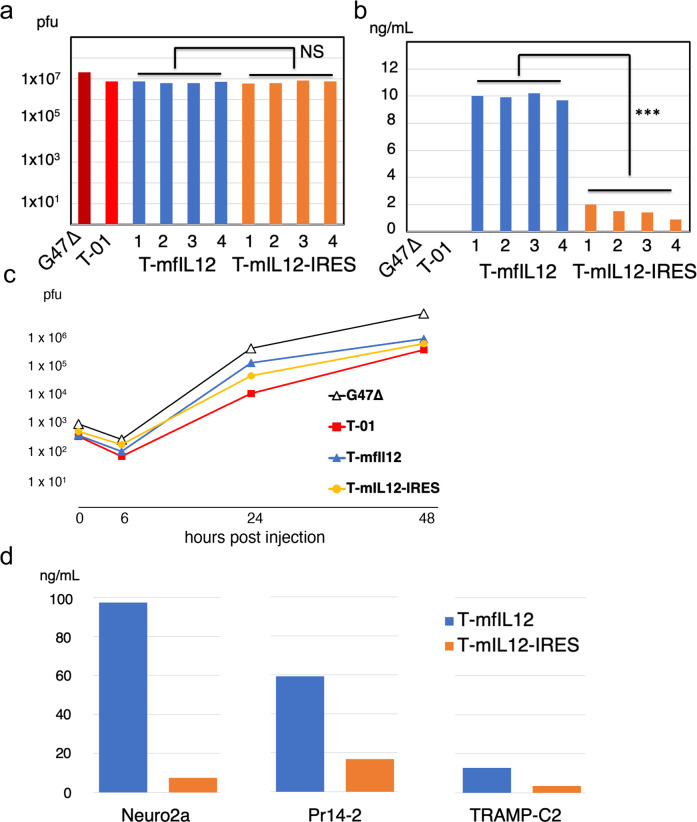
T-mfIL12 is significantly more efficient in producing IL-12 than T-mIL12-IRES in all cell lines tested, whereas the expression methods do not affect the replication capabilities and cytopathic effects. In two syngeneic mouse subcutaneous tumor models of Neuro2a and TRAMP-C2, T-mfIL12 exhibits a significantly higher efficacy than T-mIL12-IRES when inoculated intratumorally. Furthermore, T-mfIL12 shows a significantly higher intratumoral expression of functional IL-12, causing stronger stimulation of specific antitumor immune responses than T-mIL12-IRES.
The results implicate that a fusion-type expression of IL-12 is a method superior to co-expression of separate subunits, due to higher production of functional IL-12 molecules. This study led to the creation of triple-mutated oncolytic HSV-1 armed with human IL-12 currently used in phase 1/2 trial for malignant melanoma.
G47∆是一种三重突变的1型溶瘤单纯疱疹病毒(HSV-1),最近在日本被批准作为治疗恶性胶质瘤的新药。作为下一代产品,我们以G47∆为骨架开发携带武器的溶瘤HSV-1。由于溶瘤HSV-1能引发特异性抗肿瘤免疫,白细胞介素12(IL-12)可作为一种有效的载荷来增强疗效。
我们评估了将IL-12表达为基于G47∆的溶瘤HSV-1的载荷的最佳方法。通过采用不同的方法表达IL-12,产生了两种新的携带武器的病毒用于评估:T-mfIL12将小鼠IL-12表达为融合肽,两个亚基(p35和p40)的基因通过牛弹性蛋白基序连接,而T-mIL12-IRES共表达这些亚基,两个基因由内部核糖体进入位点(IRES)序列隔开。
在所有测试的细胞系中,T-mfIL12产生IL-12的效率显著高于T-mIL12-IRES,而表达方法不影响复制能力和细胞病变效应。在Neuro2a和TRAMP-C2的两种同基因小鼠皮下肿瘤模型中,瘤内接种时T-mfIL12的疗效显著高于T-mIL12-IRES。此外,T-mfIL12在肿瘤内功能性IL-12的表达显著更高,比T-mIL12-IRES更能强烈刺激特异性抗肿瘤免疫反应。
结果表明,由于功能性IL-12分子的产量更高,IL-12的融合型表达是一种优于单独亚基共表达的方法。这项研究导致了携带人IL-12的三重突变溶瘤HSV-1的产生,目前该病毒正在用于恶性黑色素瘤的1/2期试验。