Grunow Julius J, Gan Thomas, Lewald Heidrun, Martyn J A Jeevendra, Blobner Manfred, Schaller Stefan J
Charité - Universitätsmedizin Berlin, corporate Member of Freie Universität Berlin and Humboldt-Universität zu Berlin, Department of Anesthesiology and Operative Intensive Care Medicine (CVK, CCM), Charitéplatz 1, 10117, Berlin, Germany.
Technical University of Munich, School of Medicine, Klinikum rechts der Isar, Department of Anesthesiology and Intensive Care, Ismaninger Straße 22, 81675, Munich, Bavaria, Germany.
Intensive Care Med Exp. 2023 Mar 27;11(1):16. doi: 10.1186/s40635-023-00503-9.
The decline in the downstream signal transduction pathway of anabolic hormone, insulin, could play a key role in the muscle atrophy and insulin resistance observed in patients with intensive care unit acquired weakness (ICUAW). This study investigated the impact of immobilisation via surgical knee and ankle fixation and inflammation via Corynebacterium parvum injection, alone and in combination, as risk factors for altering insulin transduction and, therefore, their role in ICUAW.
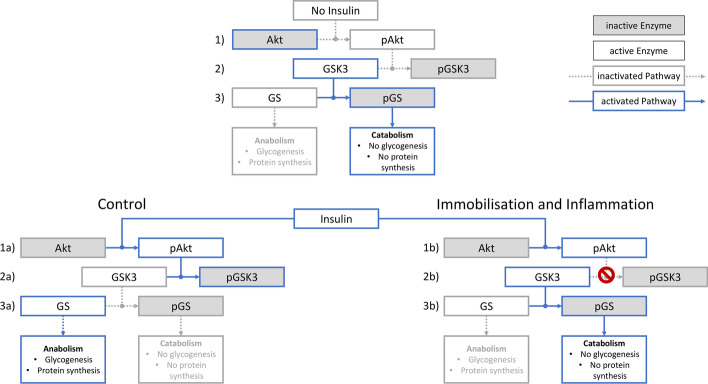
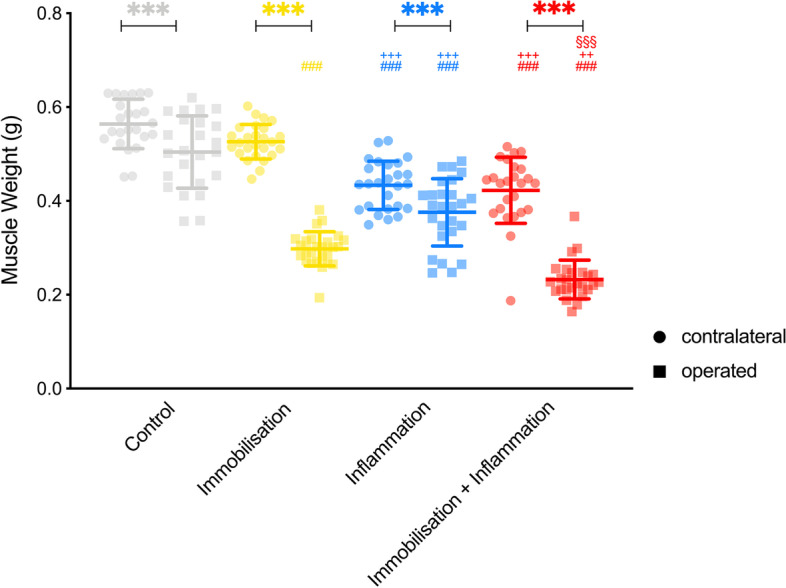
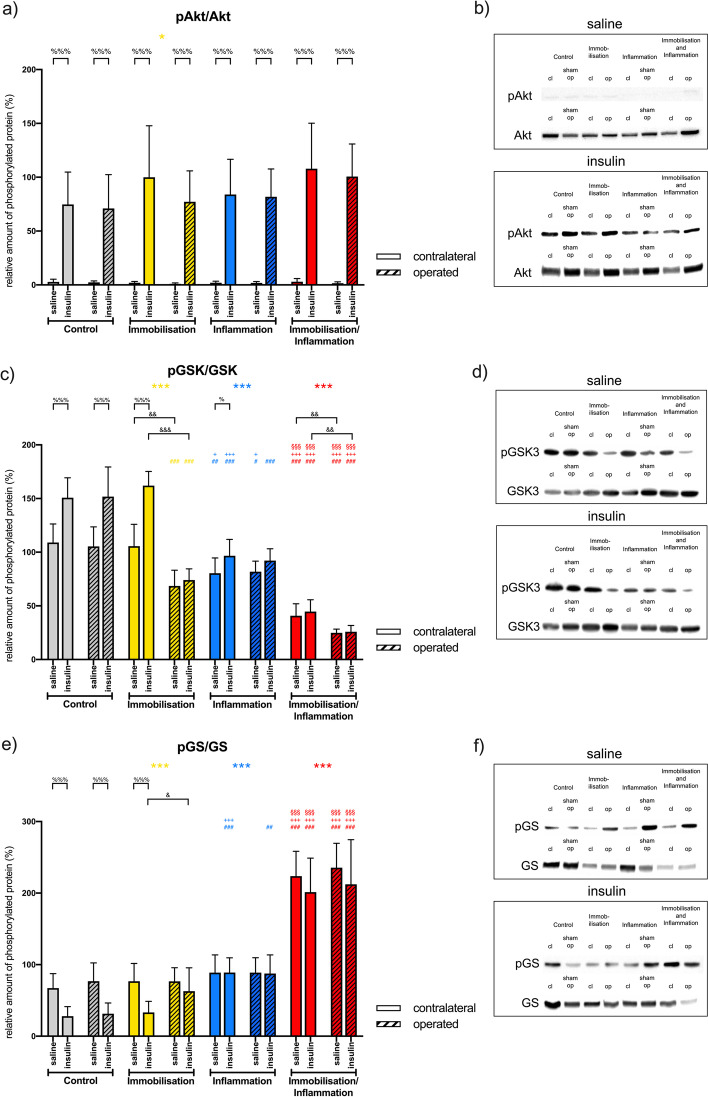
Muscle weight was significantly decreased due to immobilisation [estimated effect size (95% CI) - 0.10 g (- 0.12 to - 0.08); p < 0.001] or inflammation [estimated effect size (95% CI) - 0.11 g (- 0.13 to - 0.09); p < 0.001] with an additive effect of both combined (p = 0.024). pAkt was only detectable after insulin stimulation [estimated effect size (95% CI) 85.1-fold (76.2 to 94.0); p < 0.001] irrespective of the group and phosphorylation was not impaired by the different perturbations. Nevertheless, the phosphorylation of GSK3 observed in the control group after insulin stimulation was decreased in the immobilisation [estimated effect size (95% CI) - 40.2 (- 45.6 to - 34.8)] and inflammation [estimated effect size (95% CI) - 55.0 (- 60.4 to - 49.5)] groups. The expression of phosphorylated GS (pGS) was decreased after insulin stimulation in the control group and significantly increased in the immobilisation [estimated effect size (95% CI) 70.6-fold (58.8 to 82.4)] and inflammation [estimated effect size (95% CI) 96.7 (85.0 to 108.5)] groups.
Both immobilisation and inflammation significantly induce insulin resistance, i.e., impair the insulin signaling pathway downstream of Akt causing insufficient GSK phosphorylation and, therefore, its activation which caused increased glycogen synthase phosphorylation, which could contribute to muscle atrophy of immobilisation and inflammation.
合成代谢激素胰岛素下游信号转导通路的衰退,可能在重症监护病房获得性肌无力(ICUAW)患者出现的肌肉萎缩和胰岛素抵抗中起关键作用。本研究调查了单独及联合使用手术固定膝关节和踝关节导致的制动以及微小棒状杆菌注射引发的炎症作为改变胰岛素转导的风险因素,以及它们在ICUAW中的作用。
由于制动[估计效应量(95%置信区间)-0.10克(-0.12至-0.08);p<0.001]或炎症[估计效应量(95%置信区间)-0.11克(-0.13至-0.09);p<0.001],肌肉重量显著下降,二者联合存在累加效应(p=0.024)。无论在哪一组,仅在胰岛素刺激后可检测到pAkt[估计效应量(95%置信区间)85.1倍(76.2至94.0);p<0.001],且不同干扰因素并未损害其磷酸化。然而,胰岛素刺激后对照组中观察到的GSK3磷酸化在制动组[估计效应量(95%置信区间)-40.2(-45.6至-34.8)]和炎症组[估计效应量(95%置信区间)-55.0(-60.4至-49.5)]中降低。对照组中胰岛素刺激后磷酸化GS(pGS)的表达降低,而在制动组[估计效应量(95%置信区间)70.6倍(58.8至82.4)]和炎症组[估计效应量(95%置信区间)96.7(85.0至108.5)]中显著增加。
制动和炎症均显著诱导胰岛素抵抗,即损害Akt下游的胰岛素信号通路,导致GSK磷酸化不足,进而导致其激活,引起糖原合酶磷酸化增加,这可能导致制动和炎症所致的肌肉萎缩。