Department of Paediatrics, All India Institute of Medical Sciences, Jodhpur, 342005, Rajasthan, India.
Department of Neonatology, All India Institute of Medical Sciences, Jodhpur, 342005, Rajasthan, India.
Eur J Pediatr. 2023 Jun;182(6):2645-2654. doi: 10.1007/s00431-023-04933-1. Epub 2023 Mar 27.
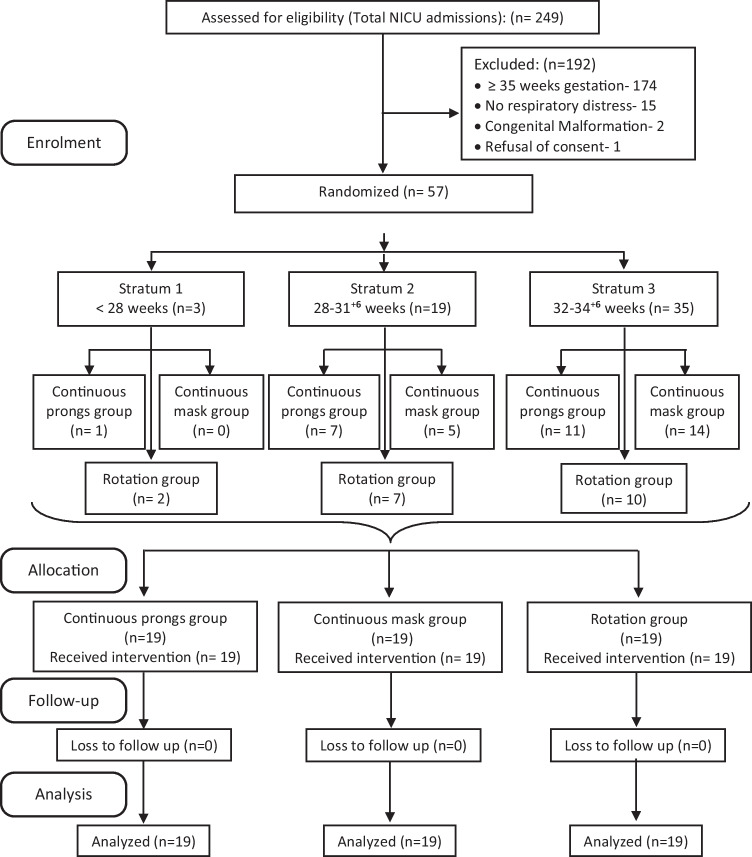
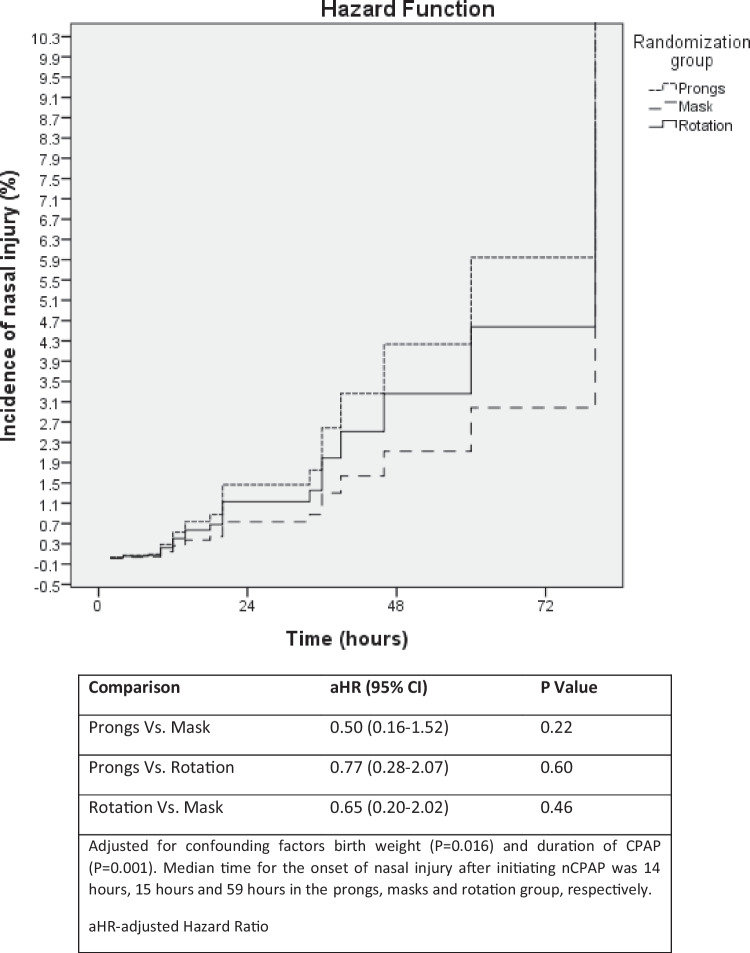
To compare whether alternate rotation of nasal mask with nasal prongs every 8 h as compared to continuous use of either interface alone decreases the incidence of nasal injury in preterm infants receiving nasal Continuous Positive Airway Pressure (nCPAP). This was an open-label, three-arm, stratified randomized controlled trial where infants < 35 weeks receiving nCPAP were randomized into three groups using two different nasal interfaces (continuous prongs group, continuous mask group, and rotation group). All infants were assessed for nasal injury six hours post-removal of nCPAP using grading suggested by Fischer et al. The nursing care was uniform across all three groups. Intention-to-treat analysis was done. Fifty-seven infants were enrolled, with nineteen in each group. The incidence of nasal injury was 42.1% vs. 47.4% vs. 68.4% in the rotation group, continuous mask, and continuous prongs groups, respectively (P = 0.228). On adjusted analysis (gestational age, birth weight, and duration of nCPAP therapy), the incidence of nasal injury was significantly less in the rotation group as compared to continuous prongs group (Adjusted Odds Ratio [AOR], 95% confidence interval [CI]; 0.10 [0.01-0.69], P = 0.02) and a trend towards lesser nasal injury as compared to continuous mask group (AOR, 95% CI; 0.15 [0.02-1.08], P = 0.06). However, there was no significant difference in incidence of nasal injuries between continuous prongs versus continuous mask group (P = 0.60). The need for surfactant, nCPAP failure rate, duration of nCPAP, and common neonatal co-morbidities were similar across all three groups. Conclusion: Systematic rotation of nasal mask with nasal prongs significantly reduced nasal injury among preterm infants on nCPAP as compared to continuous use of nasal prongs alone without affecting nCPAP failure rate. Trial registration: CTRI/2019/01/017320, registered on 31/01/2019. What is Known: • Use of nasal mask as an interface for nasal Continuous Positive Airway Pressure decreases nasal injury as compared to nasal prongs. What is New: • Rotation of nasal prongs and nasal mask interfaces alternately every 8 h may reduce the nasal injury even further as compared to either interface alone.
为了比较在接受经鼻持续气道正压通气(nCPAP)的早产儿中,与单独使用鼻插管或鼻罩相比,每 8 小时交替旋转鼻罩与鼻插管是否会降低鼻损伤的发生率。这是一项开放性标签、三臂、分层随机对照试验,将接受 nCPAP 的 <35 周龄婴儿随机分为三组,使用两种不同的鼻接口(连续插管组、连续面罩组和旋转组)。所有婴儿在 nCPAP 去除后 6 小时,使用 Fischer 等人提出的分级方法评估鼻损伤。三组的护理均保持一致。采用意向治疗分析。共纳入 57 名婴儿,每组 19 名。旋转组、连续面罩组和连续插管组的鼻损伤发生率分别为 42.1%、47.4%和 68.4%(P=0.228)。在调整了胎龄、出生体重和 nCPAP 治疗持续时间后,与连续插管组相比,旋转组的鼻损伤发生率显著降低(调整后的优势比[OR],95%置信区间[CI];0.10 [0.01-0.69],P=0.02),与连续面罩组相比,鼻损伤发生率也有降低的趋势(OR,95%CI;0.15 [0.02-1.08],P=0.06)。然而,连续插管组与连续面罩组之间的鼻损伤发生率无显著差异(P=0.60)。三组之间的表面活性剂需求、nCPAP 失败率、nCPAP 持续时间和常见新生儿合并症相似。结论:与单独使用鼻插管相比,在接受 nCPAP 的早产儿中,系统地旋转鼻罩和鼻插管可显著降低鼻损伤的发生率,而不会影响 nCPAP 的失败率。试验注册: CTRI/2019/01/017320,于 2019 年 1 月 31 日注册。已知:• 与鼻插管相比,使用鼻罩作为经鼻持续气道正压通气的接口可降低鼻损伤。新发现:• 与单独使用任何一种接口相比,每 8 小时交替旋转鼻插管和鼻罩接口可能会进一步降低鼻损伤的发生率。