Shen Shiyang, Li Teng, Fan Jinyi, Shao Quanlin, Dong He, Xu Xiao, Mo Ran
State Key Laboratory of Natural Medicines, Jiangsu Key Laboratory of Drug Discovery for Metabolic Diseases, Center of Advanced Pharmaceuticals and Biomaterials, School of Life Science and Technology, China Pharmaceutical University, Nanjing 210009, China.
Acta Pharm Sin B. 2023 Mar;13(3):1262-1273. doi: 10.1016/j.apsb.2022.11.009. Epub 2022 Nov 11.
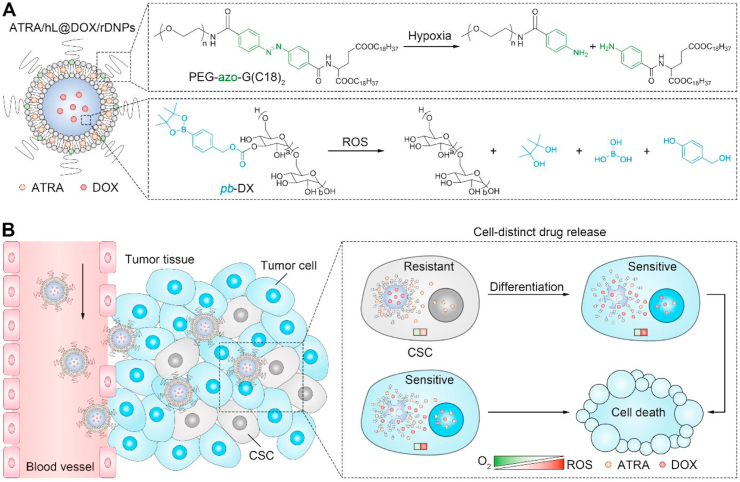
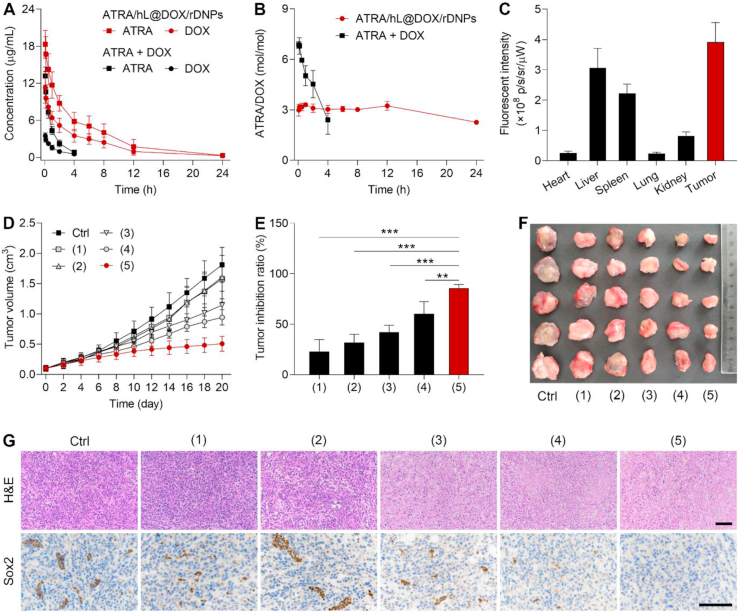
Drug resistance presents one of the major causes for the failure of cancer chemotherapy. Cancer stem-like cells (CSCs), a population of self-renewal cells with high tumorigenicity and innate chemoresistance, can survive conventional chemotherapy and generate increased resistance. Here, we develop a lipid-polymer hybrid nanoparticle for co-delivery and cell-distinct release of the differentiation-inducing agent, all- retinoic acid and the chemotherapeutic drug, doxorubicin to overcome the CSC-associated chemoresistance. The hybrid nanoparticles achieve differential release of the combined drugs in the CSCs and bulk tumor cells by responding to their specific intracellular signal variation. In the hypoxic CSCs, ATRA is released to induce differentiation of the CSCs, and in the differentiating CSCs with decreased chemoresistance, DOX is released upon elevation of reactive oxygen species to cause subsequent cell death. In the bulk tumor cells, the drugs are released synchronously upon the hypoxic and oxidative conditions to exert potent anticancer effect. This cell-distinct drug release enhances the synergistic therapeutic efficacy of ATRA and DOX with different anticancer mechanism. We show that treatment with the hybrid nanoparticle efficiently inhibit the tumor growth and metastasis of the CSC-enriched triple negative breast cancer in the mouse models.
耐药性是癌症化疗失败的主要原因之一。癌症干细胞(CSCs)是一群具有高度致瘤性和固有化学抗性的自我更新细胞,能够在传统化疗中存活并产生更强的耐药性。在此,我们开发了一种脂质-聚合物杂化纳米颗粒,用于共递送分化诱导剂全反式维甲酸和化疗药物阿霉素,并实现细胞特异性释放,以克服与癌症干细胞相关的化学抗性。该杂化纳米颗粒通过响应特定的细胞内信号变化,在癌症干细胞和实体肿瘤细胞中实现联合药物的差异释放。在缺氧的癌症干细胞中,全反式维甲酸被释放以诱导癌症干细胞分化,而在化学抗性降低的分化癌症干细胞中,阿霉素在活性氧升高时被释放,从而导致随后的细胞死亡。在实体肿瘤细胞中,药物在缺氧和氧化条件下同步释放,以发挥强大的抗癌作用。这种细胞特异性药物释放增强了全反式维甲酸和阿霉素具有不同抗癌机制的协同治疗效果。我们表明,用该杂化纳米颗粒治疗可有效抑制小鼠模型中富含癌症干细胞的三阴性乳腺癌的肿瘤生长和转移。