Department of Microbiology PathWest Laboratory Medicine WA Nedlands Western Australia Australia.
Wesfarmers Centre of Vaccines and Infectious Diseases, Telethon Kids Institute University of Western Australia Perth Western Australia Australia.
Influenza Other Respir Viruses. 2023 Mar 9;17(3):e13117. doi: 10.1111/irv.13117. eCollection 2023 Mar.
Respiratory syncytial virus (RSV) seasonality is dependent on the local climate. We assessed the stability of RSV seasonality prior to the SARS-CoV-2 pandemic in Western Australia (WA), a state spanning temperate and tropical regions.
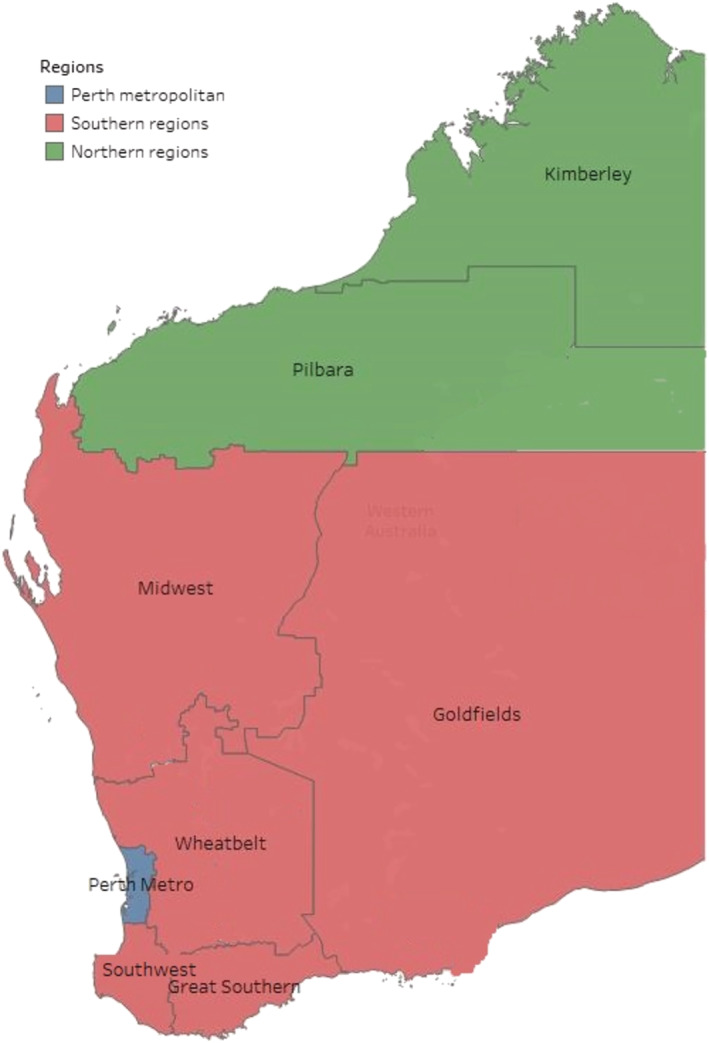
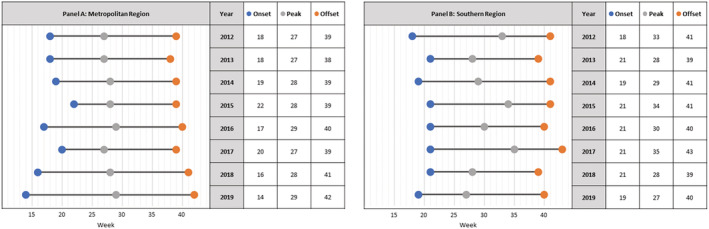
RSV laboratory testing data were collected from January 2012 to December 2019. WA was divided into three regions determined by population density and climate: Metropolitan, Northern and Southern. Season threshold was calculated per region at 1.2% annual cases, with onset the first of ≥2 weeks above this threshold and offset as the last week before ≥2 weeks below.
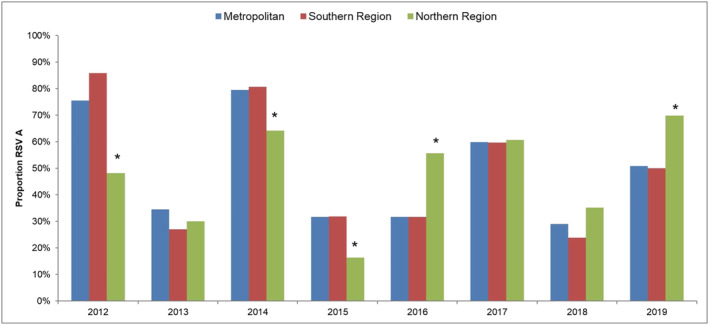
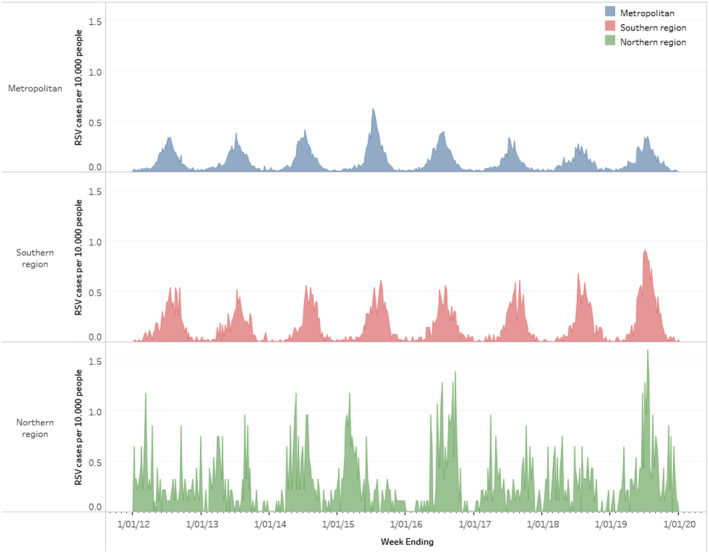
The detection rate of RSV in WA was 6.3/10,000. The Northern region had the highest detection rate (15/10,000), more than 2.5 times the Metropolitan region (detection rate ratio 2.7; 95% CI, 2.6-2.9). Test percentage positive was similar in the Metropolitan (8.6%) and Southern (8.7%) regions, with the lowest in the Northern region (8.1%). RSV seasons in the Metropolitan and Southern regions occurred annually, with a single peak and had consistent timing and intensity. The Northern tropical region did not experience a distinct season. Proportion of RSV A to RSV B in the Northern region differed from the Metropolitan region in 5 of the 8 years studied.
Detection rate of RSV in WA is high, especially in the Northern region, where climate, an expanded at-risk population and increased testing may have contributed to greater numbers. Before the SARS-CoV-2 pandemic, RSV seasonality in WA was consistent in timing and intensity for the Metropolitan and Southern regions.
呼吸道合胞病毒(RSV)的季节性取决于当地气候。我们评估了西澳大利亚州(WA)在 SARS-CoV-2 大流行之前 RSV 季节性的稳定性,该州跨越温带和热带地区。
从 2012 年 1 月至 2019 年 12 月收集了 RSV 实验室检测数据。WA 根据人口密度和气候分为三个区域:都会区、北部和南部。每个区域的季节阈值按每年 1.2%的病例计算,发病时间为高于该阈值的第 2 周的第 1 天,结束时间为低于该阈值的第 2 周之前的最后一周。
WA 中 RSV 的检出率为 6.3/10000。北部地区的检出率最高(15/10000),是都会区的两倍多(检出率比 2.7;95%CI,2.6-2.9)。都会区(8.6%)和南部地区(8.7%)的检测阳性百分比相似,北部地区最低(8.1%)。都会区和南部地区的 RSV 季节每年发生一次,呈单峰型,且时间和强度一致。北部热带地区没有明显的季节。在研究的 8 年中,有 5 年北部地区 RSV A 与 RSV B 的比例与都会区不同。
WA 中 RSV 的检出率较高,尤其是北部地区,气候、扩大的高危人群和增加的检测可能导致数量增加。在 SARS-CoV-2 大流行之前,WA 都会区和南部地区的 RSV 季节性在时间和强度上保持一致。