Kilicaslan Emrah, Yildirim Murat, Sayin Selim, Cevik Erdem, Ayli Meltem, Kaptan Meltem
University of Health Sciences Turkey, Istanbul Sultan 2. Abdulhamid Han Training and Research Hospital, Clinic of Internal Medicine, Department of Hematology, Istanbul, Turkey.
University of Health Sciences Turkey, Gulhane Faculty of Medicine, Department of Internal Medicine, Division of Hematology, Ankara, Turkey.
Medeni Med J. 2023 Mar 28;38(1):63-69. doi: 10.4274/MMJ.galenos.2023.85520.
Standard-dose methyl-prednisolone (methyl-Pd) is generally preferred as the first-line treatment in immune thrombocytopenia (ITP) unless there is an urgent indication to increase the platelet value. A significant proportion of patients (around 40%) does not benefit from this treatment. This study investigated whether pretreatment platelet level and other hemogram indices in patients with ITP patients can be used to predict early response to standard-dose methyl-Pd treatment.
Patients who received first-line standard-dose methyl- Pd therapy with the diagnosis of primary ITP were included. Patients were categorized as complete responder (CR), responder (R), and non-responder (NR) according to the response status obtained within the first 14 days of treatment. The hemogram indices of the CR, R, and NR groups measured at the start of the treatment were compared retrospectively.
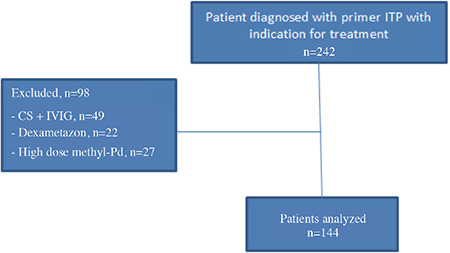
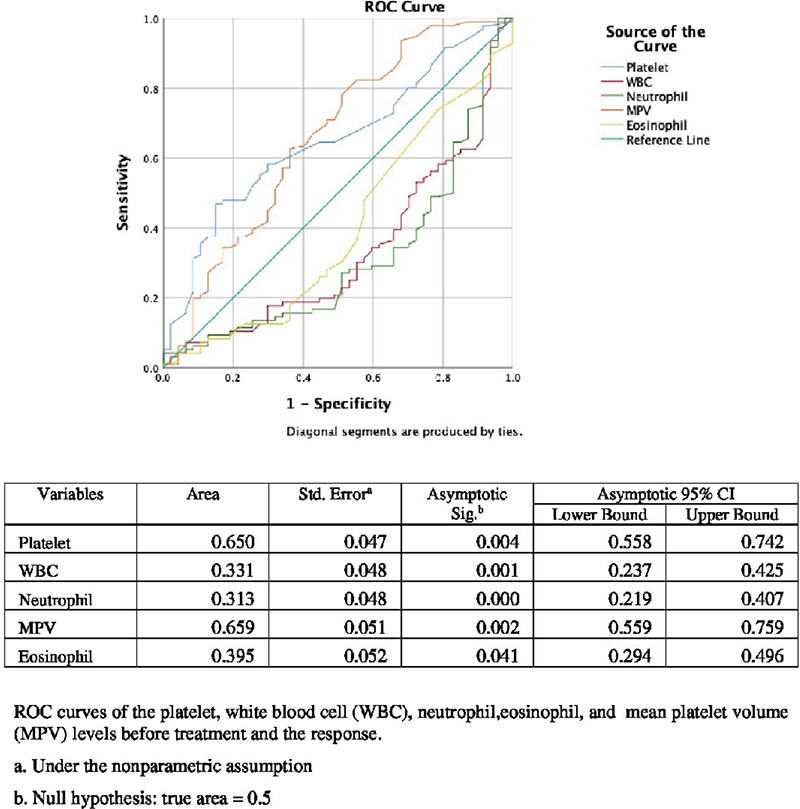
One hundred forty four patients with ITP were included in the study. The number of patients with NR, R, and CR were 47 (33%), 40 (28%), and 57 (39%), respectively. The mean platelet level of the NR group was lower than responders (R and CR groups) (p=0.002 and p=0.049, respectively). The mean platelet volume (MPV) levels of the NR group were statistically lower than that of the CR group (p=0.018). If MPV ≥10 fL and platelet >12,000/mm³, the probability of an early response with methyl-Pd is higher [sensitivity =98.1% (95% confidence interval (CI) =89.7-99.9%), specificity =45% (95% CI =23.1-68.5%), positive predictive value =82.3% (95% CI =75.7-87.4%), negative predictive value =90% (95% CI =54.9-98.5%)].
Patients with ITP with low platelet and MPV levels were less responsive to standard-dose methyl-Pd treatment. It may be more appropriate to apply more effective treatments to these patients other than standard-dose methyl-Pd alone.
在免疫性血小板减少症(ITP)中,除非有紧急指征需要提高血小板值,标准剂量的甲泼尼龙(methyl-Pd)通常被优先用作一线治疗。相当一部分患者(约40%)无法从这种治疗中获益。本研究调查了ITP患者的预处理血小板水平和其他血常规指标是否可用于预测对标准剂量甲泼尼龙治疗的早期反应。
纳入诊断为原发性ITP并接受一线标准剂量甲泼尼龙治疗的患者。根据治疗开始后14天内获得的反应状态,将患者分为完全缓解者(CR)、反应者(R)和无反应者(NR)。回顾性比较治疗开始时CR、R和NR组的血常规指标。
144例ITP患者纳入研究。NR、R和CR患者的数量分别为47例(33%)、40例(28%)和57例(39%)。NR组的平均血小板水平低于反应者(R组和CR组)(分别为p=0.002和p=0.049)。NR组的平均血小板体积(MPV)水平在统计学上低于CR组(p=0.018)。如果MPV≥10 fL且血小板>12,000/mm³,甲泼尼龙早期反应的可能性更高[敏感性=98.1%(95%置信区间(CI)=89.7-99.9%),特异性=45%(95% CI =23.1-68.5%),阳性预测值=82.3%(95% CI =75.7-87.4%),阴性预测值=90%(95% CI =54.9-98.5%)]。
血小板和MPV水平低的ITP患者对标准剂量甲泼尼龙治疗的反应较差。对这些患者应用比单独标准剂量甲泼尼龙更有效的治疗可能更合适。