University of Colorado School of Medicine, Department of Emergency Medicine, Aurora, Colorado.
University of Colorado, Skaggs School of Pharmacy and Pharmaceutical Sciences, Aurora, Colorado.
West J Emerg Med. 2023 Feb 25;24(2):312-321. doi: 10.5811/westjem.2022.11.57981.
Biorepositories lack diversity both demographically and with regard to the clinical complaints of patients enrolled. The Emergency Medicine Specimen Bank (EMSB) seeks to enroll a diverse cohort of patients for discovery research in acute care conditions. Our objective in this study was to determine the differences in demographics and clinical complaints between participants in the EMSB and the overall emergency department (ED) population.
This was a retrospective analysis of participants of the EMSB and the entire UCHealth at University of Colorado Anschutz Medical Center (UCHealth AMC) ED population across three periods: peri-EMSB; post-EMSB; and COVID-19. We compared patients consented to the EMSB to the entire ED population to determine differences in age, gender, ethnicity, race, clinical complaints, and severity of illness. We used chi-square tests to compare categorical variables and the Elixhauser Comorbidity Index to determine differences in the severity of illness between the groups.
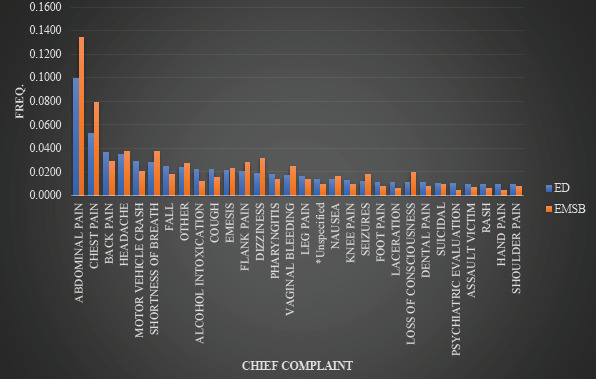
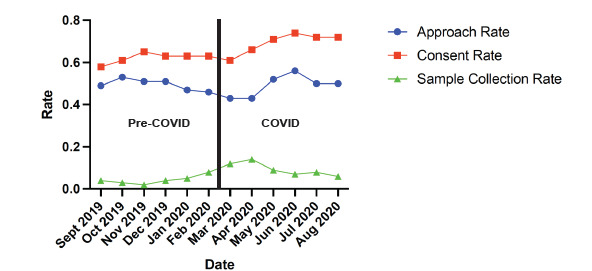
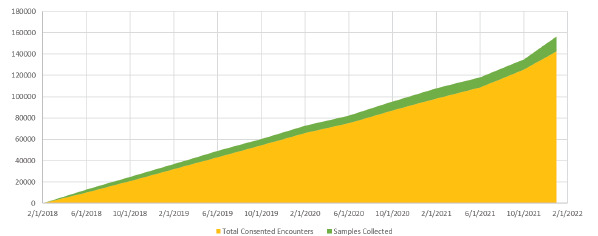
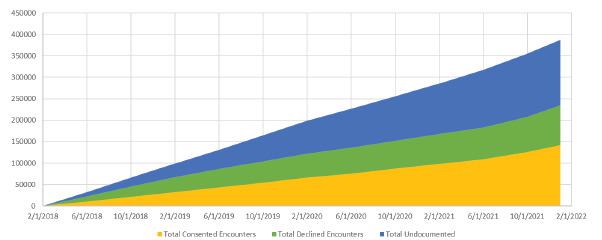
Between February 5, 2018-January 29, 2022, there were 141,670 consented encounters in the EMSB, representing 40,740 unique patients and over 13,000 blood samples collected. In that same time, the ED saw approximately 188,402 unique patients for 387,590 encounters. The EMSB had significantly higher rates of participation from the following: patients 18-59 years old (80.3% vs 77.7%); White patients (52.3% vs 47.8%), and women (54.8% vs 51.1%) compared to the overall ED population. The EMSB had lower rates of participation from patients ≥70 years, Hispanic patients, Asian patients, and men. The EMSB population had higher mean comorbidity scores. During the six months after Colorado's first COVID-19 case, the rate of consented patients and samples collected increased. The odds of consent during the COVID-19 study period were 1.32 (95% CI 1.26-1.39), and the odds of sample capture were 2.19 (95% CI 2.0-2.41).
The EMSB is representative of the overall ED population for most demographics and clinical complaints.
生物库在人口统计学方面以及所纳入患者的临床症状方面都存在多样性缺乏的问题。急诊医学标本库(EMSB)旨在为急性护理条件下的发现研究招募多样化的患者群体。我们在这项研究中的目标是确定 EMSB 参与者与整个急诊部(ED)人群在人口统计学和临床症状方面的差异。
这是对 EMSB 参与者和整个科罗拉多大学安舒茨医疗中心(UCHealth AMC)ED 人群在三个时期内的回顾性分析:EMSB 前;EMSB 后;和 COVID-19 时期。我们将同意参加 EMSB 的患者与整个 ED 人群进行比较,以确定年龄、性别、族裔、种族、临床症状和疾病严重程度方面的差异。我们使用卡方检验比较分类变量,使用 Elixhauser 合并症指数确定两组之间疾病严重程度的差异。
在 2018 年 2 月 5 日至 2022 年 1 月 29 日期间,EMSB 中有 141670 次同意参与,代表 40740 名独特患者和超过 13000 个血液样本的采集。在同一时间内,ED 大约有 188402 名独特患者进行了 387590 次就诊。EMSB 参与者中 18-59 岁的患者比例(80.3%比 77.7%)、白人患者(52.3%比 47.8%)和女性(54.8%比 51.1%)明显高于整个 ED 人群。EMSB 参与者中≥70 岁的患者、西班牙裔患者、亚裔患者和男性的比例较低。EMSB 人群的平均合并症评分较高。在科罗拉多州首例 COVID-19 病例后的六个月内,同意参与的患者和采集的样本数量增加。COVID-19 研究期间同意的几率为 1.32(95%CI 1.26-1.39),样本采集的几率为 2.19(95%CI 2.0-2.41)。
EMSB 在大多数人口统计学和临床症状方面代表了整个 ED 人群。