Emergency Trauma Center, Nanyang Second People's Hospital, No 66, East Jianshe Road, Nanyang473000, Nanyang, 473000, Henan, China.
BMC Musculoskelet Disord. 2023 Mar 28;24(1):236. doi: 10.1186/s12891-023-06362-5.
Many elder patients with hip fractures also suffered from hypertension. This study aims to explore the relationship between the use of ACEI or ARB and the outcomes of geriatric hip fractures.
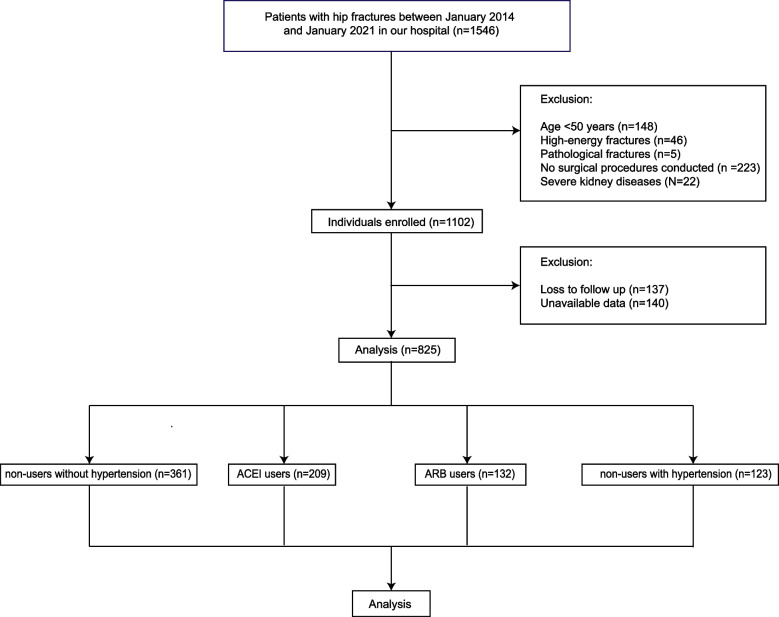
All the patients were divided into four groups: non-users without hypertension, non-users with hypertension, ACEI users, and ARB users. The outcomes of patients in different groups were compared. LASSO regression and univariable Cox analysis were used for variable screening. Then Cox models and Logistics models were established to identify the relationships between the use of RAAS inhibitors and outcomes.
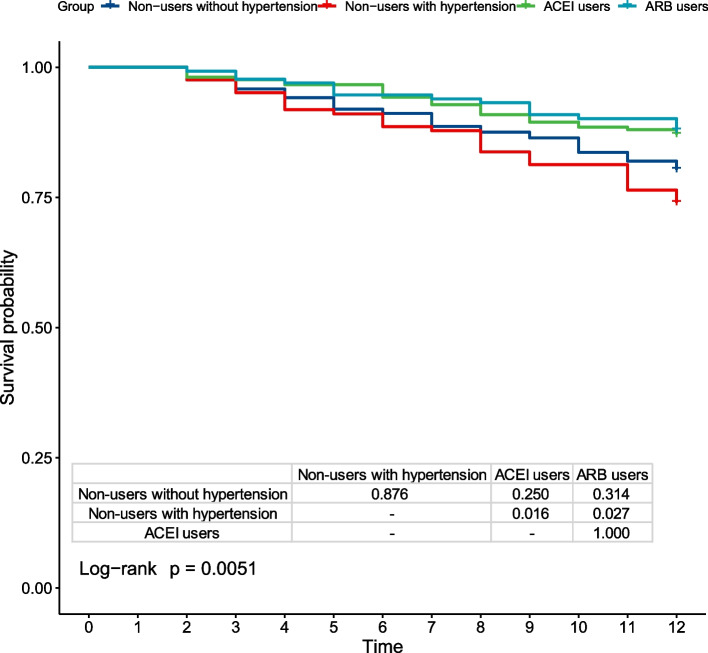
ACER users (p = 0.016) and ARB users (p = 0.027) had a significantly lower survival probability than the non-users with hypertension. Non-users without hypertension, ACEI users, and ARB users may face lower 6-month and 1-year mortalities and higher 6-month and 1-year free walking rates compared with non-users with hypertension.
Patients with the use of ACEI or ARB may face a better prognosis of hip fractures.
许多髋部骨折的老年患者还患有高血压。本研究旨在探讨 ACEI 或 ARB 的使用与老年髋部骨折结局的关系。
所有患者分为四组:无高血压的非使用者、有高血压的非使用者、ACEI 使用者和 ARB 使用者。比较不同组患者的结局。采用 LASSO 回归和单变量 Cox 分析进行变量筛选。然后建立 Cox 模型和 Logistics 模型来确定 RAAS 抑制剂的使用与结局之间的关系。
ACEI 使用者(p=0.016)和 ARB 使用者(p=0.027)的生存率明显低于有高血压的非使用者。与有高血压的非使用者相比,无高血压的非使用者、ACEI 使用者和 ARB 使用者可能面临较低的 6 个月和 1 年死亡率,以及较高的 6 个月和 1 年无行走能力率。
使用 ACEI 或 ARB 的患者可能面临更好的髋部骨折预后。