Kunutsor Setor K, Blom Ashley W, Whitehouse Michael R, Kehoe Patrick G, Laukkanen Jari A
Musculoskeletal Research Unit, School of Clinical Sciences, University of Bristol, Learning and Research Building (Level 1), Southmead Hospital, Southmead Road, Bristol, BS10 5NB, UK.
Dementia Research Group, School of Clinical Sciences, Faculty of Health Sciences, University of Bristol, Learning and Research Building (Level 1), Southmead Hospital, Southmead Road, Bristol, UK.
Eur J Epidemiol. 2017 Nov;32(11):947-959. doi: 10.1007/s10654-017-0285-4. Epub 2017 Jul 27.
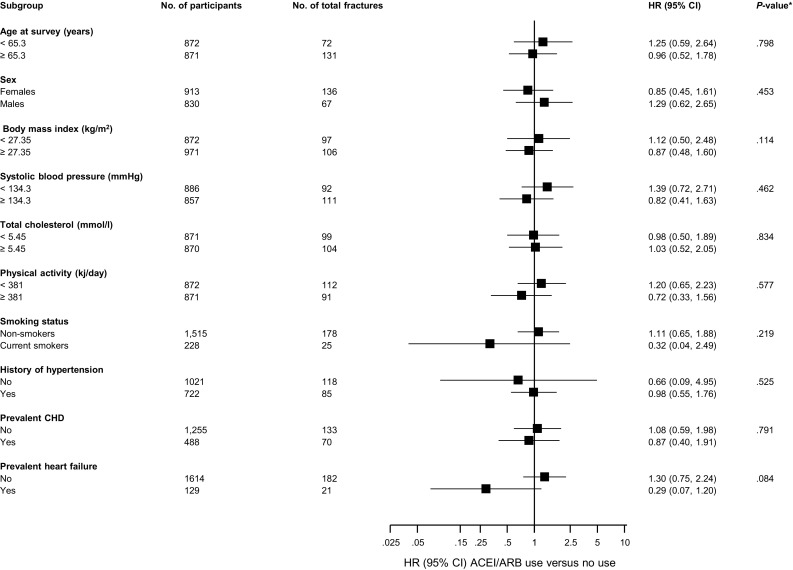
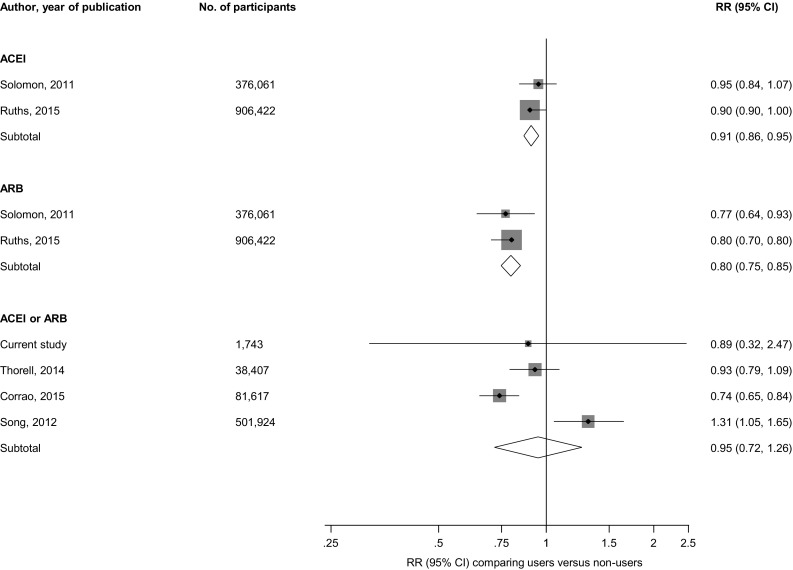
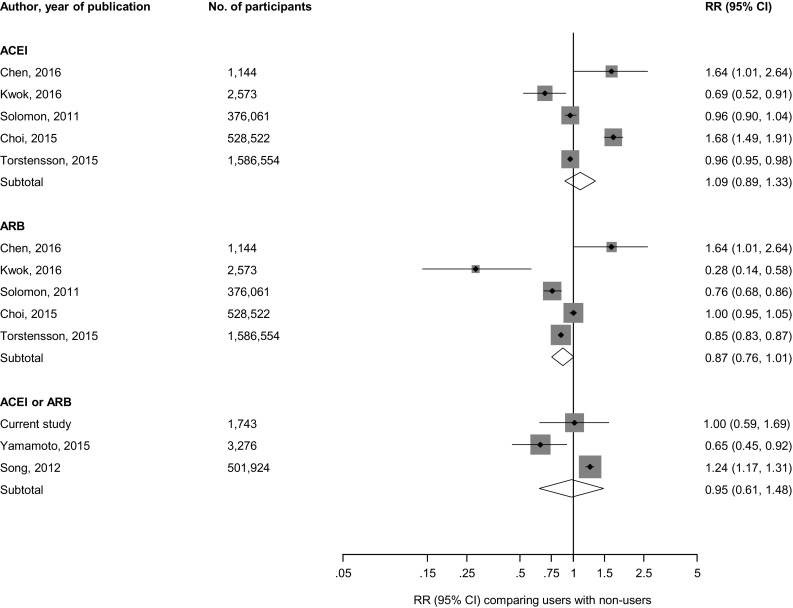
The renin-angiotensin system (RAS) represents an important target of antihypertensive medications. Angiotensin-converting enzyme inhibitors (ACEI) and angiotensin II receptor blockers (ARB), which are widely-used RAS inhibiting drugs, have been suggested to have beneficial effects on bone tissue. We aimed to assess the associations of use of ACEIs and/or ARBs with the risk of fractures using a population-based prospective cohort and a meta-analysis of published prospective cohort studies. Information on antihypertensive medication use (including both ACEIs and ARBs) were assessed in 1743 men and women of the Kuopio Ischemic Heart Disease prospective cohort study. Hazard ratios (HRs) [95% confidence intervals (CI)] of ACEIs or ARBs use with incident fractures were calculated. A total of 203 composite (hip, humeral, and wrist) fractures occurred during a median follow-up of 14.8 years. In multivariate adjusted analysis, the HR for composite fractures comparing users of ACEIs or ARBs with non-users was 1.00 (0.59-1.69). The corresponding adjusted HR for hip fractures comparing users versus non-users of ACEIs or ARBs was 0.89 (0.32-2.47). Including the current study, a total of 11 observational cohort studies involving 3526,319 participants and >323,355 fractures were included in a meta-analysis. Comparing ACEI users with non-users and ARB users with non-users, the HRs for composite fractures were 1.09 (0.89-1.33) and 0.87 (0.76-1.01) respectively. The corresponding HRs for hip fractures were 0.91 (0.86-0.95) and 0.80 (0.75-0.85) respectively. Use of RAS inhibitors was not associated with long-term risk of composite fractures in both primary and pooled analyses. Pooled evidence however suggests a beneficial effect of RAS blockers on hip fracture risk.
肾素-血管紧张素系统(RAS)是抗高血压药物的一个重要靶点。血管紧张素转换酶抑制剂(ACEI)和血管紧张素II受体阻滞剂(ARB)是广泛使用的RAS抑制药物,已被认为对骨组织有有益作用。我们旨在使用基于人群的前瞻性队列研究以及已发表的前瞻性队列研究的荟萃分析,评估使用ACEI和/或ARB与骨折风险之间的关联。在库奥皮奥缺血性心脏病前瞻性队列研究的1743名男性和女性中评估了抗高血压药物使用情况(包括ACEI和ARB)。计算了使用ACEI或ARB与新发骨折的风险比(HR)[95%置信区间(CI)]。在中位随访14.8年期间,共发生了203例复合(髋部、肱骨和腕部)骨折。在多变量调整分析中,将使用ACEI或ARB者与未使用者相比,复合骨折的HR为1.00(0.59 - 1.69)。将使用ACEI或ARB者与未使用者相比,髋部骨折的相应调整后HR为0.89(0.32 - 2.47)。纳入本研究后,一项荟萃分析共纳入了11项观察性队列研究,涉及3526319名参与者和超过323355例骨折。将ACEI使用者与未使用者以及ARB使用者与未使用者相比,复合骨折的HR分别为1.09(0.89 - 1.33)和0.87(0.76 - 1.01)。髋部骨折的相应HR分别为0.91(0.86 - 0.95)和0.80(0.75 - 0.85)。在初级分析和汇总分析中,使用RAS抑制剂均与复合骨折的长期风险无关。然而,汇总证据表明RAS阻滞剂对髋部骨折风险有有益作用。