Davico Chiara, Marcotulli Daniele, Succi Elisa, Canavese Carlotta, Bodea Ancuta F, Pellegrino Mariacristina, Cuffari Enrica, Cudia Valentina F, Svevi Barbara, Amianto Federico, Ricci Federica, Vitiello Benedetto
Section of Child and Adolescent Neuropsychiatry, Department of Public Health and Pediatric Sciences, University of Turin, 10100 Turin, Italy.
Department of Neuroscience, University of Turin, 10100 Turin, Italy.
Children (Basel). 2023 Feb 27;10(3):476. doi: 10.3390/children10030476.
Hospitals can be especially stressful for children with autism spectrum disorder (ASD) due to the communication and social skills deficits, lower capacity to adapt to disruption, and sensory hypersensitivity that are typical of these patients.
This study investigated how health-care professionals (HPs) experienced the clinical care and management of children with ASD undergoing medical testing in a day hospital setting, and assessed the rate of successful completion of laboratory tests and instrumental examinations.
A cross-sectional questionnaire was administered to 45 HPs, inquiring about their experience in obtaining blood and urine tests, ECG, audiometry, and EEG from children with ASD. The clinical sample included 153 consecutively referred children with ASD (74.5% males, mean age 5.6 years) undergoing a medical diagnostic work-up as part of their diagnostic evaluation. The success rate of completing the various assessments was examined.
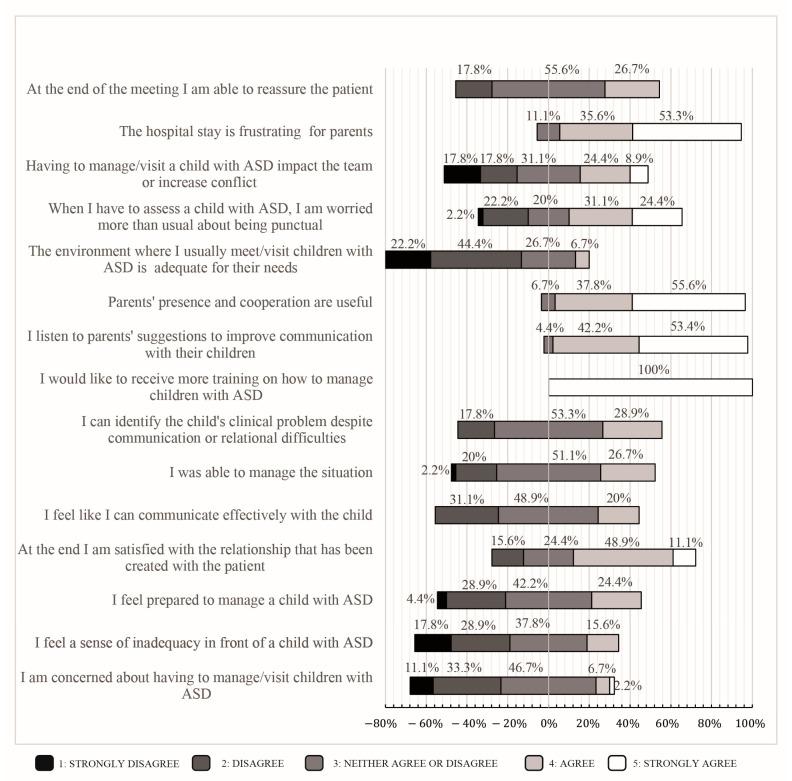
HPs identified aggressive behavior and communication deficits as the major challenges when providing care to children with ASD. The parents were seen as an important resource for managing the children. The completion rate of the laboratory tests and instrumental examinations was high (between 88.5% and 98.4% according to the specific type of examination). The lowest non-completion rate was found for the EEG (12.5%).
Despite considerable challenges being reported by HPs in managing children with ASD, the scheduled assessments could be completed in the large majority of cases. Targeted approaches to preventing aggressive behaviors and obviating the communication barriers in children with ASD undergoing hospital exams are warranted.
由于患有自闭症谱系障碍(ASD)的儿童存在沟通和社交技能缺陷、适应干扰的能力较低以及典型的感觉过敏问题,医院环境对他们来说可能特别有压力。
本研究调查了医护人员(HPs)在日间医院环境中对接受医学检查的ASD儿童进行临床护理和管理的体验,并评估了实验室检查和器械检查的成功完成率。
对45名医护人员进行了一项横断面问卷调查,询问他们从ASD儿童身上获取血液和尿液检查、心电图、听力测定和脑电图的经验。临床样本包括153名连续转诊的ASD儿童(74.5%为男性,平均年龄5.6岁),他们正在接受医学诊断检查,作为其诊断评估的一部分。检查了完成各项评估的成功率。
医护人员认为攻击行为和沟通缺陷是为ASD儿童提供护理时的主要挑战。家长被视为管理儿童的重要资源。实验室检查和器械检查的完成率很高(根据具体检查类型,在88.5%至98.4%之间)。脑电图的未完成率最低(12.5%)。
尽管医护人员在管理ASD儿童方面报告了相当大的挑战,但在大多数情况下,预定的评估仍可完成。有必要采取针对性方法来预防攻击行为,并消除接受医院检查的ASD儿童的沟通障碍。