Xing Yunfei, Fan Jiangao, Wang Hai-Jun, Wang Hui
Department of Maternal and Child Health, School of Public Health, Peking University, Beijing 100191, China.
Department of Gastroenterology, Xinhua Hospital, Shanghai Jiao Tong University School of Medicine, Shanghai 200092, China.
Children (Basel). 2023 Mar 16;10(3):560. doi: 10.3390/children10030560.
BACKGROUND & AIMS: An international panel proposed a diagnostic framework for metabolic-associated fatty liver disease (MAFLD) in children. The aim was to compare the clinical features of MAFLD and nonalcoholic fatty liver disease (NAFLD) in children.
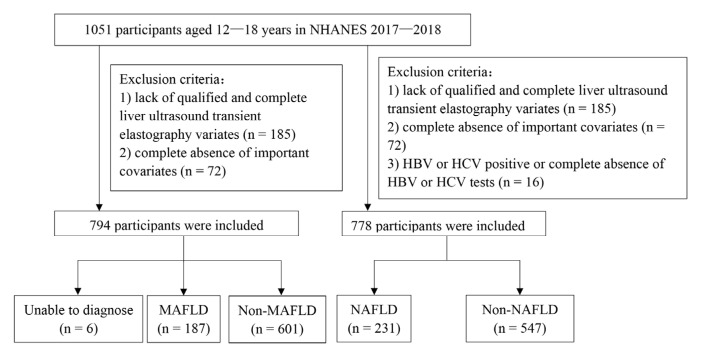
The characteristic differences between NAFLD and MAFLD in children were compared with the National Health and Nutrition Examination Survey (NHANES) 2017-2018 in the U.S. and the Comprehensive Prevention Project for Overweight and Obese Adolescents (CPOOA) study in China.
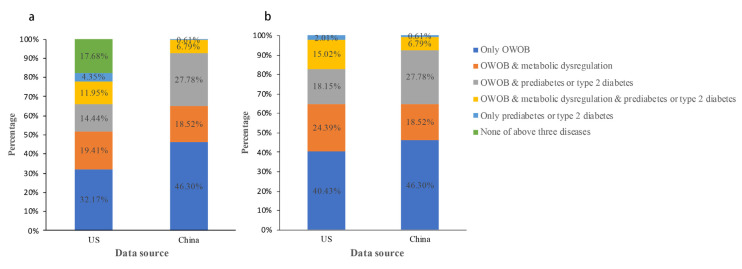
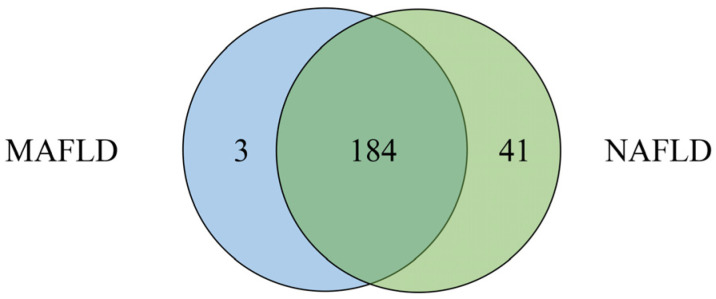
In NHANES 2017-2018, regardless of which criteria were implemented, participants with hepatic steatosis were more likely to have higher BMI z-scores, a higher prevalence of hypertension or higher metabolic indices and higher non-invasive liver fibrosis scores (all < 0.05). The cases diagnosed by those two definitions had a similarity of over 75%. More obese children were diagnosed with MAFLD than NAFLD ( < 0.001). However, approximately 19% of children with NAFLD present with normal weight and fasting glucose levels and cannot be diagnosed with MAFLD. The CPOOA study excluded viral infected liver disease and certain kinds of congenital causes of liver steatosis patients, resulting in children with NAFLD being identical with MAFLD children.
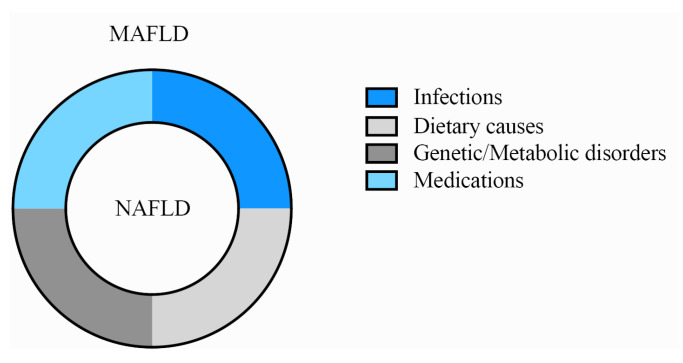
Most clinical features were similar between children with MAFLD and children with NAFLD, and more than 75% of children with NAFLD can also be diagnosed with MAFLD. However, approximately 19% of children with NAFLD cannot be categorized as MAFLD. Therefore, to gain greater benefits from renaming NAFLD to MAFLD in pediatrics, the prevalence of different causes of hepatic steatosis in children needs to be understood.
一个国际专家小组提出了儿童代谢相关脂肪性肝病(MAFLD)的诊断框架。目的是比较儿童MAFLD和非酒精性脂肪性肝病(NAFLD)的临床特征。
将美国2017 - 2018年国家健康与营养检查调查(NHANES)以及中国青少年超重与肥胖综合预防项目(CPOOA)研究中儿童NAFLD和MAFLD的特征差异进行比较。
在2017 - 2018年的NHANES中,无论采用哪种标准,肝脂肪变性的参与者更有可能具有更高的BMI z评分、更高的高血压患病率或更高的代谢指标以及更高的非侵入性肝纤维化评分(均P < 0.05)。由这两种定义诊断出的病例相似度超过75%。被诊断为MAFLD的肥胖儿童比NAFLD更多(P < 0.001)。然而,约19%的NAFLD儿童体重和空腹血糖水平正常,不能被诊断为MAFLD。CPOOA研究排除了病毒感染性肝病和某些先天性肝脂肪变性病因的患者,导致NAFLD儿童与MAFLD儿童相同。
MAFLD儿童和NAFLD儿童的大多数临床特征相似,超过75%的NAFLD儿童也可被诊断为MAFLD。然而,约19%的NAFLD儿童不能归类为MAFLD。因此,为了在儿科将NAFLD重命名为MAFLD中获得更大益处,需要了解儿童肝脂肪变性不同病因的患病率。