Hagino Teppei, Saeki Hidehisa, Fujimoto Eita, Kanda Naoko
Department of Dermatology, Nippon Medical School Chiba Hokusoh Hospital, Inzai 270-1694, Japan.
Department of Dermatology, Nippon Medical School, Tokyo 113-8602, Japan.
J Clin Med. 2023 Mar 12;12(6):2201. doi: 10.3390/jcm12062201.
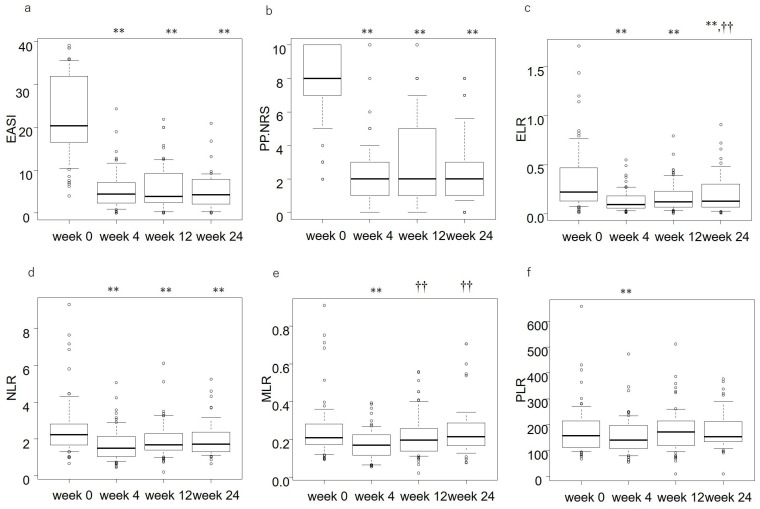
Atopic dermatitis (AD) is a chronic inflammatory skin disease with severe itch. The eosinophil-to-lymphocyte ratio (ELR), neutrophil-to-lymphocyte ratio (NLR), monocyte-to-lymphocyte ratio (MLR), and platelet-to-lymphocyte ratio (PLR) are reported to reflect itch or the severity of AD. We examined if these parameters may act as indicators for therapeutic effects of the Janus kinase 1 inhibitor upadacitinib for patients with AD in real-world clinical practice. Between August 2021 and September 2023, 65 Japanese patients (aged ≥ 12 years) with moderate to severe AD were treated with 15 mg/day of oral upadacitinib, plus twice daily topical corticosteroids. Before treatment, the baseline ELR, NLR, MLR, and PLR levels positively correlated with the eczema area and severity index (EASI), while the baseline NLR and PLR levels positively correlated with the peak pruritus-numerical rating scale (PP-NRS). After upadacitinib treatment, ELR and NLR remarkably decreased at week 4 and the reduced levels were maintained until week 24, in parallel with EASI and PP-NRS, while MLR and PLR transiently reduced at week 4, but returned to baseline levels after week 12. The percent reduction of ELR significantly correlated with the percent reductions of EASI and PP-NRS at weeks 4, 12, and 24 of upadacitinib treatment. ELR may act as an indicator for the improvement of clinical signs and itch by upadacitinib treatment in AD.
特应性皮炎(AD)是一种伴有严重瘙痒的慢性炎症性皮肤病。据报道,嗜酸性粒细胞与淋巴细胞比值(ELR)、中性粒细胞与淋巴细胞比值(NLR)、单核细胞与淋巴细胞比值(MLR)以及血小板与淋巴细胞比值(PLR)可反映AD的瘙痒或严重程度。我们研究了在真实世界临床实践中,这些参数是否可作为Janus激酶1抑制剂乌帕替尼对AD患者治疗效果的指标。在2021年8月至2023年9月期间,65例年龄≥12岁的中度至重度AD日本患者接受了每日15 mg口服乌帕替尼治疗,外加每日两次外用糖皮质激素治疗。治疗前,基线ELR、NLR、MLR和PLR水平与湿疹面积和严重程度指数(EASI)呈正相关,而基线NLR和PLR水平与最高瘙痒数字评定量表(PP-NRS)呈正相关。乌帕替尼治疗后,ELR和NLR在第4周显著下降,且下降水平维持至第24周,与EASI和PP-NRS平行,而MLR和PLR在第4周短暂下降,但在第12周后恢复至基线水平。在乌帕替尼治疗的第4周、第12周和第24周,ELR的降低百分比与EASI和PP-NRS的降低百分比显著相关。ELR可能作为乌帕替尼治疗AD改善临床症状和瘙痒的一个指标。