Schneider Ekaterina, Hopf Dora, Eckstein Monika, Scheele Dirk, Aguilar-Raab Corina, Herpertz Sabine C, Grinevich Valery, Ditzen Beate
Center for Psychosocial Medicine, Institute of Medical Psychology, Heidelberg University Hospital, Bergheimer Str. 20, 69115 Heidelberg, Germany.
Institute of Psychology, Faculty of Behavioral and Cultural Studies, Heidelberg University, 69117 Heidelberg, Germany.
J Clin Med. 2023 Mar 16;12(6):2333. doi: 10.3390/jcm12062333.
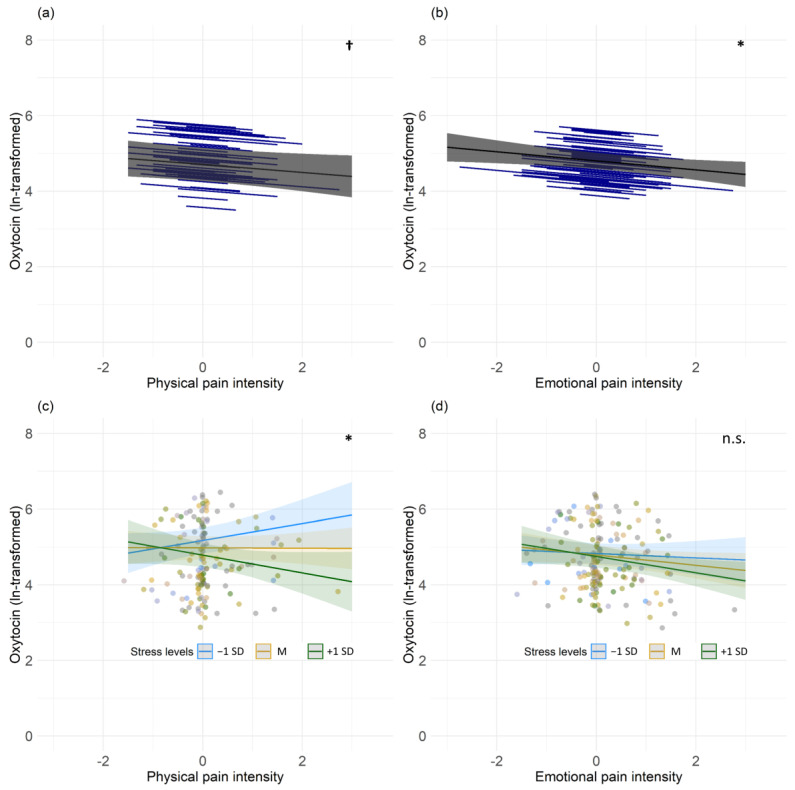
Self-reported pain levels have been associated with increased stress levels during the COVID-19 pandemic. Less is known about the long-term effects of stress on individuals' physical and emotional pain levels and their associations with the neuropeptide hormone oxytocin. We aimed to predict momentary pain through individual stress levels and momentary oxytocin levels at genuinely high-stress phases, namely during COVID-related lockdowns. In a cross-sectional ( = 254) and a longitudinal ( = 196) assessment during lockdowns in Germany, participants completed a 2-day ecological momentary assessment (EMA) protocol (collecting six saliva samples on two consecutive days each and simultaneously reporting on stress, physical, and emotional pain levels) in 2020, as well as one year later, in 2021. Hierarchical linear modeling revealed significant positive associations between individuals' stress levels and physical pain, both cross-sectionally (b = 0.017; t(103) = 3.345; = 0.001) and longitudinally (b = 0.009; t(110) = 2.025; = 0.045). Similarly, subjective stress ratings showed significant positive associations with emotional pain on a within-person (b = 0.014; t(63) = 3.594; < 0.001) as well as on a between-person (b = 0.026; t(122) = 5.191; < 0.001) level. Participants further displayed significantly lower salivary oxytocin when experiencing higher levels of emotional pain (b = -0.120; t(163) = -2.493; = 0.014). In addition, high-stress levels significantly moderated the association between physical pain and salivary oxytocin (b = -0.012; t(32) = -2.150; = 0.039). Based on mechanistic and experimental research, oxytocinergic mechanisms have long been suggested to modulate pain experiences, however, this has not yet been investigated in everyday life. Our data, which was collected from a large sample experiencing continued stress, in this case, during the COVID-19 pandemic, suggests that individuals experience more intense physical pain and elevated stress levels, as shown by particularly low salivary oxytocin concentrations.
自我报告的疼痛水平与新冠疫情期间压力水平的升高有关。关于压力对个体身体和情感疼痛水平的长期影响及其与神经肽激素催产素的关联,我们了解得较少。我们旨在通过个体在真正的高压力阶段(即新冠疫情相关封锁期间)的压力水平和即时催产素水平来预测即时疼痛。在德国封锁期间进行的一项横断面研究(n = 254)和一项纵向研究(n = 196)中,参与者在2020年以及一年后的2021年完成了一项为期2天的生态瞬时评估(EMA)方案(连续两天每天收集6份唾液样本,并同时报告压力、身体和情感疼痛水平)。分层线性模型显示,个体的压力水平与身体疼痛之间存在显著的正相关,无论是横断面研究(b = 0.017;t(103) = 3.345;p = 0.001)还是纵向研究(b = 0.009;t(110) = 2.025;p = 0.045)。同样,主观压力评分在个体内部(b = 0.014;t(63) = 3.594;p < 0.001)以及个体之间(b = 0.026;t(122) = 5.191;p < 0.001)水平上均与情感疼痛呈现出显著的正相关。当经历更高水平的情感疼痛时,参与者的唾液催产素水平也显著降低(b = -0.120;t(163) = -2.493;p = 0.014)。此外,高压力水平显著调节了身体疼痛与唾液催产素之间的关联(b = -0.012;t(32) = -2.150;p = 0.039)。长期以来,基于机制和实验研究,人们一直认为催产素能机制可调节疼痛体验,然而,这一点在日常生活中尚未得到研究。我们的数据是从一个经历持续压力的大样本中收集的,在这种情况下,是在新冠疫情期间,数据表明个体经历了更强烈的身体疼痛和更高的压力水平,唾液催产素浓度特别低就表明了这一点。