Kuroda Pedro Akira Bazaglia, Grandini Carlos Roberto, Afonso Conrado Ramos Moreira
Materials Engineering Department (DEMa), Universidade Federal de São Carlos (UFSCar), São Carlos 13565-905, SP, Brazil.
Laboratório de Anelasticidade e Biomateriais, UNESP-Universidade Estadual Paulista, Bauru 17033-360, SP, Brazil.
Materials (Basel). 2023 Mar 15;16(6):2352. doi: 10.3390/ma16062352.
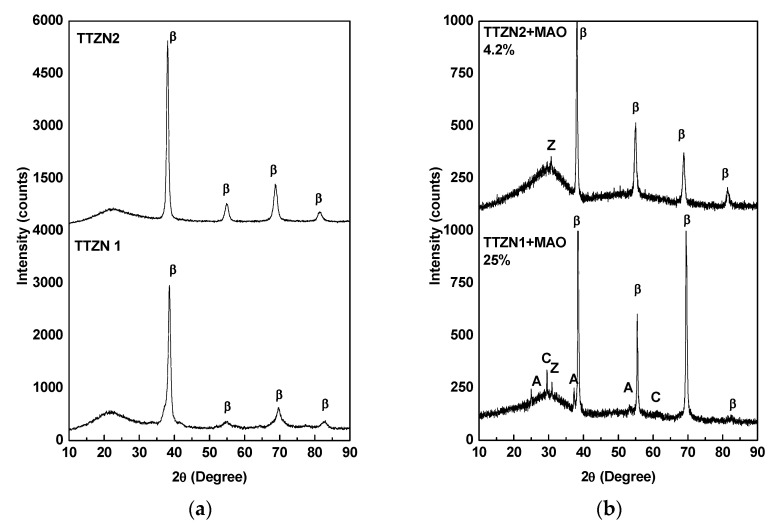
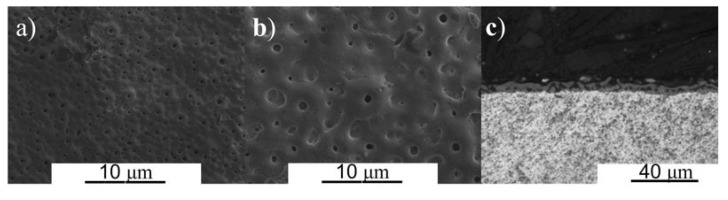
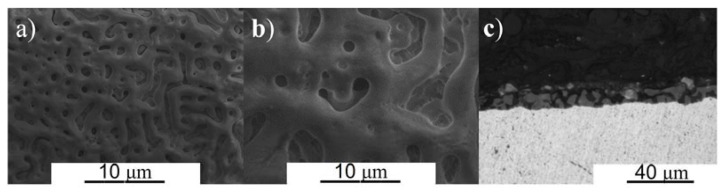
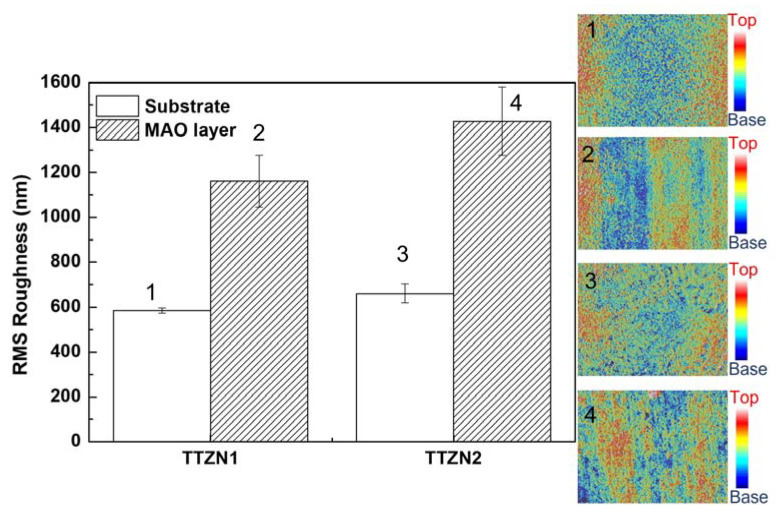
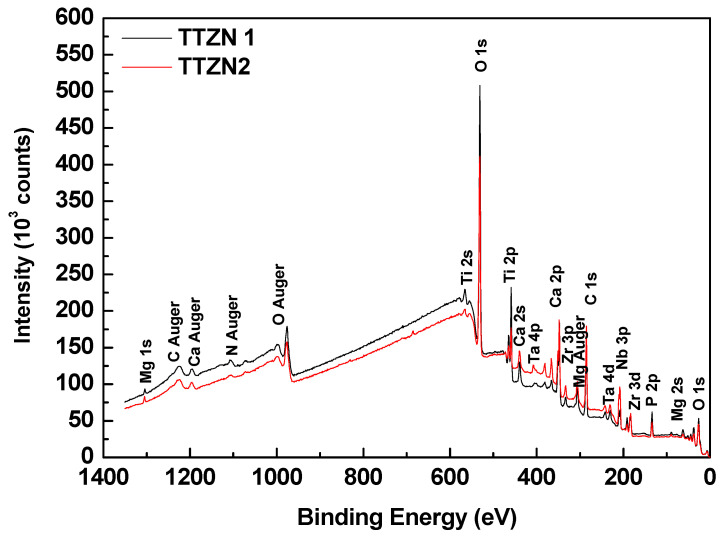
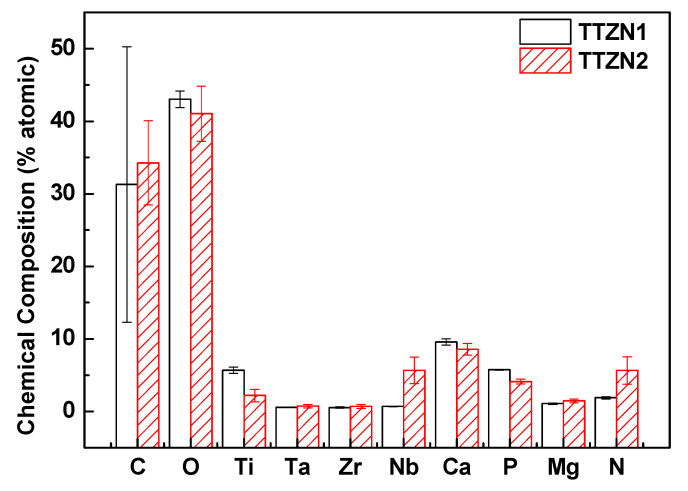
The technique of surface modification using electrolytic oxidation, called micro-arc oxidation (MAO), has been used in altering the surface properties of titanium alloys for biomedical purposes, enhancing their characteristics as an implant (biocompatibility, corrosion, and wear resistance). The layer formed by the micro-arc oxidation process induces the formation of ceramic oxides, which can improve the corrosion resistance of titanium alloys from the elements in the substrate, enabling the incorporation of bioactive components such as calcium, phosphorus, and magnesium. This study aims to modify the surfaces of Ti-25Ta-10Zr-15Nb (TTZN1) and Ti-25Ta-20Zr-30Nb (TTZN2) alloys via micro-arc oxidation incorporating Ca, P, and Mg elements. The chemical composition results indicated that the MAO treatment was effective in incorporating the elements Ca (9.5 ± 0.4 %atm), P (5.7 ± 0.1 %atm), and Mg (1.1 ± 0.1 %atm), as well as the oxidized layer formed by micropores that increases the surface roughness (1160 nm for the MAO layer of TTZN1, 585 nm for the substrate of TTZN1, 1428 nm for the MAO layer of TTZN2, and 661 nm for the substrate of TTZN2). Regarding the phases formed, the films are amorphous, with low crystallinity (4 and 25% for TTZN2 and TTZN1, respectively). Small amounts of anatase, zirconia, and calcium carbonate were detected in the Ti-25Ta-10Zr-15Nb alloy.
采用电解氧化进行表面改性的技术,即微弧氧化(MAO),已被用于改变钛合金的表面性能以用于生物医学目的,增强其作为植入物的特性(生物相容性、耐腐蚀性和耐磨性)。微弧氧化过程形成的层会诱导陶瓷氧化物的形成,这可以提高钛合金对基体中元素的耐腐蚀性,从而能够引入钙、磷和镁等生物活性成分。本研究旨在通过微弧氧化结合钙、磷和镁元素来改性Ti-25Ta-10Zr-15Nb(TTZN1)和Ti-25Ta-20Zr-30Nb(TTZN2)合金的表面。化学成分结果表明,微弧氧化处理有效地引入了钙(9.5±0.4%原子)、磷(5.7±0.1%原子)和镁(1.1±0.1%原子)元素,以及由微孔形成的氧化层,该氧化层增加了表面粗糙度(TTZN1的微弧氧化层为1160纳米,TTZN1的基体为585纳米,TTZN2的微弧氧化层为1428纳米,TTZN2的基体为661纳米)。关于形成的相,薄膜是无定形的,结晶度低(TTZN2和TTZN1分别为4%和25%)。在Ti-25Ta-10Zr-15Nb合金中检测到少量锐钛矿、氧化锆和碳酸钙。