Medical Imaging Center, Department of Radiology, Faculty of Medicine, Semmelweis University, Korányi S. u. 2/A., 1083 Budapest, Hungary.
Department of Internal Medicine and Oncology, Faculty of Medicine, Semmelweis University, Korányi S. u. 2/A., 1083 Budapest, Hungary.
Medicina (Kaunas). 2023 Feb 27;59(3):469. doi: 10.3390/medicina59030469.
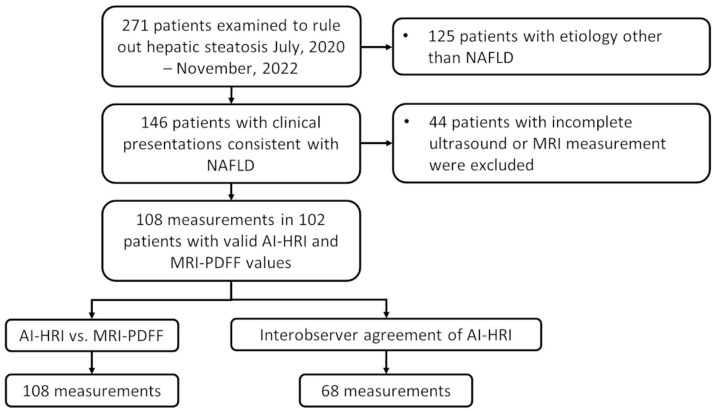
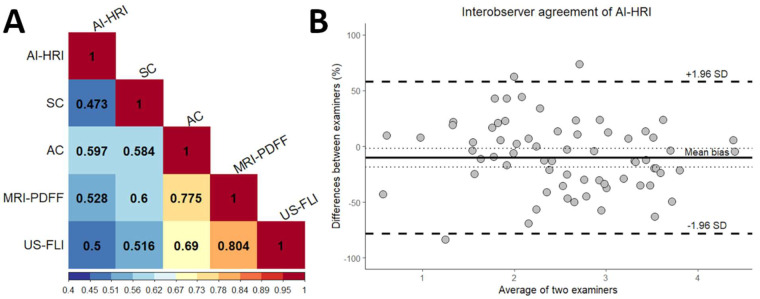
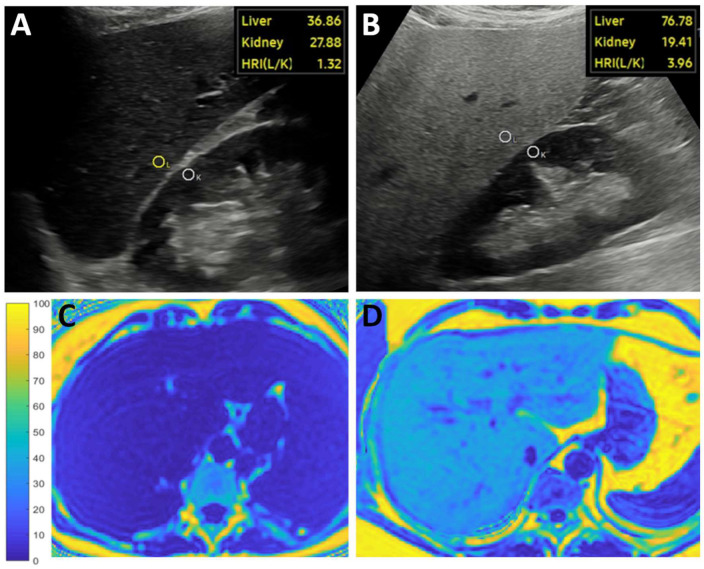
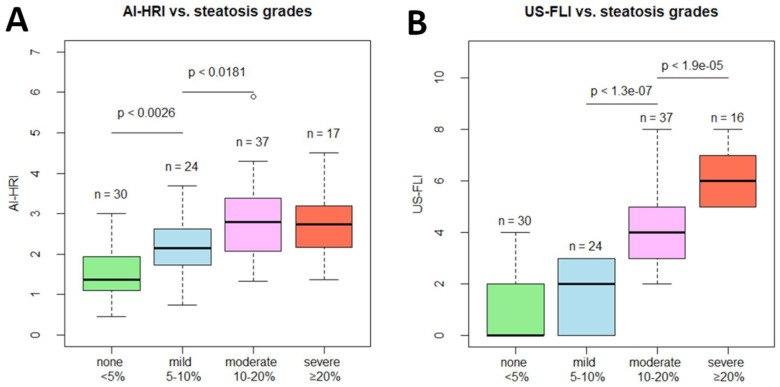
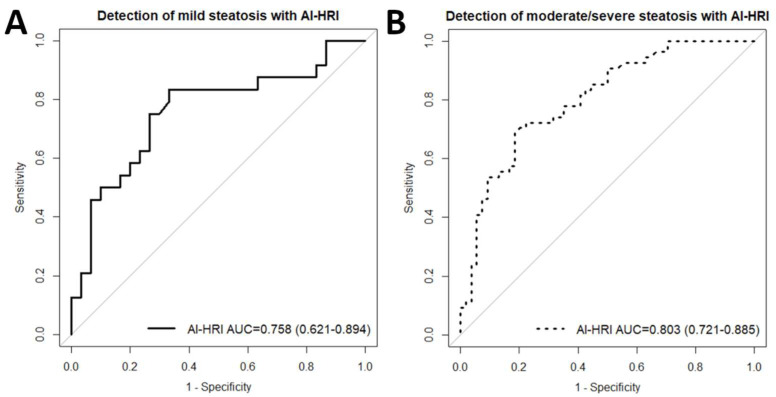
: This study aims to evaluate artificial intelligence-calculated hepatorenal index (AI-HRI) as a diagnostic method for hepatic steatosis. : We prospectively enrolled 102 patients with clinically suspected non-alcoholic fatty liver disease (NAFLD). All patients had a quantitative ultrasound (QUS), including AI-HRI, ultrasound attenuation coefficient (AC,) and ultrasound backscatter-distribution coefficient (SC) measurements. The ultrasonographic fatty liver indicator (US-FLI) score was also calculated. The magnetic resonance imaging fat fraction (MRI-PDFF) was the reference to classify patients into four grades of steatosis: none < 5%, mild 5-10%, moderate 10-20%, and severe ≥ 20%. We compared AI-HRI between steatosis grades and calculated Spearman's correlation (r) between the methods. We determined the agreement between AI-HRI by two examiners using the intraclass correlation coefficient (ICC) of 68 cases. We performed a receiver operating characteristics (ROC) analysis to estimate the area under the curve (AUC) for AI-HRI. : The mean AI-HRI was 2.27 (standard deviation, ±0.96) in the patient cohort. The AI-HRI was significantly different between groups without (1.480 ± 0.607, < 0.003) and with mild steatosis (2.155 ± 0.776), as well as between mild and moderate steatosis (2.777 ± 0.923, < 0.018). AI-HRI showed moderate correlation with AC (r = 0.597), SC (r = 0.473), US-FLI (r = 0.5), and MRI-PDFF (r = 0.528). The agreement in AI-HRI was good between the two examiners (ICC = 0.635, 95% confidence interval (CI) = 0.411-0.774, < 0.001). The AI-HRI could detect mild steatosis (AUC = 0.758, 95% CI = 0.621-0.894) with fair and moderate/severe steatosis (AUC = 0.803, 95% CI = 0.721-0.885) with good accuracy. However, the performance of AI-HRI was not significantly different ( < 0.578) between the two diagnostic tasks. : AI-HRI is an easy-to-use, reproducible, and accurate QUS method for diagnosing mild and moderate hepatic steatosis.
这项研究旨在评估人工智能计算的肝肾功能指数(AI-HRI)作为诊断肝脂肪变性的一种方法。我们前瞻性纳入了 102 例临床疑似非酒精性脂肪性肝病(NAFLD)患者。所有患者均接受定量超声(QUS)检查,包括 AI-HRI、超声衰减系数(AC)和超声背向散射分布系数(SC)测量。还计算了超声脂肪肝指数(US-FLI)评分。磁共振成像脂肪分数(MRI-PDFF)为分类患者为四个脂肪变性等级的参考:无<5%、轻度 5-10%、中度 10-20%和重度≥20%。我们比较了 AI-HRI 在不同脂肪变性等级之间的差异,并计算了方法之间的 Spearman 相关系数(r)。我们使用 68 例患者的组内相关系数(ICC)来确定两名检查者之间 AI-HRI 的一致性。我们进行了受试者工作特征(ROC)分析,以估计 AI-HRI 的曲线下面积(AUC)。患者队列的平均 AI-HRI 为 2.27(标准差±0.96)。AI-HRI 在无(1.480±0.607,<0.003)和轻度脂肪变性组(2.155±0.776)之间以及轻度和中度脂肪变性组(2.777±0.923,<0.018)之间差异有统计学意义。AI-HRI 与 AC(r=0.597)、SC(r=0.473)、US-FLI(r=0.5)和 MRI-PDFF(r=0.528)均呈中度相关。两名检查者之间 AI-HRI 的一致性良好(ICC=0.635,95%置信区间[CI]:0.411-0.774,<0.001)。AI-HRI 可检测轻度脂肪变性(AUC=0.758,95%CI:0.621-0.894),中度/重度脂肪变性的准确性较高(AUC=0.803,95%CI:0.721-0.885)。然而,AI-HRI 在这两项诊断任务中的表现无显著差异(<0.578)。AI-HRI 是一种易于使用、可重复且准确的 QUS 方法,可用于诊断轻度和中度肝脂肪变性。