Department of Endocrinology and Metabolism, The Affiliated Suzhou Hospital of Nanjing Medical University, Suzhou Municipal Hospital, Suzhou, China.
Immun Inflamm Dis. 2023 Mar;11(3):e805. doi: 10.1002/iid3.805.
To explore pro-inflammatory cytokines status in the tear fluid of patients with hyperuricemia and gout and its association with uric acid level.
A total of 58 control subjects, 58 hyperuricemia patients including 40 asymptomatic hyperuricemia and 18 gout participants were recruited in this study. For tear analysis, each patient's tears were collected using capillary action microcaps after stimulation. Tear uric acid levels were measured using chemiluminescence. Tear and serum interleukin-1beta (IL-1β) and tumor necrosis factor-alpha (TNF-α) levels were measured using enzyme-linked immunosorbent assay. The correlation of serum and tear uric acid levels with IL-1β and TNF-α were determined.
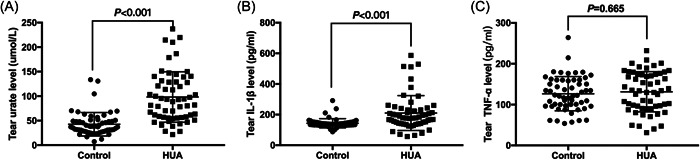
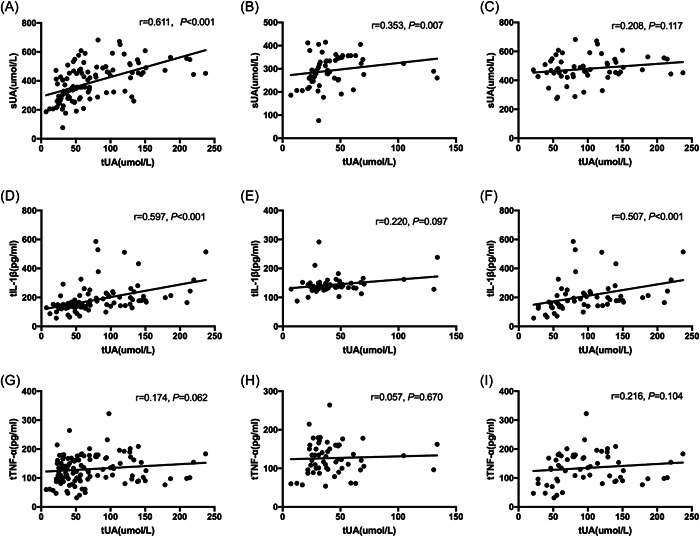
Tear uric acid levels were significantly higher in hyperuricemia group (98.2 ± 51.5 vs. 42.7 ± 24.0 µmol/L, p < .001) than in controls group. IL-1β concentrations were significantly higher in hyperuricemia eyes compared to control eyes (210.2 ± 113.9 vs. 142.6 ± 29.8 pg/mL, p < .001). Multiple linear regression analysis showed that tear uric acid levels were independently positively associated with tear IL-1β concentrations (B = 0.192, p < .001). However, no significant correlations were found between serum or tear uric acid and TNF-α level. Moreover, there were no statistically differences of tear IL-1β and TNF-α levels between the asymptomatic hyperuricemia and gout groups.
Tear uric acid levels were higher in patients with hyperuricemia and gout than in controls. There was a significant positive correlation between tear uric acid value and tear IL-1β level, implying an interaction between hyperuricemia and ocular inflammation responses.
探讨高尿酸血症和痛风患者泪液中促炎细胞因子的状态及其与尿酸水平的关系。
本研究共纳入 58 名对照受试者、58 名高尿酸血症患者,其中包括 40 名无症状高尿酸血症患者和 18 名痛风患者。为了进行泪液分析,每位患者在刺激后使用毛细作用微胶囊收集泪液。使用化学发光法测量泪液尿酸水平。使用酶联免疫吸附试验测量泪液和血清白细胞介素-1β(IL-1β)和肿瘤坏死因子-α(TNF-α)水平。确定血清和泪液尿酸水平与 IL-1β和 TNF-α的相关性。
高尿酸血症组的泪液尿酸水平明显高于对照组(98.2±51.5 vs. 42.7±24.0 μmol/L,p<0.001)。高尿酸血症组的泪液 IL-1β浓度明显高于对照组(210.2±113.9 vs. 142.6±29.8 pg/mL,p<0.001)。多元线性回归分析显示,泪液尿酸水平与泪液 IL-1β浓度呈独立正相关(B=0.192,p<0.001)。然而,血清或泪液尿酸与 TNF-α水平之间没有显著相关性。此外,无症状高尿酸血症和痛风组之间的泪液 IL-1β和 TNF-α水平没有统计学差异。
高尿酸血症和痛风患者的泪液尿酸水平高于对照组。泪液尿酸值与泪液 IL-1β水平呈显著正相关,提示高尿酸血症与眼部炎症反应之间存在相互作用。