Department of Social and Policy Sciences, University of Bath, Bath, UK.
Department of Social and Policy Sciences, University of Bath, Bath, UK
BMJ Open. 2023 Mar 29;13(3):e061591. doi: 10.1136/bmjopen-2022-061591.
To examine the characteristics of pharmaceutical payments to healthcare and patient organisations in the four UK countries. Compare companies spending the most; types of organisations receiving payments and types of payments in the four countries. Measure the extent to which companies target payments at the same recipients in each country and whether it differs depending on the type of recipient.
Cross-sectional comparative and social network analysis.
England, Scotland, Wales, Northern Ireland.
100 donors (pharmaceutical companies) reporting payments to 4229 recipients (healthcare organisations and patient organisations) in 2015.
For each country: payment totals and distribution; average number of common recipients between companies; share of payments to organisations fulfilling different roles in the health ecosystem and payments for different activities.
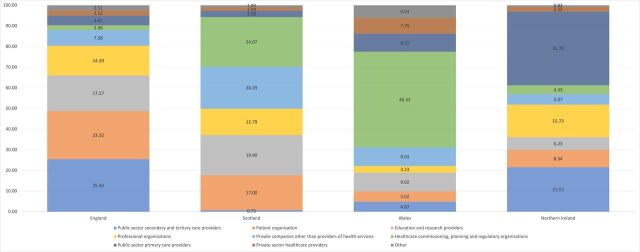
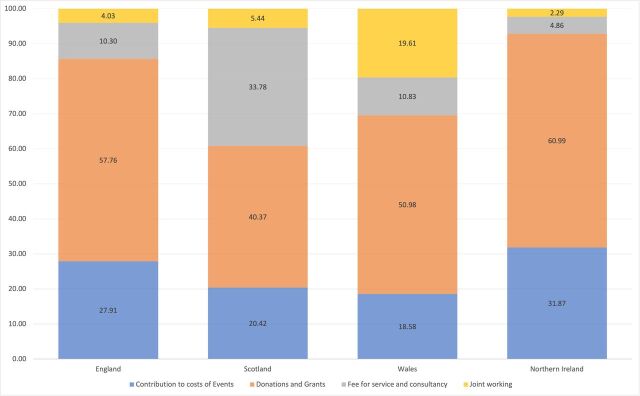
Companies prioritised different types of recipient and different types of activity in each country. There were significant differences in the distribution of payments across the four countries, even for similar types of recipients. Recipients in England and Wales received smaller individual payments than in Scotland and Northern Ireland. Overall, targeting shared recipients occurred most frequently in England, but was also common in certain pockets of each country's health ecosystem. We found evidence of reporting errors in Disclosure UK.
Our findings suggest a strategic approach to payments tailored to countries' policy and decision-making context, indicating there may be specific vulnerabilities to financial conflicts of interest at subnational level. Payment differences between countries may be occurring in other countries, particularly those with decentralised health systems and/or high levels of independence across its decision-making authorities. We call for a single database containing all recipient types, full location details and published with associated descriptive and network statistics.
考察英国四个国家向医疗保健和患者组织支付药品款项的特点。比较支出最多的公司;接受付款的组织类型和四个国家的付款类型。衡量公司在每个国家向相同的受款人定向支付的程度,以及这是否因受款人的类型而异。
横断面比较和社会网络分析。
英格兰、苏格兰、威尔士、北爱尔兰。
100 家(制药公司)报告 2015 年向 4229 家(医疗保健组织和患者组织)受款人支付款项。
每个国家:付款总额和分布;公司之间的共同受款人平均数量;在不同的国家,满足不同角色的组织和不同活动的组织的付款比例。
公司在每个国家都优先考虑不同类型的受款人和不同类型的活动。即使是类似的受款人,四个国家的付款分布也存在显著差异。英格兰和威尔士的受款人收到的个人付款少于苏格兰和北爱尔兰。总体而言,在英格兰,针对共同受款人的目标定位最常见,但在每个国家的卫生生态系统的某些领域也很常见。我们在披露英国发现了报告错误的证据。
我们的研究结果表明,付款策略是根据国家的政策和决策背景量身定制的,这表明在国家以下一级可能存在财务利益冲突的具体弱点。国家之间的付款差异可能在其他国家也存在,特别是那些具有分散的卫生系统和/或其决策机构高度独立的国家。我们呼吁建立一个包含所有受款人类型、完整位置详细信息并附有相关描述性和网络统计信息的单一数据库。