Department of Health Policy, The London School of Economics and Political Science, London, UK
Department of Health Policy, The London School of Economics and Political Science, London, UK.
BMJ Open. 2023 Jun 27;13(6):e071138. doi: 10.1136/bmjopen-2022-071138.
To assess the relationship between UK-based patient organisation funding and companies' commercial interests in rare and non-rare diseases in 2020.
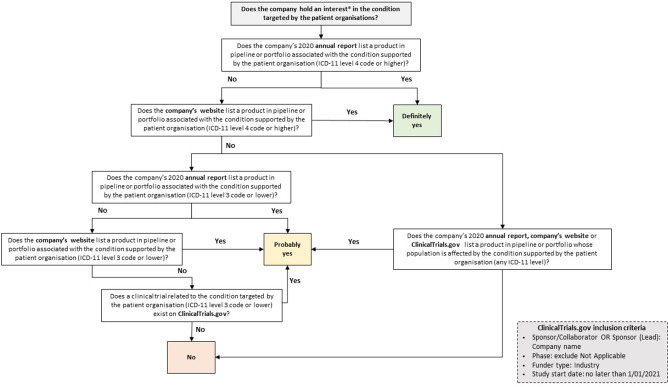
Retrospective analysis of the value and volume of payments from pharmaceutical companies to patient organisations in the UK matched with data on the conditions supported by patient organisations and drugs in companies' approved portfolios and research and development pipelines.
UK.
74 pharmaceutical companies making payments to 341 UK-based patient organisations.
Alignment between the commercial interests of pharmaceutical companies and the disease area focus of patient organisations; difference in the volume and value of payments to patient organisations broken down by prevalence of conditions; industry funding concentration, measured as the number of companies funding each patient organisation, the share of overall industry funding coming from each contributing company and the share of industry funding of each organisation comprised by the single highest payments.
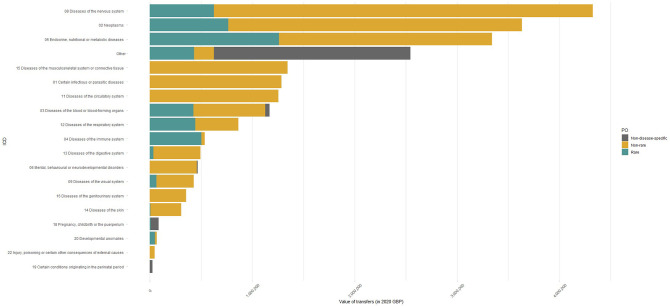
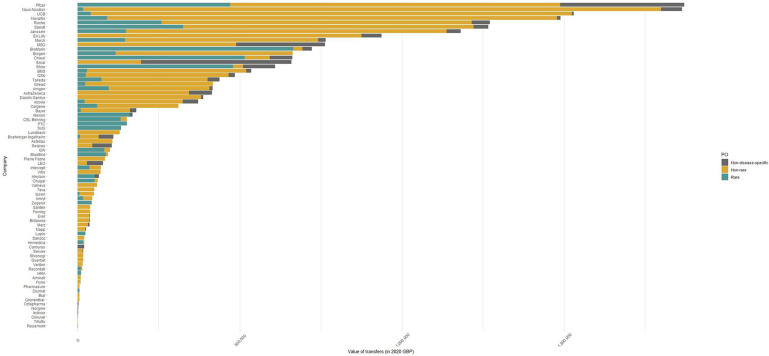
1422 payments were made by 74 companies to 341 patient organisations. Almost all funds (90%) from pharmaceutical companies were directed to patient organisations that are aligned with companies' approved drug portfolios and research and development pipelines. Despite rare diseases affecting less than 5% of the UK population, more than 20% of all payments were directed to patient organisations which target such conditions. Patient organisations focusing on rare diseases relied on payments from fewer companies (p value=0.0031) compared to organisations focusing on non-rare diseases.
Companies predominantly funded patient organisations operating in therapeutic areas relevant to companies' portfolio or drug development pipeline. Patient organisations focusing on rare diseases received more funding relative to the number of patients affected by these conditions and relied more heavily on payments from fewer companies compared to organisations targeting non-rare diseases. Increased independence of patient organisations could help avoid conflicts of interest.
评估 2020 年英国患者组织资金与公司在罕见病和非罕见病领域商业利益之间的关系。
对制药公司向英国患者组织支付的款项价值和数量进行回顾性分析,并将其与患者组织所支持的条件以及公司批准的产品组合、研发管道中的药物数据相匹配。
英国。
向 341 家英国患者组织支付款项的 74 家制药公司。
制药公司的商业利益与患者组织疾病重点领域之间的一致性;按疾病流行程度划分的向患者组织支付款项的数量和价值差异;衡量行业资金集中程度的指标,包括为每个患者组织提供资金的公司数量、每家捐款公司提供的总行业资金份额以及每个组织的行业资金构成中最高支付款项的份额。
74 家公司向 341 家患者组织支付了 1422 笔款项。制药公司的几乎所有资金(90%)都流向了与公司批准药物组合和研发管道一致的患者组织。尽管罕见病影响不到英国人口的 5%,但超过 20%的款项都流向了针对这些疾病的患者组织。与专注于非罕见病的组织相比,专注于罕见病的患者组织依赖于较少的公司提供资金(p 值=0.0031)。
公司主要为在与公司产品组合或药物开发管道相关的治疗领域运作的患者组织提供资金。与受这些疾病影响的患者人数相比,专注于罕见病的患者组织获得了更多的资金,并且与专注于非罕见病的组织相比,它们更依赖于少数几家公司的资金。增加患者组织的独立性有助于避免利益冲突。