Centre of Distance and Online Education, Bharathidasan University, Tiruchirappalli 620024, India.
Cardiff School of Technologies, Cardiff Metropolitan University, Cardiff CF5 2YB, UK.
Sensors (Basel). 2023 Mar 13;23(6):3062. doi: 10.3390/s23063062.
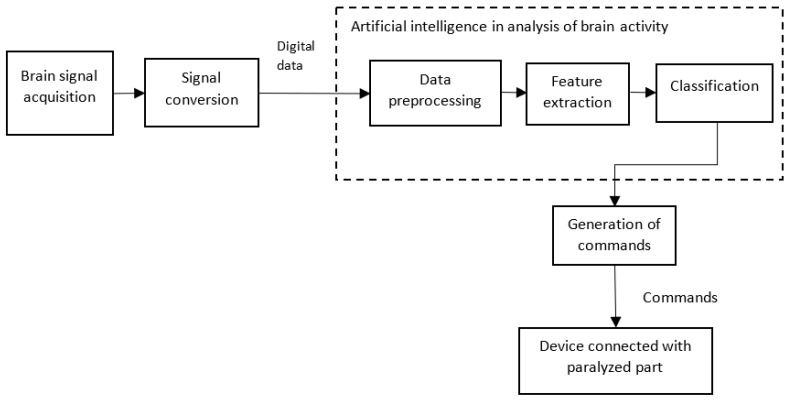
Artificial intelligence (AI) is a field of computer science that deals with the simulation of human intelligence using machines so that such machines gain problem-solving and decision-making capabilities similar to that of the human brain. Neuroscience is the scientific study of the struczture and cognitive functions of the brain. Neuroscience and AI are mutually interrelated. These two fields help each other in their advancements. The theory of neuroscience has brought many distinct improvisations into the AI field. The biological neural network has led to the realization of complex deep neural network architectures that are used to develop versatile applications, such as text processing, speech recognition, object detection, etc. Additionally, neuroscience helps to validate the existing AI-based models. Reinforcement learning in humans and animals has inspired computer scientists to develop algorithms for reinforcement learning in artificial systems, which enables those systems to learn complex strategies without explicit instruction. Such learning helps in building complex applications, like robot-based surgery, autonomous vehicles, gaming applications, etc. In turn, with its ability to intelligently analyze complex data and extract hidden patterns, AI fits as a perfect choice for analyzing neuroscience data that are very complex. Large-scale AI-based simulations help neuroscientists test their hypotheses. Through an interface with the brain, an AI-based system can extract the brain signals and commands that are generated according to the signals. These commands are fed into devices, such as a robotic arm, which helps in the movement of paralyzed muscles or other human parts. AI has several use cases in analyzing neuroimaging data and reducing the workload of radiologists. The study of neuroscience helps in the early detection and diagnosis of neurological disorders. In the same way, AI can effectively be applied to the prediction and detection of neurological disorders. Thus, in this paper, a scoping review has been carried out on the mutual relationship between AI and neuroscience, emphasizing the convergence between AI and neuroscience in order to detect and predict various neurological disorders.
人工智能(AI)是计算机科学的一个领域,它使用机器模拟人类智能,使这些机器获得类似于人脑的问题解决和决策能力。神经科学是研究大脑结构和认知功能的科学。神经科学和人工智能是相互关联的。这两个领域在各自的发展中相互帮助。神经科学理论为人工智能领域带来了许多显著的改进。生物神经网络导致了复杂的深度神经网络架构的实现,这些架构被用于开发各种应用,如文本处理、语音识别、目标检测等。此外,神经科学有助于验证现有的基于 AI 的模型。人类和动物的强化学习启发了计算机科学家开发用于人工系统强化学习的算法,这使得这些系统能够在没有明确指导的情况下学习复杂策略。这种学习有助于构建复杂的应用程序,如基于机器人的手术、自动驾驶汽车、游戏应用程序等。反过来,人工智能凭借其智能分析复杂数据和提取隐藏模式的能力,成为分析非常复杂的神经科学数据的完美选择。基于人工智能的大规模模拟有助于神经科学家检验他们的假设。通过与大脑的接口,基于人工智能的系统可以提取根据信号生成的大脑信号和命令。这些命令被输入到设备中,如机械臂,帮助瘫痪的肌肉或其他人体部位运动。人工智能在分析神经影像学数据和减轻放射科医生的工作量方面有几个用例。神经科学的研究有助于早期发现和诊断神经疾病。同样,人工智能可以有效地应用于神经疾病的预测和检测。因此,本文对人工智能和神经科学之间的相互关系进行了范围界定综述,强调了人工智能和神经科学之间的融合,以便检测和预测各种神经疾病。