Boufidou Fotini, Hatziantoniou Sophia, Theodoridou Kalliopi, Maltezou Helena C, Vasileiou Konstantinos, Anastassopoulou Cleo, Medić Snežana, Tsakris Athanasios
Neurochemistry and Biological Markers Unit, 1st Department of Neurology, Eginition Hospital, School of Medicine, National and Kapodistrian University of Athens, 11528 Athens, Greece.
Laboratory of Pharmaceutical Technology, Department of Pharmacy, School of Health Sciences, University of Patras, 26504 Patras, Greece.
Vaccines (Basel). 2023 Mar 8;11(3):613. doi: 10.3390/vaccines11030613.
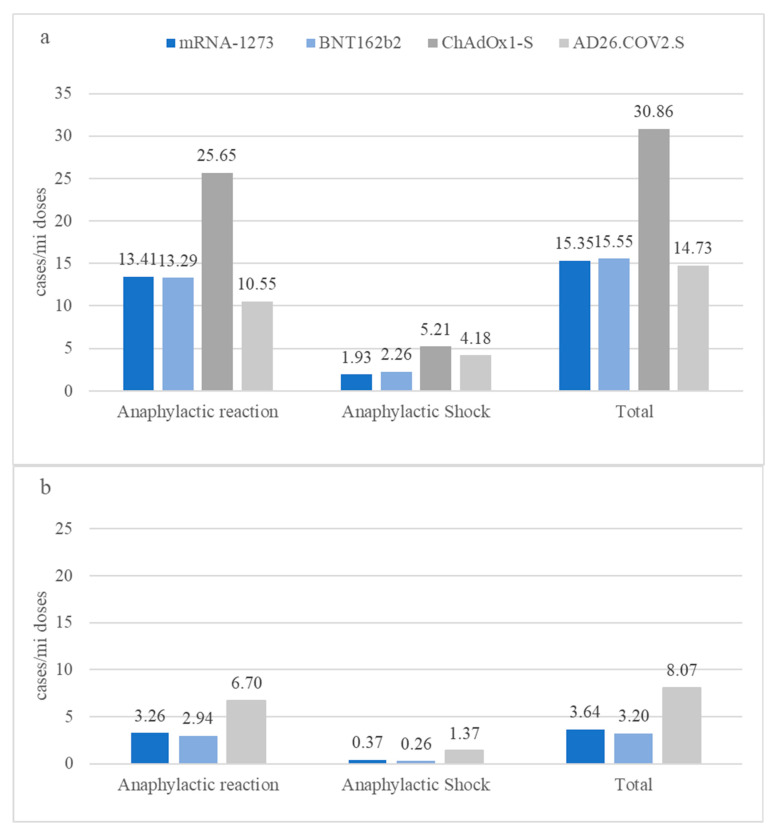
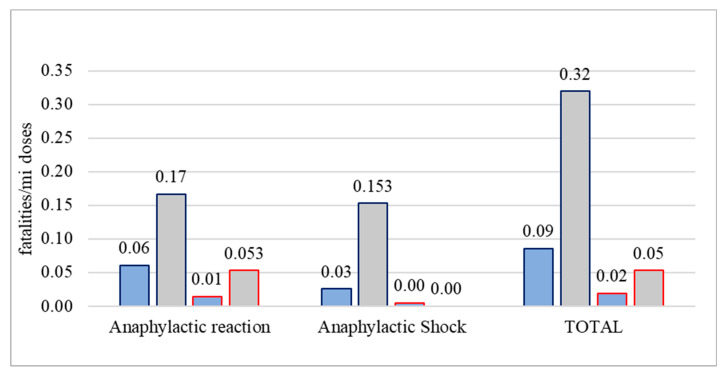
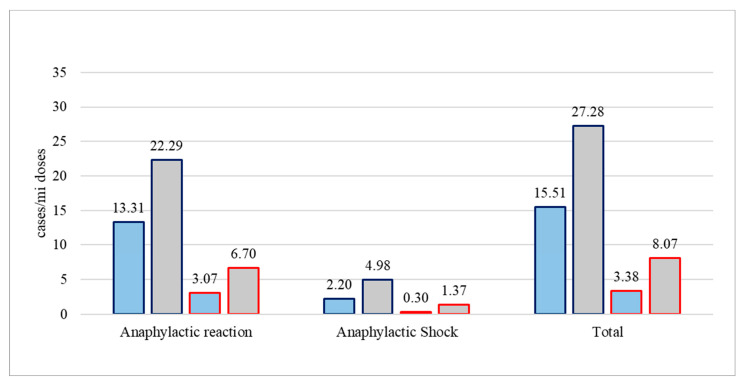
This study aimed at producing an updated assessment of the incidence of anaphylaxis associated with COVID-19 vaccines based on pharmacovigilance data. Anaphylactic reaction and anaphylactic shock data post-COVID-19-vaccination reported from week 52, 2020 to week 1 or week 2, 2023 were collected from the VAERS and EudraVigilance databases, respectively, and analyzed comparatively. Incidence rates were calculated using the corresponding administered vaccine doses as denominators for all licensed vaccines and both platform types (mRNA or vectored). The latest data from the present analysis showed lower anaphylaxis incidence associated with COVID-19 vaccination compared to previous estimates from week 52, 2020 to week 39, 2021 (anaphylactic reaction: 8.96 (95% CI 8.80-9.11)/million doses overall (EEA: 14.19 (95% CI 13.92-14.47)/million/US: 3.17 (95% CI 3.03-3.31)/million); anaphylactic shock: 1.46 (95% CI 1.39-1.52)/million doses overall (EEA: 2.47 (95% CI 2.36-2.58)/million/US: 0.33 (95% CI 0.29-0.38)/million)). Incidence rates varied by vaccine and were higher as captured in EudraVigilance compared to the VAERS and for vectored compared to mRNA vaccines. Most reported cases had a favorable outcome. The extremely rare fatalities (overall rates across continents 0.04 (95% CI 0.03-0.06)/million doses for anaphylactic reaction and 0.02 (95% CI 0.01-0.03)/million vaccine doses for anaphylactic shock) were also associated with vector-rather than mRNA-based vaccines. The diminished incidence of anaphylaxis post-vaccination with COVID-19 vaccines offers assurance about their safety, as does the continuous potential adverse events monitoring through specialized pharmacovigilance databases.
本研究旨在根据药物警戒数据,对与新冠疫苗相关的过敏反应发生率进行最新评估。分别从疫苗不良事件报告系统(VAERS)和欧洲药物警戒数据库(EudraVigilance)收集2020年第52周(即12月13日)至2023年第1周或第2周报告的新冠疫苗接种后过敏反应和过敏性休克数据,并进行比较分析。使用相应的接种疫苗剂量作为所有已获许可疫苗及两种平台类型(信使核糖核酸疫苗或载体疫苗)的分母来计算发病率。本次分析的最新数据显示,与2020年第52周(即12月13日)至2021年第39周(即9月25日)的先前估计相比,新冠疫苗接种相关的过敏反应发生率有所降低(过敏反应:总体为8.96(95%置信区间8.80 - 9.11)/百万剂(欧洲经济区:14.19(95%置信区间13.92 - 14.47)/百万剂/美国:3.17(95%置信区间3.03 - 3.31)/百万剂);过敏性休克:总体为1.46(95%置信区间1.39 - 1.52)/百万剂(欧洲经济区:2.47(95%置信区间2.36 - 2.58)/百万剂/美国:0.33(95%置信区间0.29 - 0.38)/百万剂))。发病率因疫苗而异,与VAERS相比,EudraVigilance记录的发病率更高,与信使核糖核酸疫苗相比,载体疫苗的发病率更高。大多数报告病例预后良好。极为罕见的死亡病例(各大洲过敏反应总体发生率为0.04(95%置信区间0.03 - 0.06)/百万剂,过敏性休克为0.02(95%置信区间0.01 - 0.03)/百万剂)也与载体疫苗而非信使核糖核酸疫苗相关。新冠疫苗接种后过敏反应发生率降低,这为其安全性提供了保证,通过专门的药物警戒数据库持续监测潜在不良事件也是如此。