Tjan-Heijnen Vivianne C G, Lammers Senna W M, Geurts Sandra M E, Vriens Ingeborg J H, Swinkels Astrid C P, Smorenburg Carolien H, van der Sangen Maurice J C, Kroep Judith R, de Graaf Hiltje, Honkoop Aafke H, Erdkamp Frans L G, de Roos Wilfred K, Linn Sabine C, Imholz Alexander L T
Department of Medical Oncology, Maastricht University Medical Centre, GROW, Maastricht University, Maastricht, the Netherlands.
Clinical Research Department, Netherlands Comprehensive Cancer Organisation (IKNL), Nijmegen, the Netherlands.
EClinicalMedicine. 2023 Mar 20;58:101901. doi: 10.1016/j.eclinm.2023.101901. eCollection 2023 Apr.
The DATA study evaluated the use of two different durations of anastrozole in patients with hormone receptor-positive breast cancer who were disease-free after 2-3 years of tamoxifen. We hereby present the follow-up analysis, which was performed after all patients reached a minimum follow-up of 10 years beyond treatment divergence.
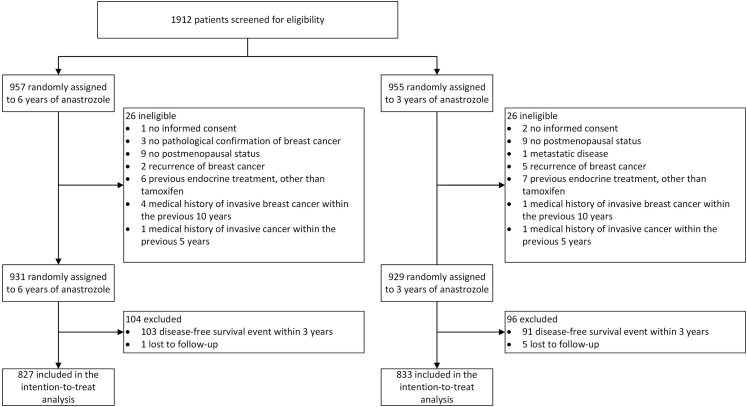
The open-label, randomised, phase 3 DATA study was performed in 79 hospitals in the Netherlands (ClinicalTrials.gov, number NCT00301457). Postmenopausal women with hormone receptor-positive breast cancer who were disease-free after 2-3 years of adjuvant tamoxifen treatment were assigned to either 3 or 6 years of anastrozole (1 mg orally once a day). Randomisation (1:1) was stratified by hormone receptor status, nodal status, HER2 status, and prior tamoxifen duration. The primary outcome was adapted disease-free survival, defined as disease-free survival from 3 years after randomisation onwards. Adapted overall survival was assessed as a secondary outcome. Analyses were performed according to the intention-to-treat design.
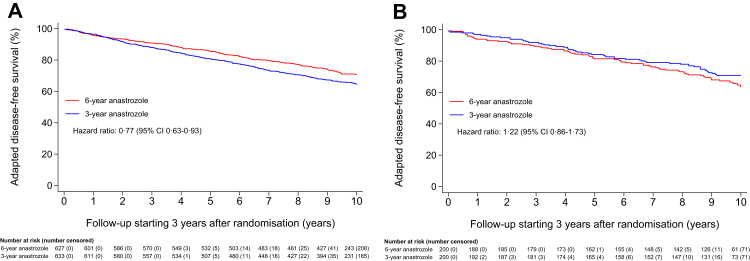
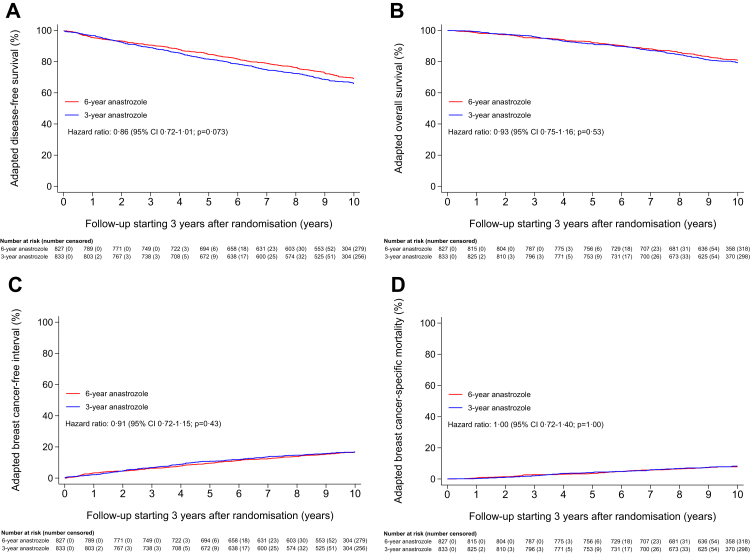
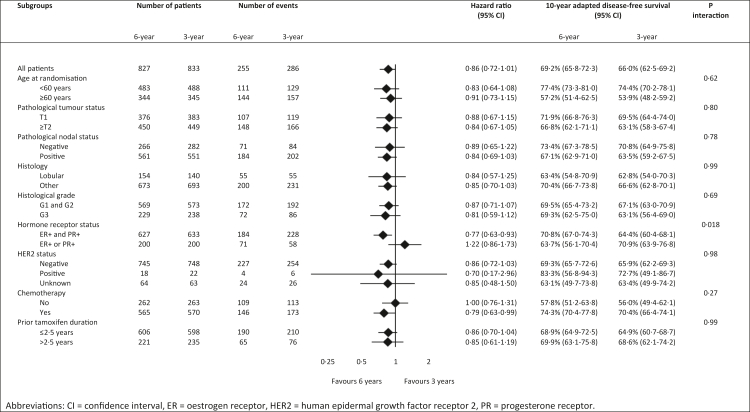
Between June 28, 2006, and August 10, 2009, 1912 patients were randomly assigned to 3 years (n = 955) or 6 years (n = 957) of anastrozole. Of these, 1660 patients were eligible and disease-free at 3 years after randomisation. The 10-year adapted disease-free survival was 69.2% (95% CI 55.8-72.3) in the 6-year group (n = 827) and 66.0% (95% CI 62.5-69.2) in the 3-year group (n = 833) (hazard ratio (HR) 0.86; 95% CI 0.72-1.01; p = 0.073). The 10-year adapted overall survival was 80.9% (95% CI 77.9-83.5) in the 6-year group and 79.2% (95% CI 76.2-81.9) in the 3-year group (HR 0.93; 95% CI 0.75-1.16; p = 0.53).
Extended aromatase inhibition beyond 5 years of sequential endocrine therapy did not improve the adapted disease-free survival and adapted overall survival of postmenopausal women with hormone receptor-positive breast cancer.
AstraZeneca.
DATA研究评估了两种不同疗程的阿那曲唑在接受他莫昔芬治疗2 - 3年后无疾病的激素受体阳性乳腺癌患者中的应用情况。在此,我们展示了一项随访分析,该分析是在所有患者达到治疗分歧后至少10年的随访期后进行的。
开放标签、随机、3期DATA研究在荷兰的79家医院开展(ClinicalTrials.gov标识符:NCT00301457)。接受辅助他莫昔芬治疗2 - 3年后无疾病的绝经后激素受体阳性乳腺癌女性被随机分配接受3年或6年的阿那曲唑治疗(每日口服1毫克)。随机分组(1:1)按激素受体状态、淋巴结状态、HER2状态及既往他莫昔芬疗程进行分层。主要结局为调整后的无病生存期,定义为随机分组后3年起的无病生存期。调整后的总生存期作为次要结局进行评估。分析按照意向性治疗设计进行。
2006年6月28日至2009年8月10日期间,1912例患者被随机分配接受3年(n = 955)或6年(n = 957)的阿那曲唑治疗。其中,1660例患者在随机分组后3年时符合条件且无疾病。6年组(n = 827)的10年调整后无病生存率为69.2%(95%CI为55.8 - 72.3),3年组(n = 833)为66.0%(95%CI为62.5 - 69.2)(风险比[HR]0.86;95%CI为0.72 - 1.01;p = 0.073)。6年组的10年调整后总生存率为80.9%(95%CI为77.9 - 83.5),3年组为79.2%(95%CI为76.2 - 81.9)(HR 0.93;95%CI为0.75 - 1.16;p = 0.53)。
序贯内分泌治疗超过5年后延长芳香化酶抑制时间并未改善绝经后激素受体阳性乳腺癌女性的调整后无病生存期和调整后总生存期。
阿斯利康公司。