Papakonstantinou Andri, Villacampa Guillermo, Navarro Victor, Oliveira Mafalda, Valachis Antonios, Pascual Tomas, Matikas Alexios
Oncology/Pathology Department, Karolinska Institutet, Stockholm, Sweden.
Breast Center, Karolinska Comprehensive Cancer Center, Stockholm, Sweden.
EClinicalMedicine. 2025 Feb 17;81:103116. doi: 10.1016/j.eclinm.2025.103116. eCollection 2025 Mar.
Multiple trials have evaluated escalation strategies of endocrine therapy for early breast cancer, including ovarian function suppression (OFS) and aromatase inhibitors (AI) in premenopausal patients and extended endocrine therapy. However, several aspects remain controversial due to the heterogeneity of study designs and lack of statistical power in relevant subgroups. We aimed to investigate the optimal endocrine therapy strategy.
A systematic literature search was performed and last updated in August 2024 to identify randomized controlled trials (RCT) evaluating endocrine treatment strategies for hormone receptor positive breast cancer. A network meta-analysis with a frequentist framework using random-effects model was used to pool direct and indirect evidence. In addition, an extracted individual patient data meta-analysis was conducted to estimate the absolute differences between treatments. Study endpoints were disease-free survival (DFS), overall survival (OS), and safety. PROSPERO: CRD42023447979.
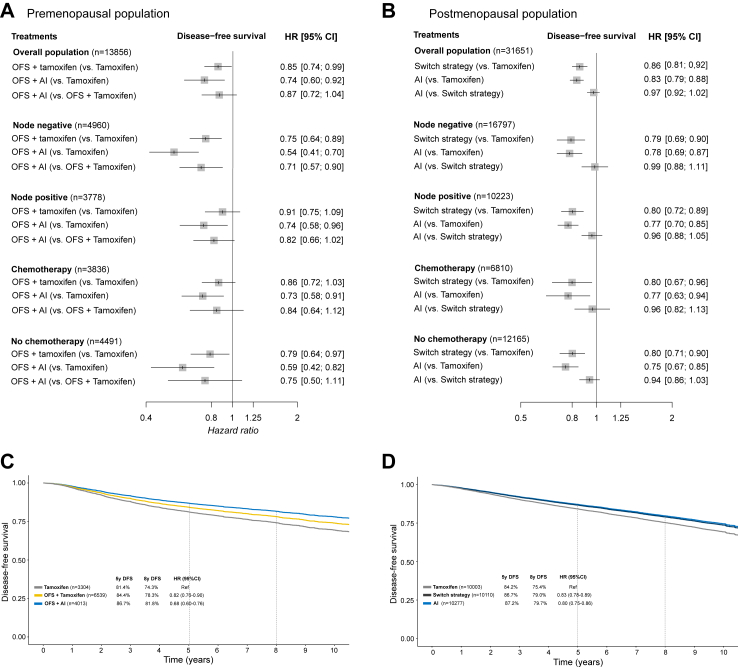
A total of 37 RCT that had enrolled 107,684 patients were included in the study. During the first five years, OFS + AI was the most effective strategy in premenopausal women, while AI or switch strategy showed the better efficacy results in postmenopausal ones. Following five years of tamoxifen, continuation with five additional years of AI was associated with improved 8-year DFS (85.8%) compared to no extended therapy (78.1%) or five additional years of tamoxifen (81.0%). Following five years of AI or switch strategy, extended treatment with AI improved DFS (Hazard Ratio = 0.81, 95% Confidence Interval 0.73-0.90).
This study provides information regarding the optimal endocrine treatment strategies for patients with resected hormone receptor positive early breast cancer.
None.
多项试验评估了早期乳腺癌内分泌治疗的强化策略,包括绝经前患者的卵巢功能抑制(OFS)和芳香化酶抑制剂(AI)以及延长内分泌治疗。然而,由于研究设计的异质性以及相关亚组缺乏统计学效力,几个方面仍存在争议。我们旨在研究最佳内分泌治疗策略。
进行了系统的文献检索,并于2024年8月进行了最后更新,以确定评估激素受体阳性乳腺癌内分泌治疗策略的随机对照试验(RCT)。使用基于频率主义框架的随机效应模型进行网络荟萃分析,以汇总直接和间接证据。此外,进行了个体患者数据荟萃分析,以估计治疗之间的绝对差异。研究终点为无病生存期(DFS)、总生存期(OS)和安全性。国际前瞻性系统评价注册库(PROSPERO):CRD42023447979。
该研究共纳入了37项RCT,涉及107,684名患者。在最初五年中,OFS + AI是绝经前女性最有效的策略,而AI或转换策略在绝经后女性中显示出更好的疗效。在接受他莫昔芬治疗五年后,继续使用AI额外治疗五年与未进行延长治疗(78.1%)或继续使用他莫昔芬额外治疗五年(81.0%)相比,8年DFS有所改善(85.8%)。在接受AI或转换策略治疗五年后,继续使用AI进行延长治疗可改善DFS(风险比=0.81,95%置信区间0.73 - 0.90)。
本研究提供了关于切除的激素受体阳性早期乳腺癌患者最佳内分泌治疗策略的信息。
无。