Twentyman Joy, Khalifeh Anthony, Felton Abby L, Emerman Michael, OhAinle Molly
Department of Global Health, University of Washington, Seattle, WA, United States.
Divisions of Human Biology and Basic Sciences, Fred Hutch Cancer Center, Seattle, WA, United States.
bioRxiv. 2023 Mar 25:2023.03.24.534139. doi: 10.1101/2023.03.24.534139.
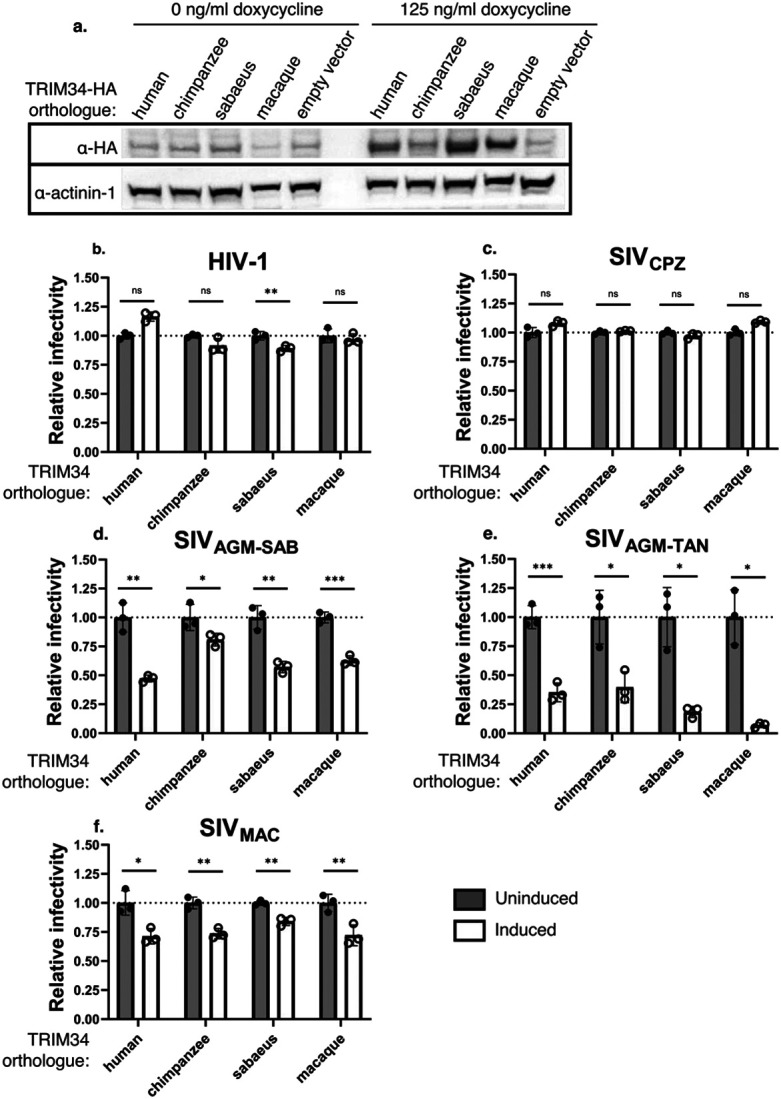
Human immunodeficiency virus (HIV) and other lentiviruses adapt to new hosts by evolving to evade host-specific innate immune proteins that differ in sequence and often viral recognition between host species. Understanding how these host antiviral proteins, called restriction factors, constrain lentivirus replication and transmission is key to understanding the emergence of pandemic viruses like HIV-1. Human TRIM34, a paralogue of the well-characterized lentiviral restriction factor TRIM5α, was previously identified by our lab via CRISPR-Cas9 screening as a restriction factor of certain HIV and SIV capsids. Here, we show that diverse primate TRIM34 orthologues from non-human primates can restrict a range of Simian Immunodeficiency Virus (SIV) capsids including SIV , SIV and SIV capsids, which infect sabaeus monkeys, tantalus monkeys, and rhesus macaques, respectively. All primate TRIM34 orthologues tested, regardless of species of origin, were able to restrict this same subset of viral capsids. However, in all cases, this restriction also required the presence of TRIM5α. We demonstrate that TRIM5α is necessary, but not sufficient, for restriction of these capsids, and that human TRIM5α functionally interacts with TRIM34 from different species. Finally, we find that both the TRIM5α SPRY v1 loop and the TRIM34 SPRY domain are essential for TRIM34-mediated restriction. These data support a model in which TRIM34 is a broadly-conserved primate lentiviral restriction factor that acts in tandem with TRIM5α, such that together, these proteins can restrict capsids that neither can restrict alone.
人类免疫缺陷病毒(HIV)和其他慢病毒通过进化来逃避宿主特异性先天免疫蛋白,从而适应新宿主,这些先天免疫蛋白在序列上存在差异,并且宿主物种之间的病毒识别方式也常常不同。了解这些被称为限制因子的宿主抗病毒蛋白如何限制慢病毒的复制和传播,是理解像HIV-1这样的大流行病毒出现的关键。人类TRIM34是特征明确的慢病毒限制因子TRIM5α的旁系同源物,此前我们实验室通过CRISPR-Cas9筛选将其鉴定为某些HIV和SIV衣壳的限制因子。在这里,我们表明来自非人类灵长类动物的多种灵长类TRIM34直系同源物可以限制一系列猿猴免疫缺陷病毒(SIV)衣壳,包括分别感染黑猩猩、红腹白眉猴和恒河猴的SIV 、SIV 和SIV 衣壳。所有测试的灵长类TRIM34直系同源物,无论其来源物种如何,都能够限制这同一组病毒衣壳。然而,在所有情况下,这种限制也需要TRIM5α的存在。我们证明TRIM5α对于这些衣壳的限制是必要的,但不是充分的,并且人类TRIM5α与来自不同物种的TRIM34在功能上相互作用。最后,我们发现TRIM5α的SPRY v1环和TRIM34的SPRY结构域对于TRIM34介导的限制都是必不可少的。这些数据支持了一个模型,即TRIM34是一种广泛保守的灵长类慢病毒限制因子,它与TRIM5α协同作用,因此,这些蛋白共同作用可以限制它们各自单独无法限制的衣壳。