Jinna Nikita, Van Alsten Sarah, Rida Padmashree, Seewaldt Victoria, Troester Melissa
City of Hope Beckman Research Institute.
The University of North Carolina at Chapel Hill.
Res Sq. 2023 Mar 22:rs.3.rs-2693555. doi: 10.21203/rs.3.rs-2693555/v1.
Androgen receptor (AR) expression is absent in 40-90% of estrogen receptor (ER)-negative breast cancers. The prognostic value of AR in ER-negative patients and therapeutic targets for patients absent in AR remains poorly explored.
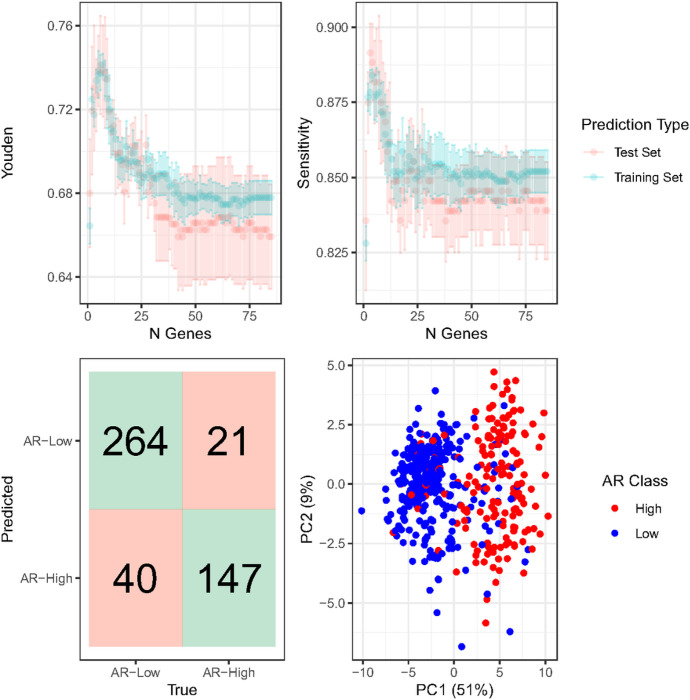
We used an RNA-based multigene classifier to identify AR-low and AR-high ER-negative participants in the Carolina Breast Cancer Study (CBCS; n=669) and The Cancer Genome Atlas (TCGA; n=237). We compared AR-defined subgroups by demographics, tumor characteristics, and established molecular signatures [PAM50 risk of recurrence (ROR), homologous recombination deficiency (HRD), and immune response].
AR-low tumors were more prevalent among Black (relative frequency difference (RFD) = +7%, 95% CI = 1% to 14%) and younger (RFD = +10%, 95% CI = 4% to 16%) participants in CBCS and were associated with HER2-negativity (RFD = -35%, 95% CI = -44% to -26%), higher grade (RFD = +17%, 95% CI = 8% to 26%), and higher risk of recurrence scores (RFD = +22%, 95% CI = 16.1% to 28%), with similar results in TCGA. The AR-low subgroup was strongly associated with HRD in CBCS (RFD = +33.3%, 95% CI = 23.8% to 43.2%) and TCGA (RFD = +41.5%, 95% CI = 34.0% to 48.6%). In CBCS, AR-low tumors had high adaptive immune marker expression.
Multigene, RNA-based low AR expression is associated with aggressive disease characteristics as well as DNA repair defects and immune phenotypes, suggesting plausible precision therapies for AR-low, ER-negative patients.
在40%-90%的雌激素受体(ER)阴性乳腺癌中,雄激素受体(AR)表达缺失。AR在ER阴性患者中的预后价值以及AR缺失患者的治疗靶点仍未得到充分探索。
我们使用基于RNA的多基因分类器,在卡罗来纳乳腺癌研究(CBCS;n=669)和癌症基因组图谱(TCGA;n=237)中识别AR低表达和AR高表达的ER阴性参与者。我们通过人口统计学、肿瘤特征和既定的分子特征[PAM50复发风险(ROR)、同源重组缺陷(HRD)和免疫反应]比较AR定义的亚组。
在CBCS中,AR低表达肿瘤在黑人(相对频率差异(RFD)=+7%,95%CI=1%至14%)和年轻参与者(RFD=+10%,95%CI=4%至16%)中更为普遍,并且与HER2阴性(RFD=-35%,95%CI=-44%至-26%)、高级别(RFD=+17%,95%CI=8%至26%)以及更高的复发风险评分(RFD=+22%,95%CI=16.1%至28%)相关,在TCGA中结果相似。在CBCS(RFD=+33.3%,95%CI=23.8%至43.2%)和TCGA(RFD=+41.5%,95%CI=34.0%至48.6%)中,AR低表达亚组与HRD密切相关。在CBCS中,AR低表达肿瘤具有高适应性免疫标志物表达。
基于RNA的多基因低AR表达与侵袭性疾病特征以及DNA修复缺陷和免疫表型相关,提示对AR低表达、ER阴性患者可能有合理的精准治疗方法。