DOE Great Lakes Bioenergy Research Center, University of Wisconsin-Madison, Madison, Wisconsin, USA.
Department of Bacteriology, University of Wisconsin-Madison, Madison, Wisconsin, USA.
mSystems. 2023 Apr 27;8(2):e0009223. doi: 10.1128/msystems.00092-23. Epub 2023 Mar 30.
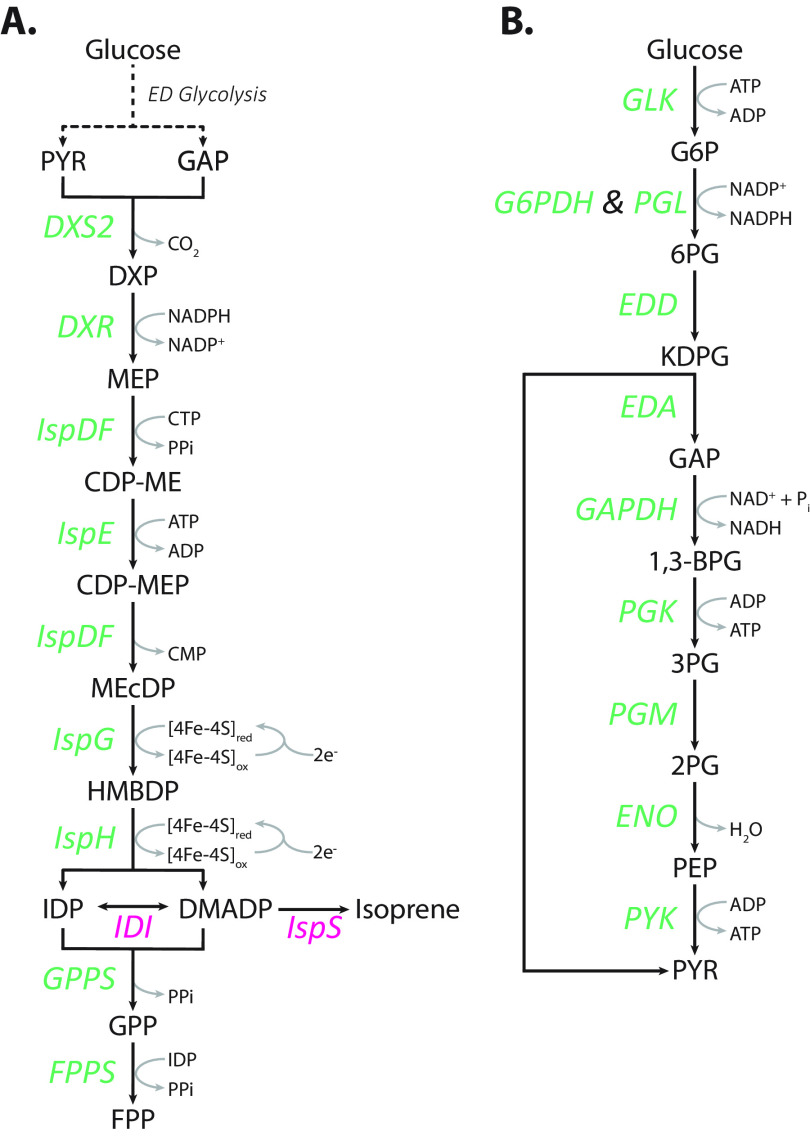
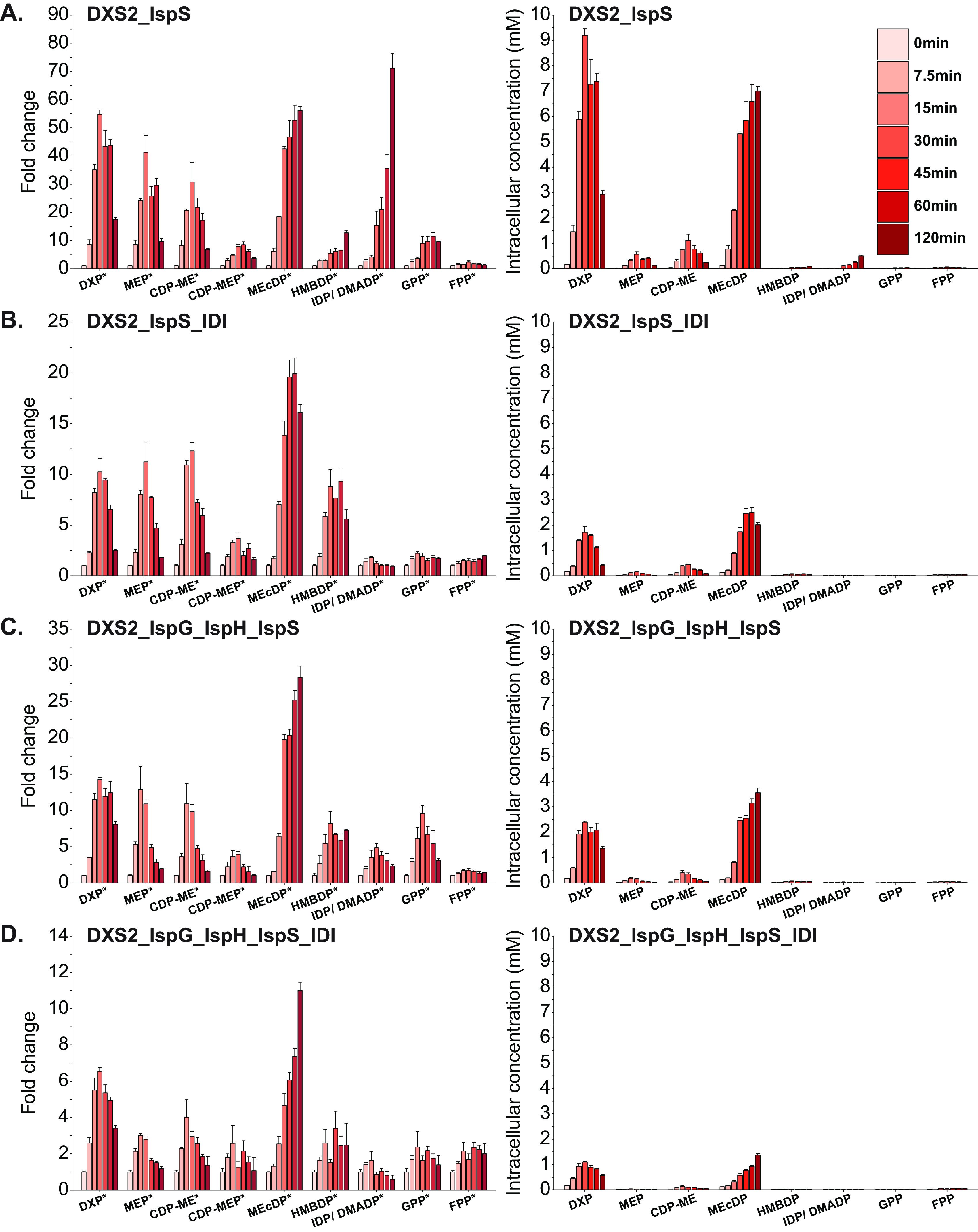
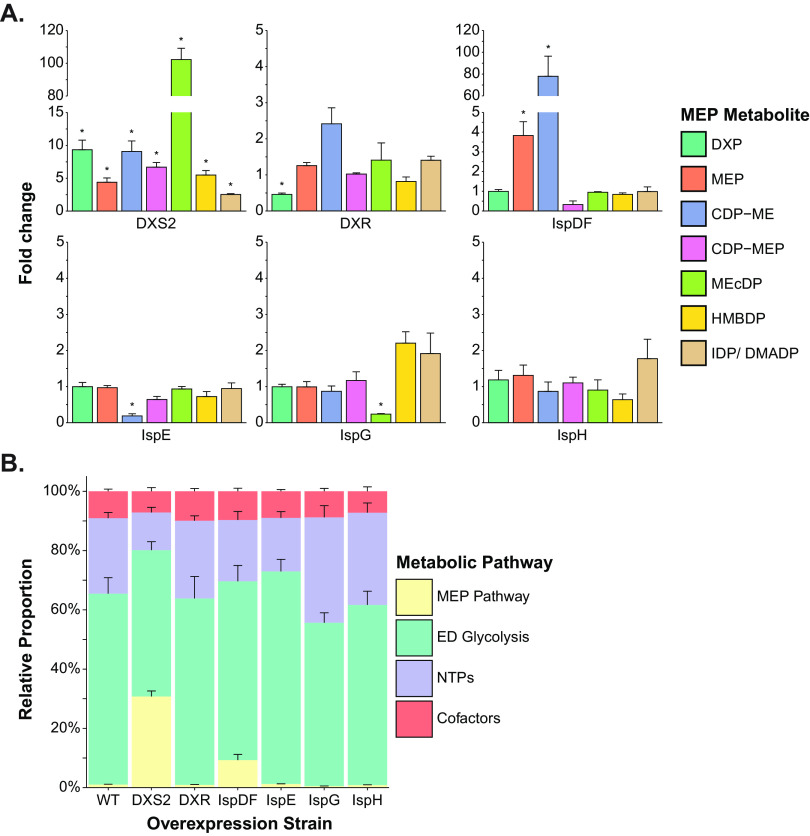
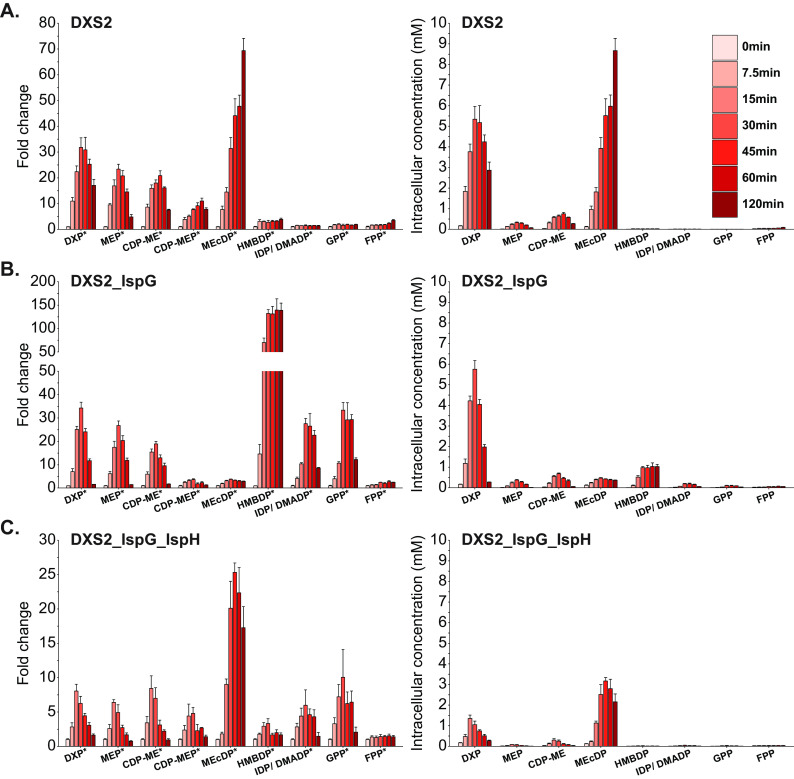
Zymomonas mobilis is an industrially relevant aerotolerant anaerobic bacterium that can convert up to 96% of consumed glucose to ethanol. This highly catabolic metabolism could be leveraged to produce isoprenoid-based bioproducts via the methylerythritol 4-phosphate (MEP) pathway, but we currently have limited knowledge concerning the metabolic constraints of this pathway in Z. mobilis. Here, we performed an initial investigation of the metabolic bottlenecks within the MEP pathway of Z. mobilis using enzyme overexpression strains and quantitative metabolomics. Our analysis revealed that 1-deoxy-d-xylulose 5-phosphate synthase (DXS) represents the first enzymatic bottleneck in the Z. mobilis MEP pathway. DXS overexpression triggered large increases in the intracellular levels of the first five MEP pathway intermediates, of which the buildup in 2-C-methyl-d-erythritol 2,4-cyclodiphosphate (MEcDP) was the most substantial. The combined overexpression of DXS, 4-hydroxy-3-methylbut-2-enyl diphosphate (HMBDP) synthase (IspG), and HMBDP reductase (IspH) mitigated the bottleneck at MEcDP and mobilized carbon to downstream MEP pathway intermediates, indicating that IspG and IspH activity become the primary pathway constraints during DXS overexpression. Finally, we overexpressed DXS with other native MEP enzymes and a heterologous isoprene synthase and showed that isoprene can be used as a carbon sink in the Z. mobilis MEP pathway. By revealing key bottlenecks within the MEP pathway of Z. mobilis, this study will aid future engineering efforts aimed at developing this bacterium for industrial isoprenoid production. Engineered microorganisms have the potential to convert renewable substrates into biofuels and valuable bioproducts, which offers an environmentally sustainable alternative to fossil-fuel-derived products. Isoprenoids are a diverse class of biologically derived compounds that have commercial applications as various commodity chemicals, including biofuels and biofuel precursor molecules. Thus, isoprenoids represent a desirable target for large-scale microbial generation. However, our ability to engineer microbes for the industrial production of isoprenoid-derived bioproducts is limited by an incomplete understanding of the bottlenecks in the biosynthetic pathway responsible for isoprenoid precursor generation. In this study, we combined genetic engineering with quantitative analyses of metabolism to examine the capabilities and constraints of the isoprenoid biosynthetic pathway in the industrially relevant microbe Zymomonas mobilis. Our integrated and systematic approach identified multiple enzymes whose overexpression in Z. mobilis results in an increased production of isoprenoid precursor molecules and mitigation of metabolic bottlenecks.
运动发酵单胞菌是一种具有工业应用价值的兼性厌氧细菌,能够将消耗的葡萄糖转化为 96%的乙醇。这种高度分解代谢的能力可以通过 1-脱氧-D-木酮糖 5-磷酸合酶(DXS)来利用,定量代谢组学。我们的分析表明,1-脱氧-D-木酮糖 5-磷酸合酶(DXS)代表了运动发酵单胞菌 MEP 途径中的第一个酶学瓶颈。DXS 的过表达导致 MEP 途径前五个中间产物的细胞内水平大幅增加,其中 2-C-甲基-D-赤藓醇 2,4-环二磷酸(MEcDP)的积累最为显著。DXS、4-羟基-3-甲基丁-2-烯基二磷酸合酶(IspG)和 4-羟基-3-甲基丁-2-烯基二磷酸还原酶(IspH)的组合过表达缓解了 MEcDP 瓶颈,并将碳动员到下游 MEP 途径中间产物,表明 IspG 和 IspH 的活性在 DXS 过表达期间成为主要的途径限制。最后,我们过表达了 DXS 与其他天然 MEP 酶和异戊烯基合酶,并表明异戊二烯可以作为运动发酵单胞菌 MEP 途径中的碳汇。通过揭示运动发酵单胞菌 MEP 途径中的关键瓶颈,本研究将有助于未来开发该细菌用于工业异戊二烯生产的工程努力。 工程微生物具有将可再生底物转化为生物燃料和有价值的生物产品的潜力,为基于化石燃料的产品提供了一种环境可持续的替代方案。异戊二烯类化合物是一类具有商业应用价值的生物衍生化合物,可作为各种商品化学品,包括生物燃料和生物燃料前体分子。因此,异戊二烯是大规模微生物生成的理想目标。然而,我们对微生物进行工程改造以生产异戊二烯衍生的生物产品的能力受到负责异戊二烯前体生成的生物合成途径中的瓶颈的不完全理解的限制。在这项研究中,我们结合了遗传工程和代谢的定量分析,研究了工业相关微生物运动发酵单胞菌中异戊二烯生物合成途径的能力和限制。我们的综合系统方法确定了多个酶,其过表达导致运动发酵单胞菌中异戊二烯前体分子的产量增加,并缓解了代谢瓶颈。