Department of Infectious Disease, National Medical Center for Infectious Diseases and Shanghai Key Laboratory of Infectious Diseases and Biosafety Emergency Response, Huashan Hospital, Fudan University, Shanghai, P.R. China.
Department of Gastroenterology, Sir Run Run Shaw Hospital, Zhejiang University School of Medicine, Hangzhou, Zhejiang Province, P.R. China.
Hepatol Commun. 2023 Mar 30;7(4). doi: 10.1097/HC9.0000000000000111. eCollection 2023 Apr 1.
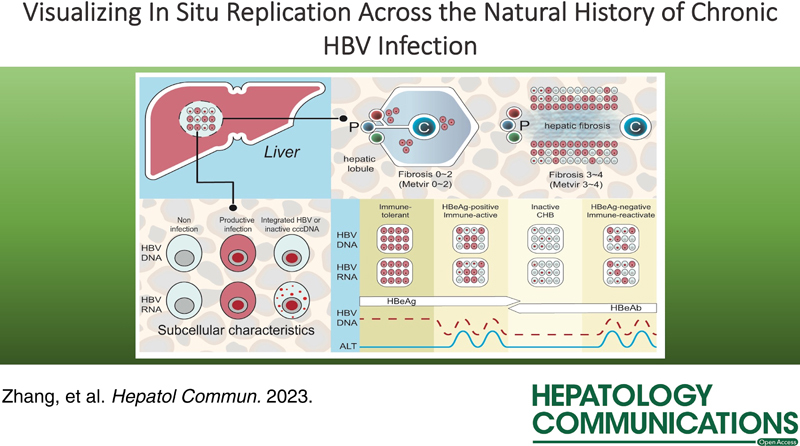
Chronic HBV infection evolves through different phases. Interactions between viral replication and the host immune response in the liver underlie the pathogenesis of this disease. The aim of this study was to directly visualize the HBV replication intermediates at a single-cell resolution inscribed on morphological changes corresponding to disease activity.
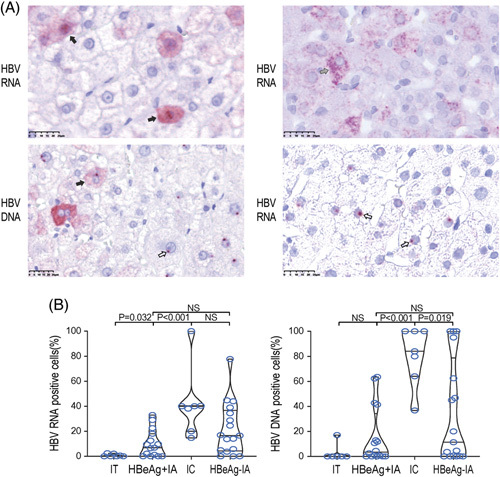
A set of archived formalin-fixed paraffin-embedded liver needle biopsies from treatment-naïve patients were collected and categorized into phases according to the American Association for the Study of the Liver Diseases (AASLD) guidelines. HBV RNA and DNA were detected using in situ hybridization assays.
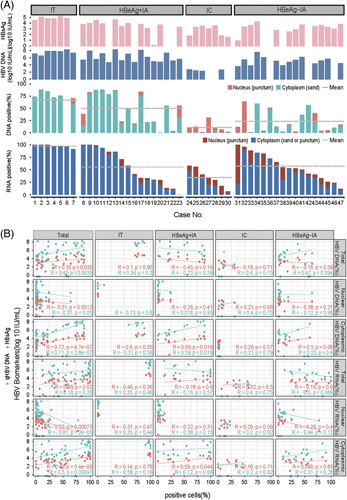
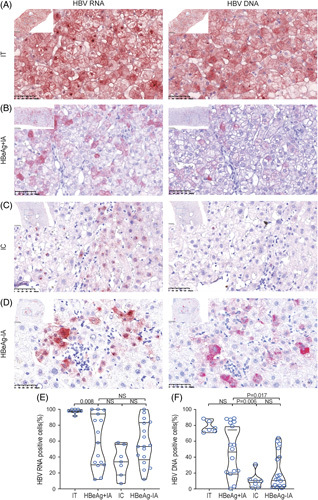
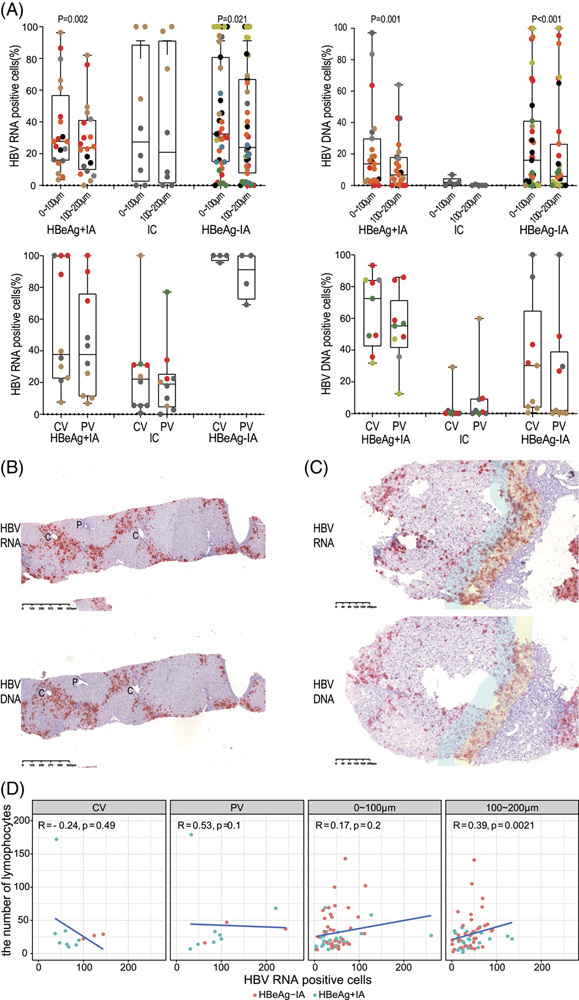
The hepatocytes were ubiquitously infected in subjects with immune tolerance, and their percentage was gradually decreased in immune-active and inactive chronic hepatitis B phases. HBV-infected hepatocytes were prone to localize close to fibrous septa. The subcellular distribution of signals was able to distinguish hepatocytes with productive infection from those harboring HBV integrants and transcriptionally inactive covalently closed circular DNAs. A smaller number of hepatocytes with productive infection and more harboring transcriptionally inactive covalently closed circular DNA or HBV integrants became apparent in the inactive chronic hepatitis B phase.
An atlas of in situ characteristics of viral-host interactions for each phase is described, which sheds light on the nature of viral replication and disease pathogenesis among the phases of chronic HBV infection.
慢性 HBV 感染通过不同阶段演变。病毒复制与肝脏中宿主免疫反应之间的相互作用是该病发病机制的基础。本研究旨在直接观察 HBV 复制中间体在对应于疾病活动的形态变化上的单细胞分辨率。
收集了一组来自未经治疗的患者的存档福尔马林固定石蜡包埋肝针活检,并根据美国肝病研究协会 (AASLD) 指南进行分类。使用原位杂交检测 HBV RNA 和 DNA。
在免疫耐受的患者中,HBV 感染的肝细胞普遍存在,其百分比在免疫活性和非活性慢性乙型肝炎阶段逐渐降低。HBV 感染的肝细胞容易定位于纤维间隔附近。信号的亚细胞分布能够区分具有生产性感染的肝细胞与携带 HBV 整合体和转录非活性共价闭合环状 DNA 的肝细胞。在非活性慢性乙型肝炎阶段,具有生产性感染的肝细胞数量减少,而携带转录非活性共价闭合环状 DNA 或 HBV 整合体的肝细胞数量增加。
描述了每个阶段病毒-宿主相互作用的原位特征图谱,这揭示了慢性 HBV 感染各阶段病毒复制和发病机制的本质。