Zhang Xiang, Huang Aijie, Liu Lixia, Qin Jiayue, Wang Chengcheng, Yang Min, Lou Yinjun, Wang Lei, Ni Xiong, Hu Xiaoxia, Tang Gusheng, Zhang Mengmeng, Cao Shanbo, Mao Liping, Qian Jiejin, Xu Weilai, Wei Juying, Xu Gaixiang, Meng Haitao, Mai Wenyuan, Yang Chunmei, Zhu Honghu, Tong Hongyan, Yang Jianmin, Yu Wenjuan, Wang Jianmin, Jin Jie
Department of Hematology, The First Affiliated Hospital, Zhejiang University School of Medicine, #79 Qingchun Road, Hangzhou, 310003, Zhejiang, People's Republic of China.
Department of Hematology, Institute of Hematology, Changhai Hospital, #168 Changhai Road, Shanghai, 200433, People's Republic of China.
Exp Hematol Oncol. 2023 Mar 30;12(1):33. doi: 10.1186/s40164-023-00398-y.
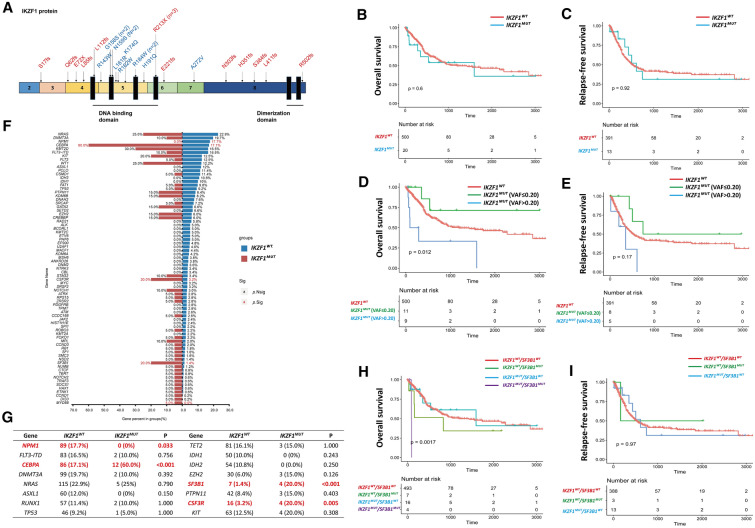
Genetic heterogeneity poses a great challenge to the understanding and management of acute myeloid leukemia (AML). Knowledge of the IKZF1 mutation in AML specifically is extremely limited. In a previous work, we described the distribution pattern of IKZF1 mutation in AML, but its clinical impact has remained undefined due to the limited number of cases. Herein, we attempt to answer this question in one relatively large cohort covering 522 newly diagnosed AML patients. A total of 26 IKZF1 mutations were found in 20 AML patients (20/522, 3.83%). This condition has a young median age of onset of morbidity (P = 0.032). The baseline characteristics of IKZF1-mutated and wild-type patients were comparable. IKZF1 mutation showed significant co-occurrences with CEBPA (P < 0.001), SF3B1 (P < 0.001), and CSF3R (P = 0.005) mutations, and it was mutually exclusive with NPM1 mutation (P = 0.033). Although IKZF1-mutated AML was more preferably classified into the intermediate-risk group (P = 0.004), it showed one inferior complete remission rate (P = 0.032). AML with high burden of IKZF1 mutation (variant allele frequency > 0.20) showed relatively short overall survival period (P = 0.012), and it was an independent factor for the increased risk of death (hazard ratio, 6.101; 95% CI 2.278-16.335; P = 0.0003). In subgroup analysis, our results showed that IKZF1 mutation conferred poor therapeutic response and prognosis for SF3B1-mutated AML (P = 0.0017). We believe this work improves our knowledge of IKZF1 mutation.
基因异质性给急性髓系白血病(AML)的理解和治疗带来了巨大挑战。关于AML中IKZF1突变的了解极为有限。在之前的一项研究中,我们描述了AML中IKZF1突变的分布模式,但由于病例数量有限,其临床影响仍不明确。在此,我们试图在一个涵盖522例新诊断AML患者的相对大型队列中回答这个问题。在20例AML患者(20/522,3.83%)中总共发现了26个IKZF1突变。这种情况的发病中位年龄较轻(P = 0.032)。IKZF1突变患者和野生型患者的基线特征具有可比性。IKZF1突变与CEBPA(P < 0.001)、SF3B1(P < 0.001)和CSF3R(P = 0.005)突变显著共现,且与NPM1突变相互排斥(P = 0.033)。尽管IKZF1突变的AML更倾向于被归类为中危组(P = 0.004),但其完全缓解率较低(P = 0.032)。IKZF1突变负担高(变异等位基因频率>0.20)的AML总体生存期相对较短(P = 0.012),并且是死亡风险增加的独立因素(风险比,6.101;95%置信区间2.278 - 16.335;P = 0.0003)。在亚组分析中,我们的结果表明IKZF1突变赋予SF3B1突变的AML较差的治疗反应和预后(P = 0.0017)。我们相信这项工作增进了我们对IKZF1突变的了解。