Alwahsh Mohammad, Farhat Joviana, Talhouni Shahd, Hamadneh Lama, Hergenröder Roland
Department of Pharmacy, Faculty of Pharmacy, Al-Zaytoonah University of Jordan, P.O. Box 130, Amman, 11733, Jordan.
Leibniz-Institut für Analytische Wissenschaften-ISAS-e.V., 44139 Dortmund, Germany.
EXCLI J. 2023 Jan 16;22:146-168. doi: 10.17179/excli2022-5653. eCollection 2023.
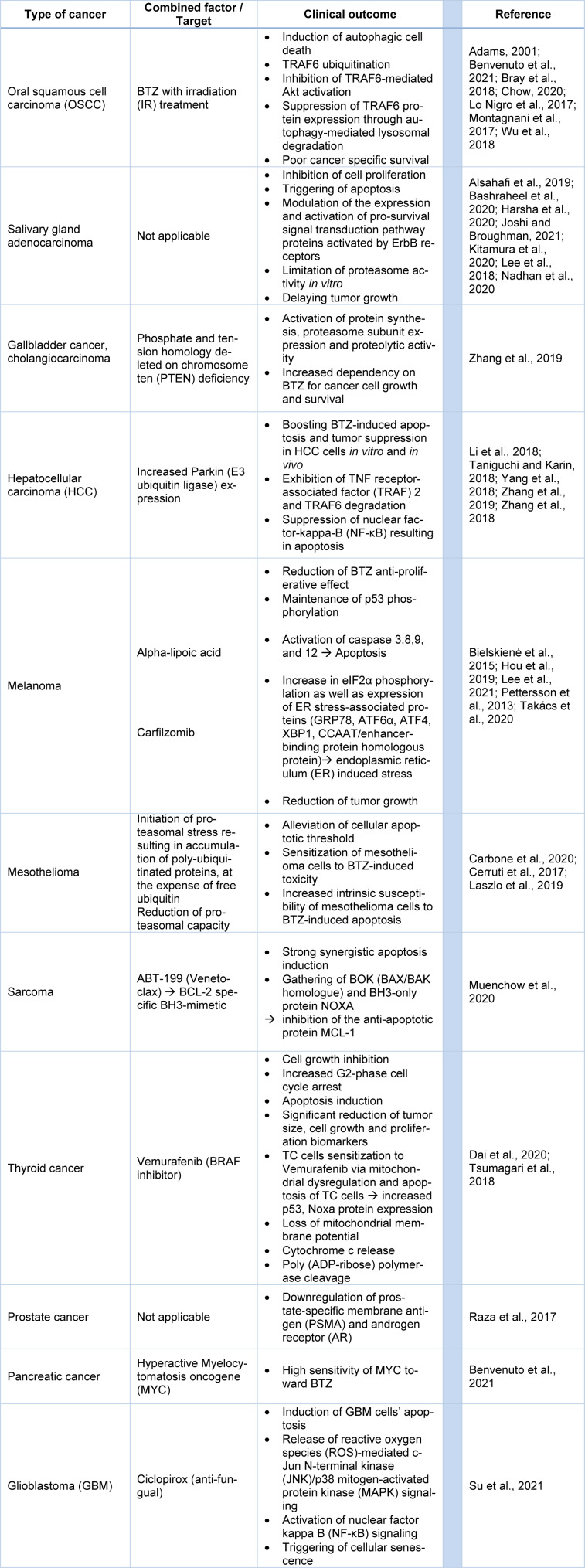
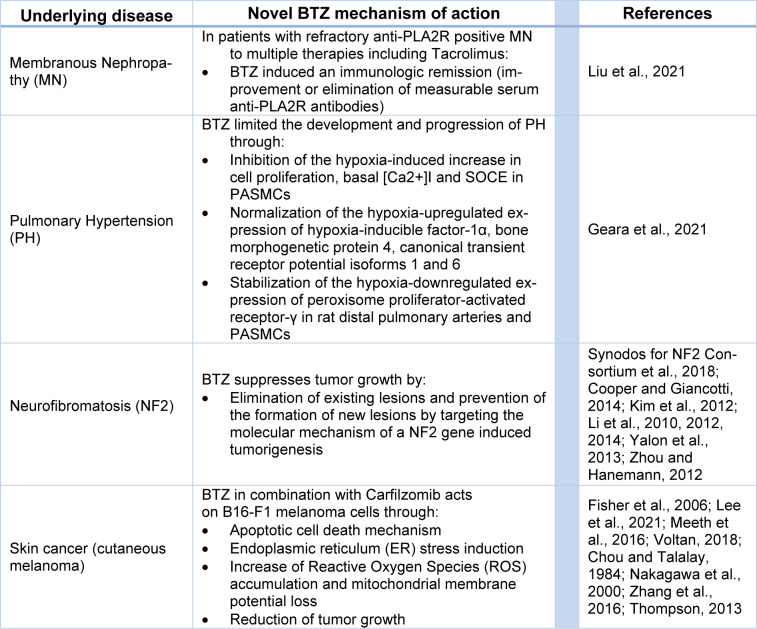
Bortezomib (BTZ) is a first-in-class reversible and selective proteasome inhibitor. It inhibits the ubiquitin proteasome pathway that leads to the degradation of many intracellular proteins. Initially, BTZ was FDA approved for the treatment of refractory or relapsed multiple myeloma (MM) in 2003. Later, its usage was approved for patients with previously untreated MM. In 2006, BTZ was approved for the treatment of relapsed or refractory Mantle Cell Lymphoma (MCL) and, in 2014, for previously untreated MCL. BTZ has been extensively studied either alone or in combination with other drugs for the treatment of different liquid tumors especially in MM. However, limited data evaluated the efficacy and safety of using BTZ in patients with solid tumors. In this review, we will discuss the advanced and novel mechanisms of action of BTZ documented in MM, solid tumors and liquid tumors. Moreover, we will shed the light on the newly discovered pharmacological effects of BTZ in other prevalent diseases.
硼替佐米(BTZ)是首个可逆性、选择性蛋白酶体抑制剂。它抑制泛素蛋白酶体途径,该途径会导致许多细胞内蛋白质的降解。最初,BTZ于2003年被美国食品药品监督管理局(FDA)批准用于治疗难治性或复发性多发性骨髓瘤(MM)。后来,其用途被批准用于先前未接受治疗的MM患者。2006年,BTZ被批准用于治疗复发性或难治性套细胞淋巴瘤(MCL),2014年,被批准用于先前未接受治疗的MCL。BTZ已被广泛研究,无论是单独使用还是与其他药物联合使用,用于治疗不同的液体肿瘤,尤其是在MM中。然而,评估BTZ在实体瘤患者中疗效和安全性的数据有限。在本综述中,我们将讨论在MM、实体瘤和液体肿瘤中记录的BTZ的先进和新颖作用机制。此外,我们将阐明BTZ在其他常见疾病中新发现的药理作用。