National Cancer Center Hospital, Tokyo, Japan.
Aichi Cancer Center, Nagoya, Japan.
Cancer Med. 2023 May;12(9):10597-10611. doi: 10.1002/cam4.5798. Epub 2023 Mar 31.
FIGHT-102 was a phase 1, dose-escalation, dose-expansion study of pemigatinib in Japanese patients with advanced solid tumors. Here, we report safety, tolerability, and preliminary efficacy of pemigatinib from FIGHT-102.
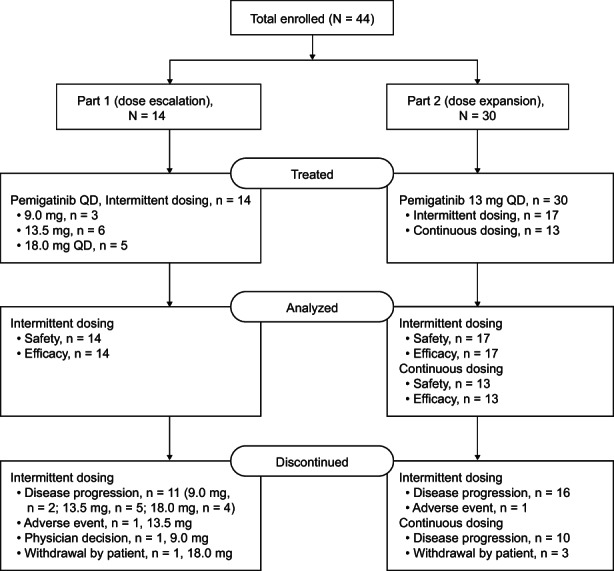
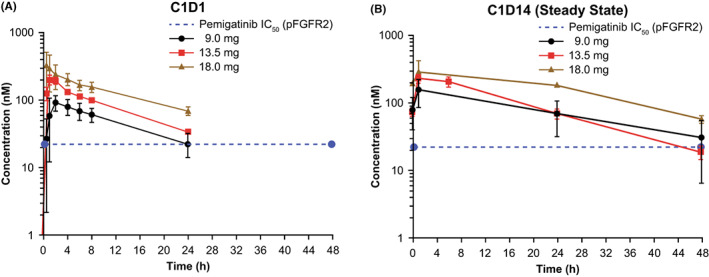
Patients (≥20 years old) self-administered oral pemigatinib 9, 13.5, or 18 mg QD on intermittent dosing (Part 1) or 13.5 mg QD intermittent or continuous dosing (Part 2). A dosing cycle was 21 days (2 weeks on/1 week off or 21 continuous days). Primary endpoint was safety. Secondary endpoints were pharmacokinetics, pharmacodynamics, and preliminary efficacy.
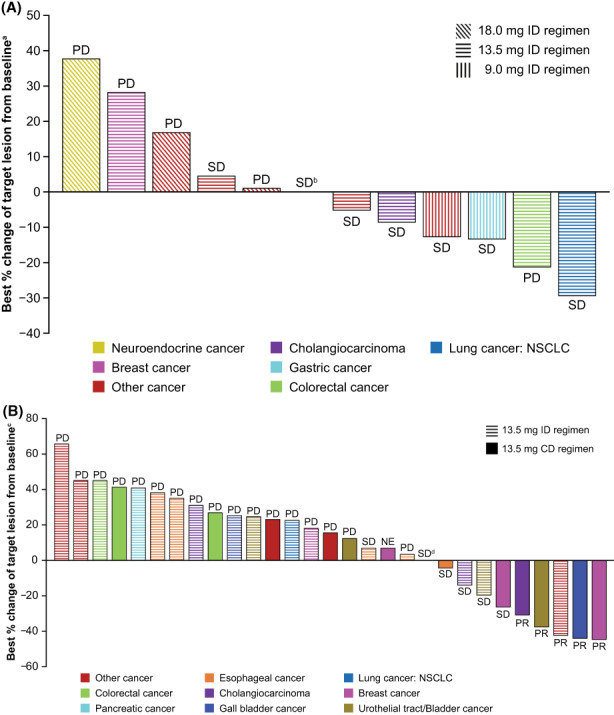
Forty-four patients (Part 1, n = 14; Part 2, n = 30) were enrolled; most common tumors, cholangiocarcinoma, n = 8; esophageal, n = 6; 26 patients had confirmed FGF/FGFR alterations (Part 1, n = 3; Part 2, n = 23); 70.5% had ≥3 prior systemic therapies. Maximum tolerated dose was not identified. The recommended phase 2 dosage was determined to be 13.5 mg QD. Most common treatment-emergent adverse events (TEAEs) were hyperphosphatemia (81.8%), dysgeusia (45.5%), stomatitis (43.2%), and alopecia (38.6%); most frequent Grade ≥3 TEAEs were anemia and decreased appetite (9.1% each). In Part 1, no patient achieved partial response (PR) or complete response, and 7 (50.0%) patients had stable disease (SD). In Part 2, 5 (16.7%) patients achieved PR (one each with cholangiocarcinoma, gall bladder cancer, breast cancer, urothelial tract/bladder cancer, and sweat gland carcinoma) and 6 (20%) had SD. Median duration of response was 9.56 months (95% CI: 4.17, 14.95).
Pemigatinib demonstrated manageable adverse events, consistent pharmacokinetics and pharmacodynamics profiles, and preliminary efficacy in Japanese patients with advanced solid tumors.
FIGHT-102 是一项在日本晚期实体瘤患者中进行的帕米替尼的 1 期、剂量递增、剂量扩展研究。在此,我们报告 FIGHT-102 中帕米替尼的安全性、耐受性和初步疗效。
年龄≥20 岁的患者(n=44)分别接受口服帕米替尼 9、13.5 或 18mg QD 间歇性给药(第 1 部分)或 13.5mg QD 间歇性或连续给药(第 2 部分)。一个给药周期为 21 天(2 周用药/1 周停药或连续 21 天)。主要终点为安全性。次要终点为药代动力学、药效学和初步疗效。
第 1 部分(n=14)和第 2 部分(n=30)分别纳入 14 例和 30 例患者;最常见的肿瘤为胆管癌(n=8)、食管(n=6);26 例患者存在 FGFR 改变(第 1 部分,n=3;第 2 部分,n=23);70.5%的患者既往接受过≥3 线系统治疗。未确定最大耐受剂量。确定帕米替尼的推荐 2 期剂量为 13.5mg QD。最常见的治疗相关不良事件(TEAEs)为高磷血症(81.8%)、味觉障碍(45.5%)、口腔炎(43.2%)和脱发(38.6%);最常见的 3 级及以上 TEAEs 为贫血和食欲下降(各占 9.1%)。第 1 部分中,无患者达到部分缓解(PR)或完全缓解(CR),7 例(50.0%)患者疾病稳定(SD)。第 2 部分中,5 例(16.7%)患者达到 PR(胆管癌、胆囊癌、乳腺癌、尿路上皮/膀胱癌和汗腺癌各 1 例),6 例(20%)患者疾病稳定。中位缓解持续时间为 9.56 个月(95%CI:4.17,14.95)。
帕米替尼在日本晚期实体瘤患者中具有可管理的不良反应、一致的药代动力学和药效学特征以及初步疗效。