Institute of Clinical Sciences, Department of Surgery, Sahlgrenska Academy, University of Gothenburg, Vita stråket 11, S-413 45, Gothenburg, Sweden.
Department of Surgical Sciences, Uppsala University, Uppsala, Sweden.
Obes Surg. 2023 May;33(5):1564-1570. doi: 10.1007/s11695-023-06561-y. Epub 2023 Mar 31.
Obesity is associated with increased incidence of kidney stones, a risk further increased by metabolic and bariatric surgery, particularly after procedures with a malabsorptive component. However, there is a paucity in reports on baseline risk factor and on larger population-based cohorts. The objective was to evaluate incidence and risk factors for kidney stones after bariatric surgery by comparing them to an age-, sex-, and geographically matched cohort from the normal population.
Patients operated with primary Roux-en-Y gastric bypass (RYGB), sleeve gastrectomy (SG), or biliopancreatic diversion with duodenal switch (BPD-DS) from 2007 until 2017 within the Scandinavian Obesity Surgery registry were matched 1:10 to controls from the normal population. Hospital admission or outpatient visits due to kidney stones registered in the National Patient Registry were considered as endpoint.
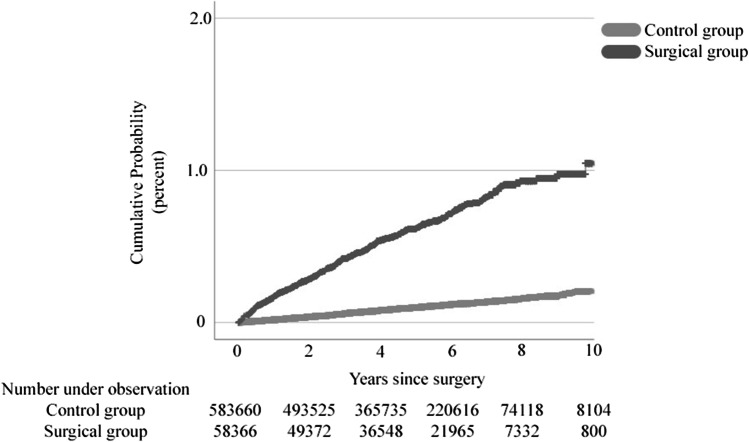
The study included 58,366 surgical patients (mean age 41.0±11.1, BMI 42.0±5.68, 76% women) with median follow-up time 5.0 [IQR 2.9-7.0] years and 583,660 controls. All surgical procedures were associated with a significantly increased risk for kidney stones (RYGB, HR 6.16, [95% CI 5.37-7.06]; SG, HR 6.33, [95% CI 3.57-11.25]; BPD/DS, HR 10.16, [95% CI 2.94-35.09]). Higher age, type 2 diabetes hypertension at baseline, and a preoperative history of kidney stones were risk factors for having a postoperative diagnosis of kidney stones.
Primary RYGB, SG, and BPD/DS were all associated with a more than sixfold increased risk for postoperative kidney stones. The risk increased with advancing age, two common obesity-related conditions, and among patients with preoperative history of kidney stones.
肥胖与肾结石的发病率增加有关,代谢和减重手术会进一步增加这种风险,尤其是在具有吸收不良成分的手术后。然而,关于基线风险因素和更大的基于人群队列的报告却很少。本研究的目的是通过比较与正常人群中年龄、性别和地理位置相匹配的队列,评估减重手术后肾结石的发生率和危险因素。
2007 年至 2017 年期间,在斯堪的纳维亚肥胖手术登记处接受原发性 Roux-en-Y 胃旁路术(RYGB)、袖状胃切除术(SG)或胆胰分流十二指肠转位术(BPD-DS)的患者与正常人群中 1:10 匹配的对照组进行匹配。国家患者登记处记录的因肾结石住院或门诊就诊被视为终点。
本研究纳入了 58366 例手术患者(平均年龄 41.0±11.1 岁,BMI 42.0±5.68,76%为女性),中位随访时间为 5.0 [IQR 2.9-7.0]年,有 583660 例对照组。所有手术均显著增加了肾结石的风险(RYGB,HR 6.16,[95%CI 5.37-7.06];SG,HR 6.33,[95%CI 3.57-11.25];BPD/DS,HR 10.16,[95%CI 2.94-35.09])。较高的年龄、基线时的 2 型糖尿病、高血压以及术前肾结石病史是术后肾结石诊断的危险因素。
原发性 RYGB、SG 和 BPD/DS 均与术后肾结石的风险增加 6 倍以上相关。风险随年龄增长、两种常见的肥胖相关疾病以及术前有肾结石病史而增加。