Department of Neurology, Perelman School of Medicine, Philadelphia, Pennsylvania, USA.
Department of Pathology and Laboratory Medicine, University of Pennsylvania, Philadelphia, Pennsylvania, USA.
Ann Clin Transl Neurol. 2023 May;10(5):802-813. doi: 10.1002/acn3.51768. Epub 2023 Mar 31.
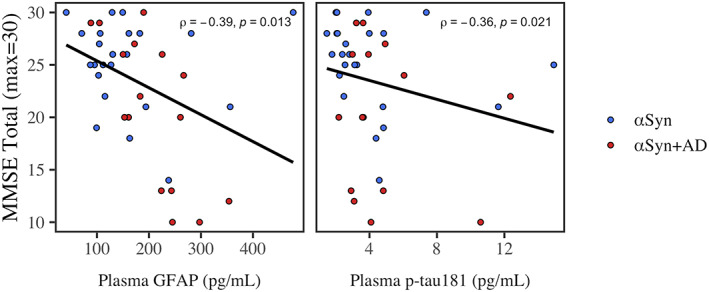
Within Lewy body spectrum disorders (LBSD) with α-synuclein pathology (αSyn), concomitant Alzheimer's disease (AD) pathology is common and is predictive of clinical outcomes, including cognitive impairment and decline. Plasma phosphorylated tau 181 (p-tau ) is sensitive to AD neuropathologic change (ADNC) in clinical AD, and plasma glial fibrillary acidic protein (GFAP) is associated with the presence of β-amyloid plaques. While these plasma biomarkers are well tested in clinical and pathological AD, their diagnostic and prognostic performance for concomitant AD in LBSD is unknown.
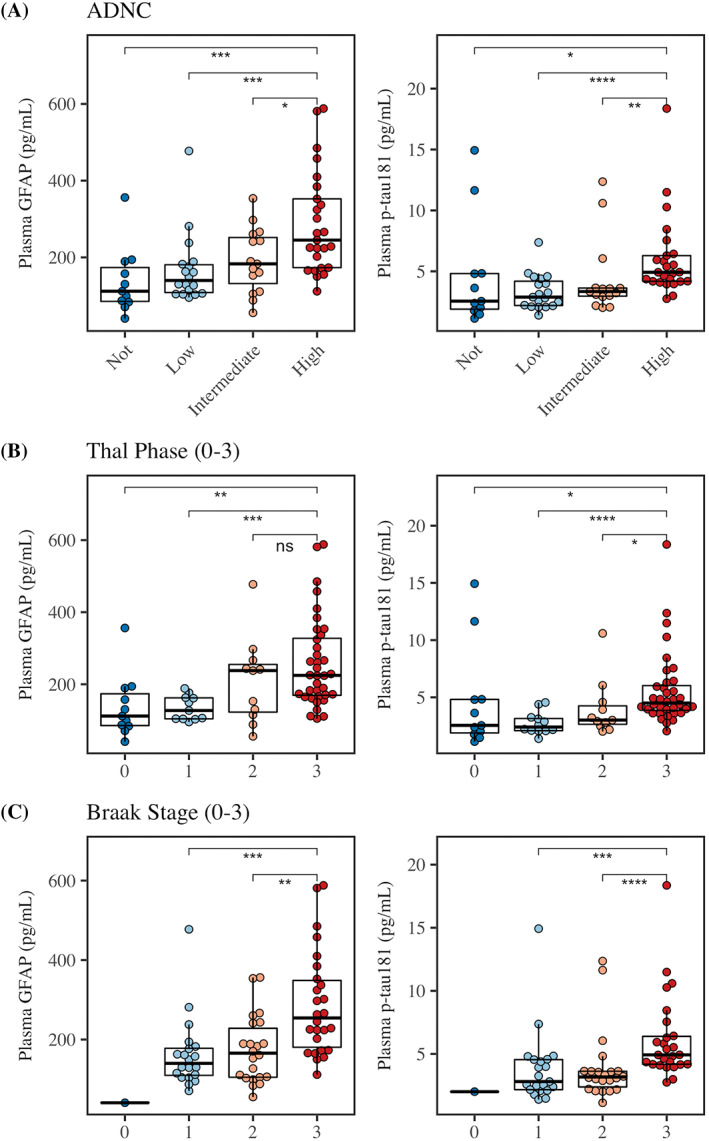
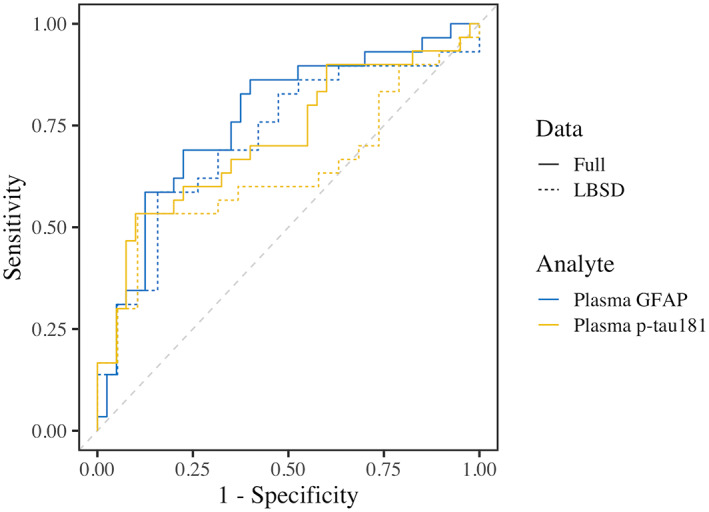
In autopsy-confirmed αSyn-positive LBSD, we tested how plasma p-tau and GFAP differed across αSyn with concomitant ADNC (αSyn+AD; n = 19) and αSyn without AD (αSyn; n = 30). Severity of burden was scored on a semiquantitative scale for several pathologies (e.g., β-amyloid and tau), and scores were averaged across sampled brainstem, limbic, and neocortical regions.
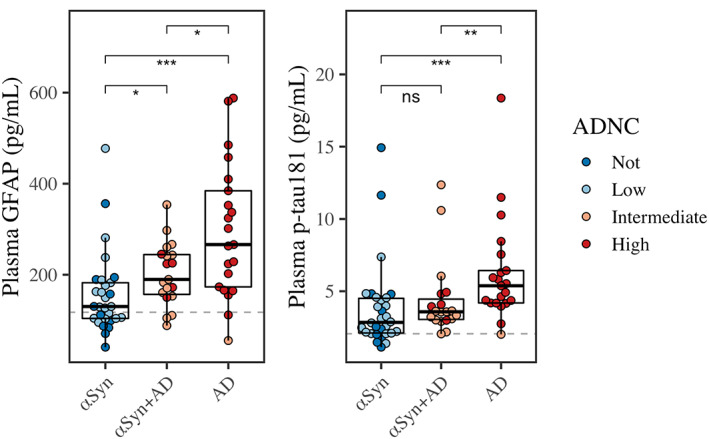
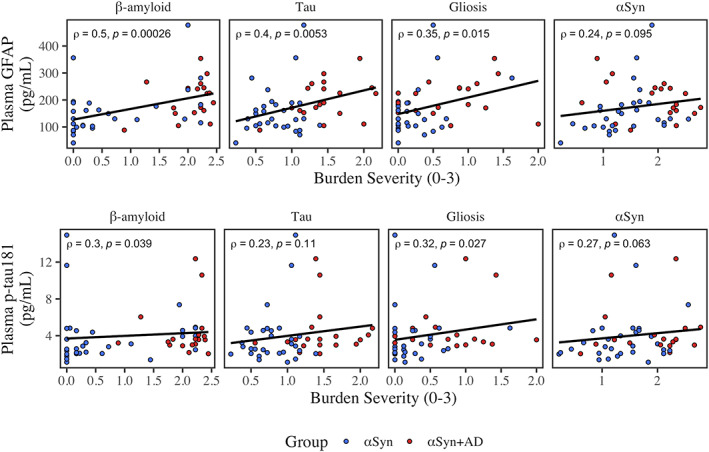
Linear models showed that plasma GFAP was significantly higher in αSyn+AD compared to αSyn (β = 0.31, 95% CI = 0.065-0.56, and P = 0.015), after covarying for age at plasma, plasma-to-death interval, and sex; plasma p-tau was not (P = 0.37). Next, linear models tested associations of AD pathological features with both plasma analytes, covarying for plasma-to-death, age at plasma, and sex. GFAP was significantly associated with brain β-amyloid (β = 15, 95% CI = 6.1-25, and P = 0.0018) and tau burden (β = 12, 95% CI = 2.5-22, and P = 0.015); plasma p-tau was not associated with either (both P > 0.34).
Findings indicate that plasma GFAP may be sensitive to concomitant AD pathology in LBSD, especially accumulation of β-amyloid plaques.
在具有α-突触核蛋白病理学(αSyn)的路易体谱系障碍(LBSD)中,同时存在阿尔茨海默病(AD)病理学很常见,并且可预测临床结局,包括认知障碍和下降。在临床 AD 中,血浆磷酸化 tau181(p-tau)对 AD 神经病理变化(ADNC)敏感,而血浆神经胶质纤维酸性蛋白(GFAP)与β-淀粉样斑块的存在相关。虽然这些血浆生物标志物在临床和病理 AD 中得到了很好的测试,但它们在 LBSD 中同时存在 AD 的诊断和预后性能尚不清楚。
在通过尸检证实的 αSyn 阳性 LBSD 中,我们测试了血浆 p-tau 和 GFAP 在具有 ADNC 的 αSyn (αSyn+AD;n=19)和无 AD 的 αSyn (αSyn;n=30)之间的差异。通过半定量评分对几种病理学(例如β-淀粉样蛋白和 tau)的严重程度进行评分,并对采样的脑干、边缘和新皮质区域的评分进行平均。
线性模型显示,与 αSyn 相比,αSyn+AD 中的血浆 GFAP 显著升高(β=0.31,95%CI=0.065-0.56,P=0.015),在调整了血浆时年龄、血浆到死亡的时间间隔和性别后;血浆 p-tau 则不然(P=0.37)。接下来,线性模型测试了 AD 病理特征与两种血浆分析物的关联,同时调整了血浆到死亡的时间、血浆年龄和性别。GFAP 与脑β-淀粉样蛋白(β=15,95%CI=6.1-25,P=0.0018)和 tau 负担(β=12,95%CI=2.5-22,P=0.015)显著相关;血浆 p-tau 则没有(两者 P>0.34)。
研究结果表明,血浆 GFAP 可能对 LBSD 中的同时存在的 AD 病理学敏感,特别是β-淀粉样斑块的积累。