
液体活检在非小细胞肺癌免疫治疗中的应用:现状、挑战与展望。
Liquid biopsy on the horizon in immunotherapy of non-small cell lung cancer: current status, challenges, and perspectives.
机构信息
Department of Clinical Laboratory, The First Affiliated Hospital of Zhengzhou University, Zhengzhou, Henan, China.
Department of Obstetrics and Gynecology, The Third Affiliated Hospital of Zhengzhou University, Zhengzhou, Henan, China.
出版信息
Cell Death Dis. 2023 Mar 31;14(3):230. doi: 10.1038/s41419-023-05757-5.
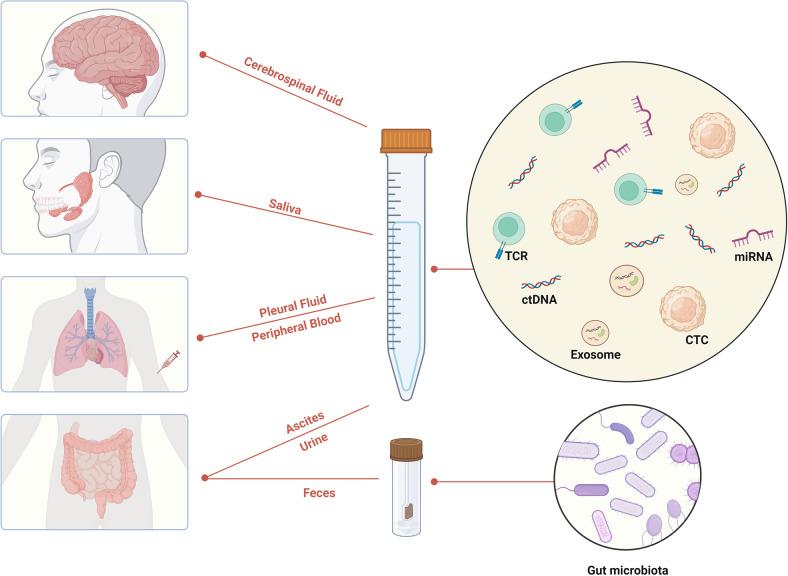
Non-small cell lung cancer (NSCLC) is one of the most threatening malignancies to human health and life. In most cases, patients with NSCLC are already at an advanced stage when they are diagnosed. In recent years, lung cancer has made great progress in precision therapy, but the efficacy of immunotherapy is unstable, and its response rate varies from patient to patient. Several biomarkers have been proposed to predict the outcomes of immunotherapy, such as programmed cell death-ligand 1 (PD-L1) expression and tumor mutational burden (TMB). Nevertheless, the detection assays are invasive and demanding on tumor tissue. To effectively predict the outcomes of immunotherapy, novel biomarkers are needed to improve the performance of conventional biomarkers. Liquid biopsy is to capture and detect circulating tumor cells (CTCs), circulating tumor DNA (ctDNA) and exosomes in body fluids, such as blood, saliva, urine, pleural fluid and cerebrospinal fluid as samples from patients, so as to make analysis and diagnosis of cancer and other diseases. The application of liquid biopsy provides a new possible solution, as it has several advantages such as non-invasive, real-time dynamic monitoring, and overcoming tumor heterogeneity. Liquid biopsy has shown predictive value in immunotherapy, significantly improving the precision treatment of lung cancer patients. Herein, we review the application of liquid biopsy in predicting the outcomes of immunotherapy in NSCLC patients, and discuss the challenges and future directions in this field.
非小细胞肺癌(NSCLC)是对人类健康和生命威胁最大的恶性肿瘤之一。大多数情况下,NSCLC 患者在确诊时已经处于晚期。近年来,肺癌在精准治疗方面取得了很大进展,但免疫疗法的疗效不稳定,其反应率因患者而异。已经提出了几个生物标志物来预测免疫治疗的结果,例如程序性死亡配体 1(PD-L1)表达和肿瘤突变负担(TMB)。然而,检测方法具有侵袭性且对肿瘤组织要求较高。为了有效预测免疫治疗的结果,需要新的生物标志物来提高传统生物标志物的性能。液体活检是从患者的体液(如血液、唾液、尿液、胸腔积液和脑脊液)中捕获和检测循环肿瘤细胞(CTC)、循环肿瘤 DNA(ctDNA)和外泌体,从而对癌症和其他疾病进行分析和诊断。液体活检的应用提供了一个新的可能的解决方案,因为它具有非侵入性、实时动态监测和克服肿瘤异质性等优点。液体活检在免疫治疗中具有预测价值,显著提高了 NSCLC 患者的精准治疗水平。在此,我们综述了液体活检在预测 NSCLC 患者免疫治疗结果中的应用,并讨论了该领域的挑战和未来方向。


 Zotero 插件