Division of Biology, Kansas State University, Manhattan, KS, 66506, USA.
Interdepartmental Genetics Graduate Program, Kansas State University, Manhattan, KS, 66506, USA.
Sci Rep. 2023 Mar 31;13(1):5268. doi: 10.1038/s41598-023-29742-2.
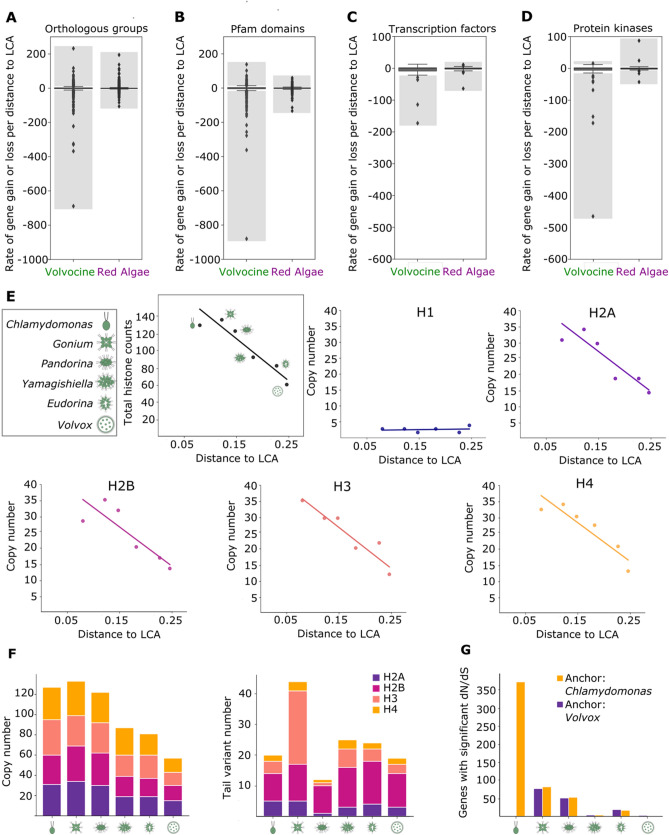
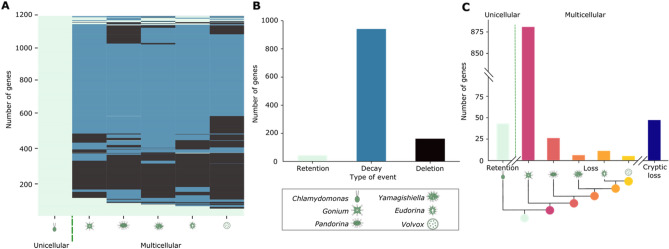
Multicellular evolution is a major transition associated with momentous diversification of multiple lineages and increased developmental complexity. The volvocine algae comprise a valuable system for the study of this transition, as they span from unicellular to undifferentiated and differentiated multicellular morphologies despite their genomes being similar, suggesting multicellular evolution requires few genetic changes to undergo dramatic shifts in developmental complexity. Here, the evolutionary dynamics of six volvocine genomes were examined, where a gradual loss of genes was observed in parallel to the co-option of a few key genes. Protein complexes in the six species exhibited novel interactions, suggesting that gene loss could play a role in evolutionary novelty. This finding was supported by gene network modeling, where gene loss outpaces gene gain in generating novel stable network states. These results suggest gene loss, in addition to gene gain and co-option, may be important for the evolution developmental complexity.
多细胞进化是一个主要的转折点,伴随着多个谱系的重大多样化和发育复杂性的增加。团藻藻类是研究这一转变的一个有价值的系统,因为尽管它们的基因组相似,但它们从单细胞到无差别和有差别多细胞形态的跨越,表明多细胞进化需要很少的遗传变化就可以在发育复杂性上发生巨大的转变。在这里,研究了六个团藻基因组的进化动态,观察到在少数关键基因被共选的同时,基因逐渐丢失。六个物种中的蛋白质复合物表现出新的相互作用,表明基因丢失可能在进化新奇性中起作用。这一发现得到了基因网络建模的支持,其中基因丢失在产生新的稳定网络状态方面超过了基因获得。这些结果表明,除了基因获得和共选之外,基因丢失对于发育复杂性的进化可能也很重要。