School of Biological Sciences, Georgia Institute of Technology, Atlanta, GA, 30332, USA.
Department of Organismic and Evolutionary Biology, Harvard University, 26 Oxford St., Cambridge, MA, 02138, USA.
BMC Biol. 2024 Apr 10;22(1):79. doi: 10.1186/s12915-024-01878-1.
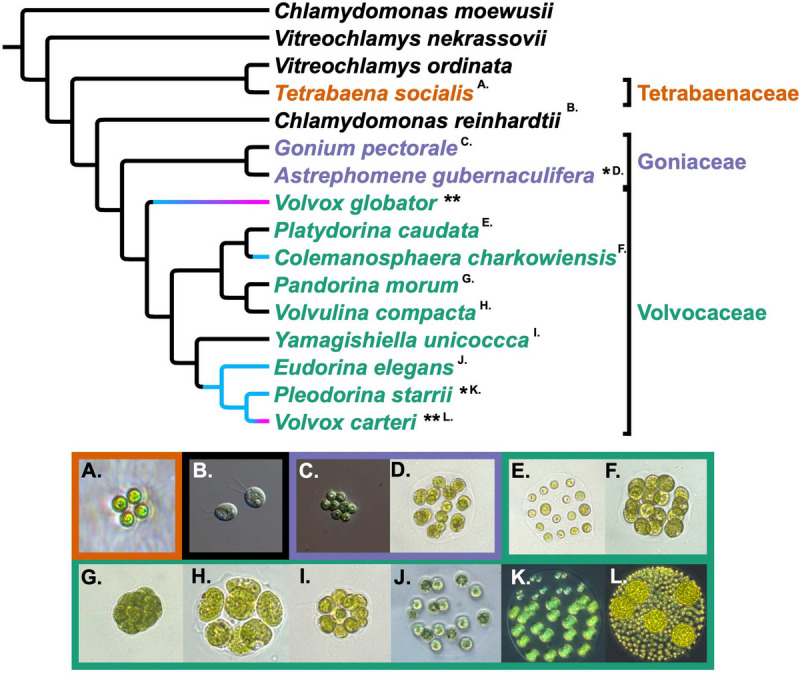
Throughout its nearly four-billion-year history, life has undergone evolutionary transitions in which simpler subunits have become integrated to form a more complex whole. Many of these transitions opened the door to innovations that resulted in increased biodiversity and/or organismal efficiency. The evolution of multicellularity from unicellular forms represents one such transition, one that paved the way for cellular differentiation, including differentiation of male and female gametes. A useful model for studying the evolution of multicellularity and cellular differentiation is the volvocine algae, a clade of freshwater green algae whose members range from unicellular to colonial, from undifferentiated to completely differentiated, and whose gamete types can be isogamous, anisogamous, or oogamous. To better understand how multicellularity, differentiation, and gametes evolved in this group, we used comparative genomics and fossil data to establish a geologically calibrated roadmap of when these innovations occurred.
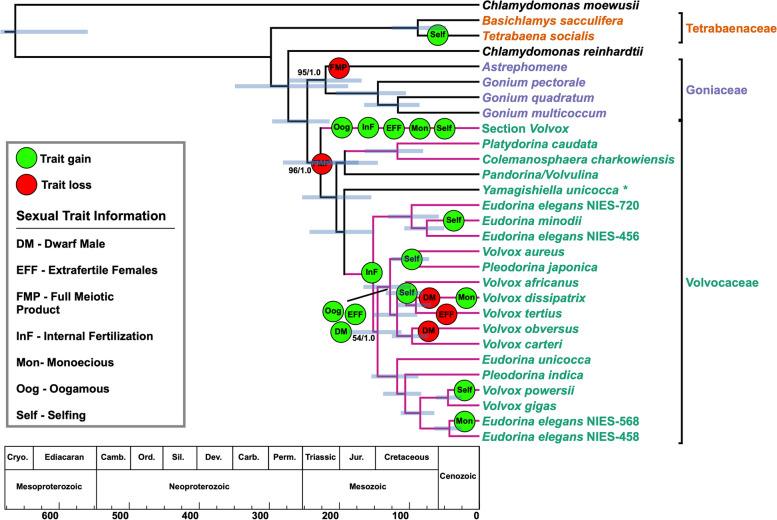
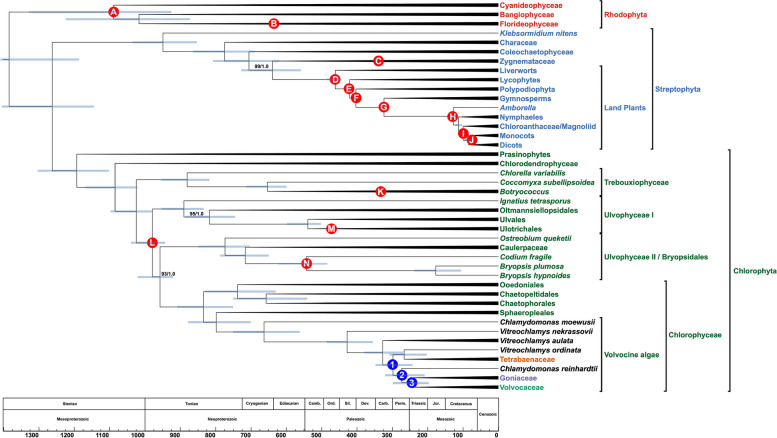
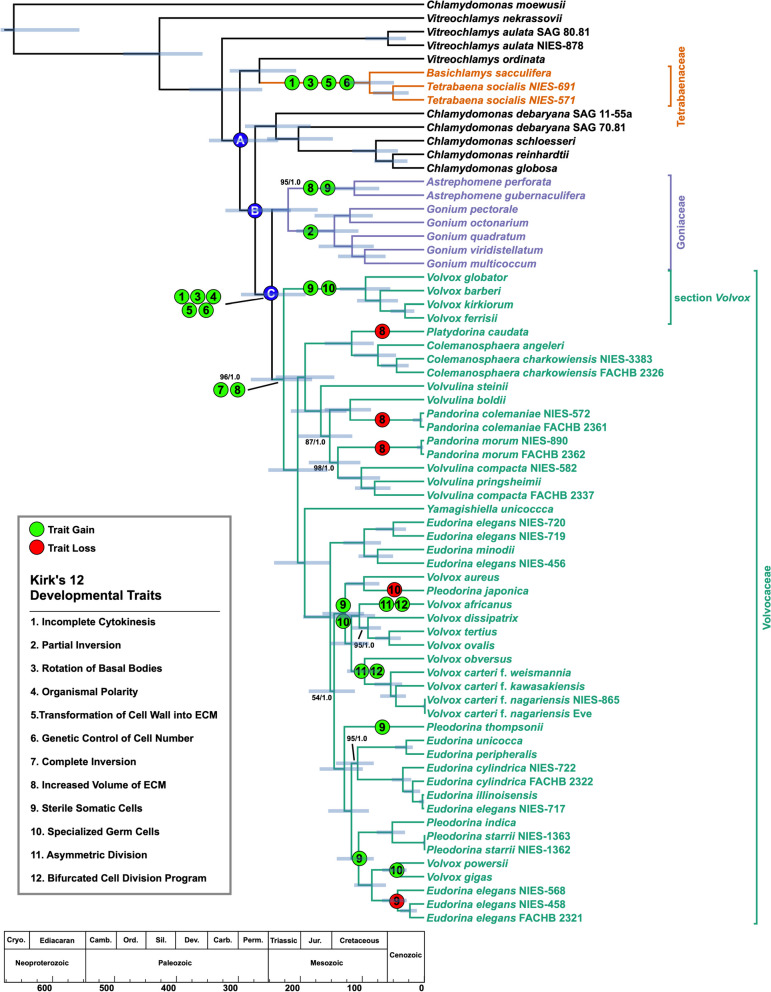
Our ancestral-state reconstructions, show that multicellularity arose independently twice in the volvocine algae. Our chronograms indicate multicellularity evolved during the Carboniferous-Triassic periods in Goniaceae + Volvocaceae, and possibly as early as the Cretaceous in Tetrabaenaceae. Using divergence time estimates we inferred when, and in what order, specific developmental changes occurred that led to differentiated multicellularity and oogamy. We find that in the volvocine algae the temporal sequence of developmental changes leading to differentiated multicellularity is much as proposed by David Kirk, and that multicellularity is correlated with the acquisition of anisogamy and oogamy. Lastly, morphological, molecular, and divergence time data suggest the possibility of cryptic species in Tetrabaenaceae.
Large molecular datasets and robust phylogenetic methods are bringing the evolutionary history of the volvocine algae more sharply into focus. Mounting evidence suggests that extant species in this group are the result of two independent origins of multicellularity and multiple independent origins of cell differentiation. Also, the origin of the Tetrabaenaceae-Goniaceae-Volvocaceae clade may be much older than previously thought. Finally, the possibility of cryptic species in the Tetrabaenaceae provides an exciting opportunity to study the recent divergence of lineages adapted to live in very different thermal environments.
在近 40 亿年的历史中,生命经历了进化转变,其中简单的亚单位被整合形成更复杂的整体。这些转变中的许多为创新打开了大门,从而增加了生物多样性和/或生物体的效率。从单细胞形式向多细胞形式的进化就是这样一个转变,为细胞分化铺平了道路,包括雄性和雌性配子的分化。研究多细胞生物和细胞分化进化的一个有用模型是绿色植物的盘藻属,这是淡水绿藻的一个分支,其成员从单细胞到群体,从无分化到完全分化,其配子类型可以是同型配子、异型配子或卵配子。为了更好地理解多细胞生物、分化和配子在该组中的进化方式,我们使用比较基因组学和化石数据来建立一个地质校准的路线图,说明这些创新的发生时间。
我们的祖先状态重建表明,多细胞生物在盘藻属中独立出现了两次。我们的时标表明,多细胞生物进化发生在石炭纪-三叠纪时期的绿球藻科+盘藻科,可能早在白垩纪就已经在四鞭藻科中出现了。利用分歧时间估计,我们推断了导致分化的多细胞生物和卵配子发生的具体发育变化的时间和顺序。我们发现,在盘藻属中,导致分化的多细胞生物进化的发育变化的时间顺序与大卫·柯克提出的非常相似,而且多细胞生物与获得异型配子和卵配子有关。最后,形态学、分子和分歧时间数据表明,四鞭藻科可能存在隐种。
大型分子数据集和稳健的系统发育方法使盘藻属的进化历史更加清晰。越来越多的证据表明,该组中的现存物种是多细胞生物和细胞分化的两次独立起源以及多次独立起源的结果。此外,四鞭藻科-绿球藻科-盘藻科分支的起源可能比以前认为的要早得多。最后,四鞭藻科中隐种的可能性为研究适应生活在非常不同热环境中的谱系的最近分化提供了一个令人兴奋的机会。