Department of Neurology, Medical University of Graz, Graz, Austria.
Department of Neurosurgery, Medical University of Graz, Graz, Austria.
J Neurol. 2023 Jul;270(7):3475-3482. doi: 10.1007/s00415-023-11679-1. Epub 2023 Apr 1.
Although decompressive hemicraniectomy (DHC) is a lifesaving treatment strategy for patients with malignant middle cerebral artery infarction (mMCAi), only one in four patients achieves low to moderate post-stroke disability according to previous studies. However, the short follow-up periods in prior studies could have overestimated the poor clinical prognosis. This study therefore examined the long-term outcome after DHC for mMCAi.
We retrospectively included all patients who had undergone DHC after mMCAi at the University Hospital Graz between 2006 and 2019. Demographics, clinical data and complications were collected from electronic clinical patient records. To investigate long-term prognosis, all patients were followed up to 14 years after stroke including quality of life (QOL) assessment. Post-stroke disability was rated according to the modified Rankin Scale (mRS).
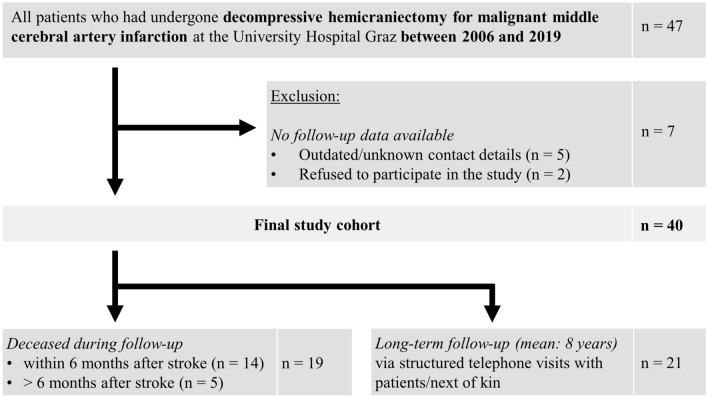
Of 47 patients that had undergone DHC for mMCAi, follow-up data were available in 40 patients (mean age: 48 years; 40% female). Six months after the mMCAi, 14 patients had died (35%) and nine (23%) had a low to moderate post-stroke disability (mRS 0-3). Of 26 stroke survivors, half (50%) showed further mRS improvement (≥ 1 point) during the long-term follow-up period (mean follow-up time: 8 years). At last follow-up, 17 patients had achieved an mRS score of ≤ 3 (65% versus 35% after 6 months; p = 0.008) and 55% had no signs of depression and anxiety, and 50% no signs of pain or discomfort in QOL assessment.
This study shows substantial long-term improvement of functional disability and reasonable QOL in mMCAi patients after DHC.
虽然去骨瓣减压术(DHC)是治疗恶性大脑中动脉梗死(mMCAi)患者的一种救生治疗策略,但根据之前的研究,只有四分之一的患者能达到低至中度卒中后残疾。然而,之前的研究随访时间较短,可能高估了不良的临床预后。因此,本研究对 mMCAi 后行 DHC 的长期结果进行了研究。
我们回顾性纳入了 2006 年至 2019 年在格拉茨大学医院接受 DHC 治疗的所有 mMCAi 患者。从电子临床病历中收集了人口统计学、临床数据和并发症。为了调查长期预后,所有患者在卒中后随访 14 年,包括生活质量(QOL)评估。卒中后残疾采用改良 Rankin 量表(mRS)评分。
在 47 例行 DHC 治疗的 mMCAi 患者中,40 例(平均年龄:48 岁;40%为女性)患者的随访数据可用。在 mMCAi 后 6 个月,14 例患者死亡(35%),9 例(23%)存在低至中度卒中后残疾(mRS 0-3)。26 例卒中幸存者中,有一半(50%)在长期随访期间(平均随访时间:8 年)进一步改善 mRS(≥1 分)。在最后一次随访时,17 例患者 mRS 评分≤3(65%比 6 个月后 35%;p=0.008),55%无抑郁和焦虑迹象,50%无疼痛或不适迹象,在 QOL 评估中。
本研究表明,在接受 DHC 治疗后,mMCAi 患者的功能残疾和合理的 QOL 有明显的长期改善。